
 EN
EN
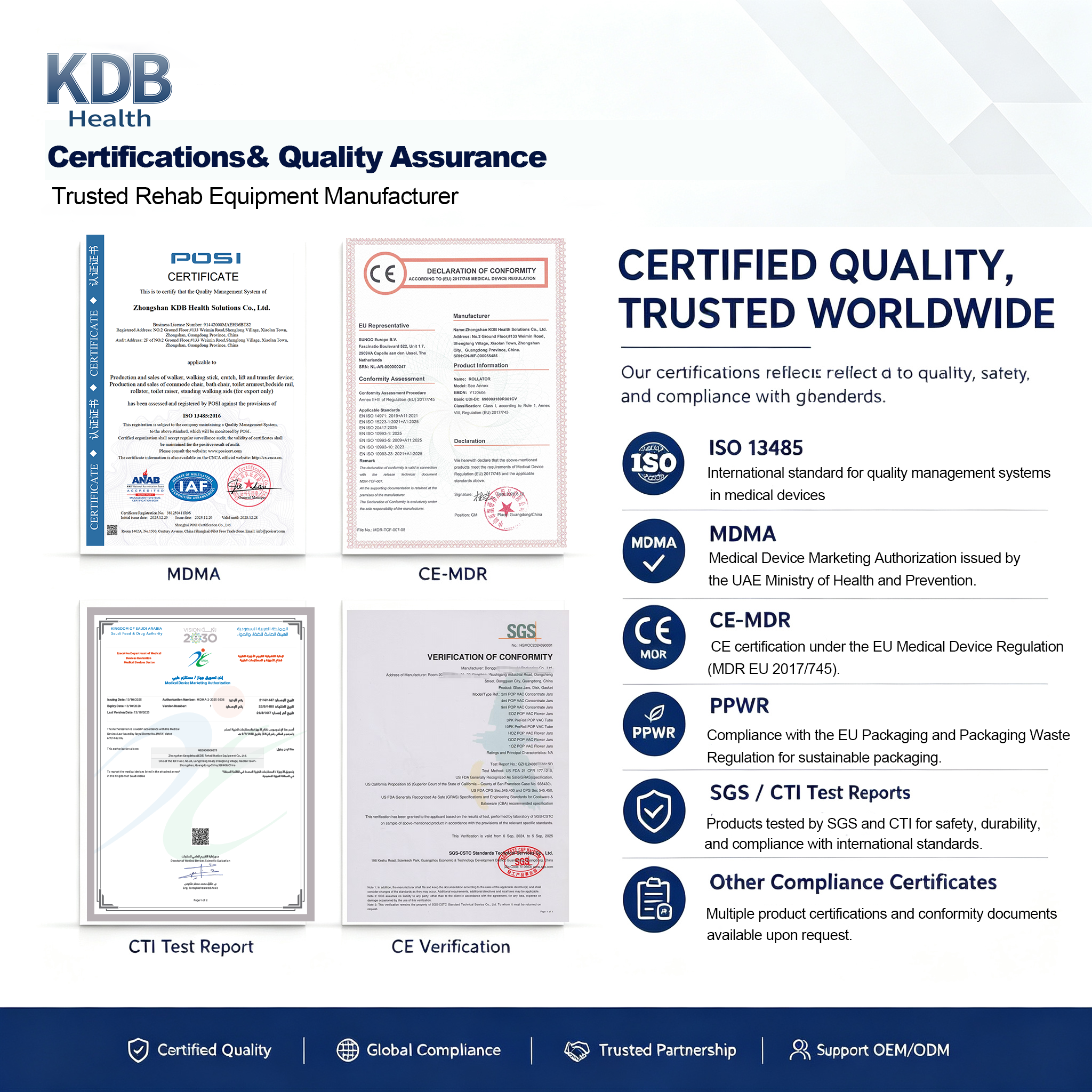
Importing commode chairs is not simply a matter of comparing price, load capacity and delivery time. Depending on the product’s intended use, design and target market, a commode chair may be regulated as a medical device or assistive product.
For importers, distributors and private-label brands, compliance should therefore be evaluated before confirming the product, packaging or purchase order. A certificate alone is not enough. Buyers must confirm that the documentation applies to the exact product being imported and that the manufacturer, importer and local representative understand their respective responsibilities.
This guide explains the main CE and FDA requirements that professional buyers should review when sourcing commode chairs. It is intended as a practical procurement reference rather than legal or regulatory advice.
Compliance Starts with the Product’s Intended Use
Two products that look similar may not follow exactly the same regulatory pathway.
Classification can be affected by:
-
 Intended purpose
 -
Product claims
-
Static or wheeled configuration
-
Manual or powered functions
-
Height-adjustment or lifting mechanisms
-
Transfer functions
-
User population
-
Sterile or non-sterile supply
-
Accessories supplied with the chair
-
Target country
A conventional bedside commode, a wheeled shower-commode chair and a mechanically assisted lifting chair should not automatically be treated as the same device.
Before accepting any compliance claim, importers should obtain the model number, intended-use statement and product configuration and compare them with the documents supplied by the manufacturer.
United States: FDA Requirements for Commode Chairs
Determine the Correct Device Classification
Many conventional commode-chair configurations are regulated by the U.S. Food and Drug Administration as Class I devices. However, the exact product code and regulation number depend on the product’s design and intended use.
FDA records include different Class I classifications for products such as:
-
 Hygiene adaptors and portable commode chairs
 -
 Chairs with casters
 -
 Mechanically adjustable chairs
 -
 Wheelchair commode attachments
Importers should not assume that every commode chair uses the same FDA product code. The manufacturer should determine the applicable classification by reviewing the FDA Product Classification Database and the device’s intended use.
More complex products, including powered lifting products or products making additional medical claims, may follow a different regulatory pathway.
Confirm Whether the Device Is 510(k)-Exempt
Most Class I medical devices are exempt from 510(k) premarket notification, but the exemption is not universal.
The correct process is to:
-
Identify the applicable FDA product code and regulation number.
-
Check the classification database for the device class.
-
Confirm whether the specific device type is 510(k)-exempt.
-
Review any limitations on the exemption.
-
Determine which general controls and quality-system requirements still apply.
A 510(k) exemption does not mean that the product is exempt from all FDA requirements.
Establishment Registration and Device Listing
When applicable, a foreign manufacturer exporting medical devices to the United States must complete FDA establishment registration and list the relevant devices.
A foreign establishment must also appoint a U.S. Agent. The U.S. initial importer has separate responsibilities and must identify the foreign manufacturers whose devices it imports.
Importers should verify:
-
 The legal name of the registered establishment
 -
 Registration status for the current registration year
 -
 Device listing information
 -
 Applicable product code
 -
 U.S. Agent information
 -
 Initial-importer responsibilities
 -
 Consistency between the listed manufacturer and commercial documents
FDA establishment registration and device listing do not mean that the FDA has approved, cleared or certified the factory or product. Marketing materials should not use phrases such as “FDA certified” merely because a registration or listing exists.
Quality Management Requirements under QMSR
The FDA Quality Management System Regulation became effective on February 2, 2026. The QMSR amended 21 CFR Part 820 and incorporated ISO 13485:2016 by reference, together with additional FDA-specific requirements.
The requirements applicable to a particular manufacturer or device depend on the classification and any relevant exemptions.
Importers should evaluate whether the manufacturer maintains appropriate controls for:
-
 Document and record management
 -
 Supplier qualification
 -
 Incoming-material inspection
 -
 Production controls
 -
 Product identification and traceability
 -
 Nonconforming products
 -
 Complaint handling
 -
 Corrective and preventive action
 -
 Risk management
 -
 Post-market responsibilities
An ISO 13485 certificate is useful evidence of a structured quality-management system, but importers should still confirm its scope, issuing certification body, validity and relevance to the manufacturing site.
Labeling and Import Information
The product and packaging must comply with the applicable U.S. labeling requirements. Depending on the device and distribution model, the labeling package may need to address:
-
 Manufacturer identification
 -
 Device identity
 -
 Intended use
 -
 Directions for use
 -
 Warnings and precautions
 -
 Model or catalog number
 -
 Lot or other traceability information
 -
 U.S. importer information, where applicable
 -
 Country-of-origin marking
 -
 Unique Device Identification requirements, where applicable
Information submitted during import entry must be consistent with the manufacturer registration, device listing, product code and shipment documents. Incomplete or inconsistent information may cause review delays or detention at the port.
European Union: CE Marking under the MDR
Medical devices placed on the EU market must comply with Regulation (EU) 2017/745.
Many standard, non-active commode chairs are generally evaluated as Class I devices under the MDR. However, the final classification must be based on the product’s intended purpose and the classification rules in Annex VIII.
Adding wheels does not automatically move a commode chair into a higher EU risk class. A wheeled shower-commode chair may still be Class I, depending on its intended use and design. Products incorporating powered lifting, active therapeutic functions or other higher-risk characteristics require a separate classification assessment.
Does a Class I Commode Chair Need a Notified Body?
For an ordinary Class I device supplied non-sterile and without a measuring function, the manufacturer generally performs the conformity assessment and issues the EU Declaration of Conformity without routine involvement from a Notified Body.
Notified Body involvement applies to specific Class I subclasses, including devices supplied sterile, devices with a measuring function and reusable surgical instruments, within the scope specified by the MDR.
Therefore, importers should not automatically ask for a “CE certificate with a Notified Body number” for every ordinary Class I commode chair. For many such products, the principal compliance document is the manufacturer’s EU Declaration of Conformity.
Technical Documentation Required for CE Marking
The manufacturer should maintain technical documentation covering the device and its conformity with the MDR.
The file normally includes:
-
 Product and model identification
 -
 Intended purpose and user population
 -
 Device classification rationale
 -
 Design drawings and specifications
 -
 Bill of materials
 -
 Manufacturing information
 -
 General Safety and Performance Requirements checklist
 -
 Risk-management documentation
 -
 Verification and validation reports
 -
 Applicable standards
 -
 Clinical-evaluation documentation
 -
 Labeling and instructions for use
 -
 Post-market surveillance plan
 -
 Vigilance and corrective-action procedures
 -
 EU Declaration of Conformity
The documents supplied to the importer should identify the exact model or product family being purchased. A declaration issued for an unrelated product does not demonstrate compliance for the ordered commode chair.
Risk Management and Product Testing
Risk management should cover the device throughout its expected lifecycle. Relevant risks may include:
-
 Structural instability
 -
 Failure of height-adjustment mechanisms
 -
 Failure of wheels or brakes
 -
 Excessive deflection under load
 -
 Pinching or trapping points
 -
 Sharp edges
 -
 Incorrect assembly
 -
 Material-related risks
 -
 Cleaning and cross-contamination risks
 -
 Foreseeable misuse
ISO 14971 is commonly used as the framework for medical-device risk management.
For personal-hygiene assistive products, ISO 17966 provides requirements and test methods covering product groups that include static and mobile commode chairs and shower chairs. The applicable edition, test program and market requirements should be confirmed for the product concerned.
Importers should request model-specific test reports rather than accept a generic claim that the complete product range has been tested.
EU Authorised Representative and Importer Responsibilities
A manufacturer established outside the European Union must appoint an EU Authorised Representative when required by the MDR.
The EU importer also has its own obligations. Before placing a device on the market, the importer should verify matters such as:
-
 CE marking
 -
 EU Declaration of Conformity
 -
 Manufacturer identification
 -
 EU Authorised Representative
 -
 Required labeling and instructions
 -
 UDI information, where applicable
 -
 Registration requirements
 -
 Storage and transport conditions
 -
 Complaint and nonconformity procedures
The manufacturer’s documentation does not remove the importer’s responsibility to complete its own regulatory checks.
What ISO 13485 Does—and Does Not—Prove
ISO 13485:2016 is a quality-management-system standard for medical-device organizations. It is not a product certificate and does not, by itself, prove that a particular commode chair complies with EU or U.S. requirements.
A valid ISO 13485 certificate can demonstrate that the certified organization operates a documented quality-management system within the stated scope.
Importers should check:
-
 Name and address of the certified organization
 -
 Manufacturing-site coverage
 -
 Certification scope
 -
 Certificate number
 -
 Issue and expiry dates
 -
 Accreditation and certification-body information
 -
 Whether the product category falls within the stated scope
The strongest compliance package combines a relevant quality-management system with product-specific classification, risk management, testing, labeling and market-access documentation.
Regional Requirements Beyond the EU and United States
CE marking or FDA registration should not be treated as universal authorization for every market.
For example, Saudi Arabia operates a Medical Devices Marketing Authorization system administered by the Saudi Food and Drug Authority. Other Gulf, Middle Eastern, Asian and Latin American markets maintain their own registration, local-representative, labeling or import requirements.
MDSAP may allow a recognized auditing organization to conduct one audit addressing requirements of participating regulatory authorities. It does not automatically replace product registration or marketing authorization in each country.
Packaging and environmental obligations may also apply separately from medical-device requirements. Importers selling in European countries should evaluate applicable packaging-registration, producer-responsibility and reporting obligations in each target market.
Importer Compliance Verification Checklist
Before confirming a bulk order, importers should complete the following checks.
1. Identify the Exact Product
Record the model number, configuration, accessories, intended use and target market.
2. Confirm Classification
Ask the supplier to provide the classification rationale, applicable product code or MDR rule and the regulatory pathway for that exact model.
3. Verify the Manufacturer
Make sure the legal manufacturer named in the documentation matches the product labeling, declaration, invoice and manufacturing arrangement.
4. Review Market-Access Documents
Depending on the market, request applicable documents such as:
-
 EU Declaration of Conformity
 -
 MDR classification rationale
 -
 EU Authorised Representative details
 -
 FDA establishment registration and device-listing information
 -
 Applicable U.S. product code
 -
 ISO 13485 certificate
 -
 Local registration or marketing authorization
5. Review Product-Specific Technical Evidence
Request relevant summaries or reports covering:
-
 Stability
 -
 Static strength
 -
 Durability
 -
 Load testing
 -
 Adjustment mechanisms
 -
 Wheels and brakes
 -
 Material safety
 -
 Risk management
 -
 Labeling
 -
 Instructions for use
6. Check Document Consistency
The model number, manufacturer name and product description should be consistent across certificates, declarations, test reports, labels and commercial documents.
7. Evaluate Change Control
Ask how the supplier manages changes to materials, components, subcontractors, design and labeling. An unapproved change can affect the validity of existing test evidence or regulatory documentation.
8. Audit the Supplier When Appropriate
For strategic or high-volume projects, conduct an on-site or remote supplier audit covering production, incoming inspection, traceability, testing, nonconforming-product control and complaint handling.
Professional buyers can also review our guide on how to evaluate a medical equipment OEM manufacturer before selecting a long-term partner.
Common Compliance Mistakes Importers Should Avoid
Importers should be cautious when a supplier:
-
 Describes FDA registration as FDA approval or certification
 -
 Uses one document to cover unrelated models
 -
 Cannot explain the applicable product code or MDR classification
 -
 Provides an expired or unverifiable ISO 13485 certificate
 -
 Offers a generic CE document without model identification
 -
 Claims that every Class I device follows the same pathway
 -
 Cannot provide product-specific testing evidence
 -
 Uses a Notified Body logo or number without a valid reason
 -
 Changes components without updating risk and technical documentation
 -
 Treats CE marking as automatic authorization for non-EU markets
These warning signs do not always prove noncompliance, but they require further investigation before an order is placed.
Working with KDB Health
KDB Health supports healthcare distributors, importers, private-label brands and institutional buyers sourcing commode chairs and related rehabilitation equipment.
Our product and manufacturing support includes:
-
 ISO 13485 quality-management processes
 -
 Product-specific documentation coordination
 -
 EU Declaration of Conformity support for applicable models
 -
 Risk-management and technical-file support
 -
 Model-specific testing coordination
 -
 Labeling and instruction-manual customization
 -
 OEM and ODM development
 -
 Documentation support for qualified regional projects
The exact documents available depend on the product model, configuration and destination market. Buyers should provide the target country and intended distribution channel at the beginning of the project so that the appropriate requirements can be reviewed before production.
Explore our commode chair product range or contact the KDB Health team for product specifications, compliance-document availability, catalogs, MOQ information and a tailored quotation.
Frequently Asked Questions
Are all commode chairs Class I medical devices?
Many conventional commode chairs are treated as Class I devices in the United States and European Union, but classification depends on intended use, design, functions and local regulations. Each model should be evaluated separately.
Does FDA registration mean that a commode chair is FDA approved?
No. Establishment registration and device listing do not constitute FDA approval, clearance or certification.
Does every Class I commode chair require a 510(k)?
No. Many Class I device types are 510(k)-exempt, but the correct product code and any limitations on the exemption must be checked.
Does every Class I commode chair need a CE certificate from a Notified Body?
No. An ordinary non-sterile Class I device without a measuring function is generally self-declared by the manufacturer under the MDR. Its EU Declaration of Conformity and technical documentation are therefore particularly important.
Is an ISO 13485 certificate enough to import the product?
No. ISO 13485 concerns the organization’s quality-management system. Product classification, technical documentation, testing, labeling, registration and importer obligations must also be addressed.
Can one compliance file cover several commode-chair models?
A product family may share documentation when the grouping is technically and regulatorily justified. The file must clearly identify the covered models and address relevant design and risk differences.
Table of Contents
- Compliance Starts with the Product’s Intended Use
- United States: FDA Requirements for Commode Chairs
- European Union: CE Marking under the MDR
- What ISO 13485 Does—and Does Not—Prove
- Regional Requirements Beyond the EU and United States
- Importer Compliance Verification Checklist
- Common Compliance Mistakes Importers Should Avoid
- Working with KDB Health
-
Frequently Asked Questions
- Are all commode chairs Class I medical devices?
- Does FDA registration mean that a commode chair is FDA approved?
- Does every Class I commode chair require a 510(k)?
- Does every Class I commode chair need a CE certificate from a Notified Body?
- Is an ISO 13485 certificate enough to import the product?
- Can one compliance file cover several commode-chair models?