 EN
EN
For a growing healthcare brand, launching a new product often creates a difficult trade-off. Larger orders may provide a more competitive unit cost, but they also require more working capital, warehouse space and confidence in future demand.
This is especially challenging when a distributor is entering a new country, building a private-label range or testing a product category for the first time.
Low-MOQ medical equipment sourcing provides a more controlled way to start. By selecting an existing product platform and limiting unnecessary engineering changes, buyers can test market demand before committing to larger production volumes.
ODM can support this strategy, but low MOQ is not simply a promise of a small order. A workable program depends on the selected model, available tooling, materials, branding requirements, packaging and the supplier’s production system.
This guide explains how growing healthcare brands can use existing-platform ODM and small-batch purchasing to launch, learn and scale more carefully.
Why MOQ Creates Pressure for Growing Healthcare Brands
Manufacturing requires preparation before production begins. Depending on the product, this may include:
-
 Material purchasing
 -
Component preparation
-
Production-line setup
-
Tooling and fixtures
-
Color matching
-
Logo application
-
Packaging preparation
-
Label and instruction-manual printing
-
Inspection and testing
-
Export-carton preparation
These costs are easier to absorb across a large production run. This is why deeper customization and newly developed products normally require higher quantities than standard models.
For a small or mid-sized healthcare brand, a high MOQ can create several risks.
Working Capital Is Locked in Inventory
Money invested in one large order cannot be used for marketing, product development, customer acquisition or additional categories.
Demand Has Not Yet Been Proven
A product may perform differently across countries, sales channels and buyer groups. Ordering a large quantity before testing the market increases exposure if sales are slower than expected.
Warehouse and Fulfilment Costs Increase
Bulky rehabilitation products such as commode chairs, shower chairs, walkers and bedside rails require significant storage space. Carton dimensions and stacking efficiency can materially affect the total cost of inventory.
Product Feedback Arrives Too Late
When the first order is too large, the buyer may identify packaging, assembly, labeling or configuration improvements only after substantial inventory has already been produced.
A low-MOQ strategy reduces the size of the first commitment so that purchasing decisions can be supported by actual market feedback.
What Does Low-MOQ ODM Manufacturing Mean?
ODM generally refers to a model in which the supplier already has an existing product design, engineering platform, molds or tooling that can be adapted for a buyer.
The buyer does not necessarily begin with a completely new product. Instead, the project may start with an existing model and add selected changes such as:
-
Brand logo
-
Product color
-
Private-label packaging
-
Instruction manuals
-
Carton markings
-
Selected accessories
-
Seat or armrest options
-
Minor configuration changes
Because the core product platform and much of the tooling already exist, the project may require less development work than a completely new design.
However, ODM does not automatically mean low MOQ. The achievable quantity still depends on the product, components, material purchasing requirements and customization level.
ODM, OEM and Existing-Platform Customization
The terms OEM and ODM are often used inconsistently. Professional buyers should focus on the actual scope of work rather than the label alone.
| Cooperation model | Typical project | MOQ impact |
|---|---|---|
| Standard product | Existing model with standard color and packaging | Usually the most flexible |
| Private-label customization | Existing model with logo, label, manual or carton changes | Depends on printing and packaging requirements |
| Existing-platform ODM | Existing structure with selected component or functional changes | Engineering review may increase MOQ |
| New-product ODM | New structure, new parts or exclusive design | Usually requires tooling, samples and a higher commitment |
| Buyer-design OEM | Production based on the buyer’s established design and specifications | Depends on tooling ownership, materials and production complexity |
For a growing brand, the most practical starting point is often a standard or existing-platform product with carefully selected branding changes.
This allows the buyer to validate the market before investing in an exclusive structure or new mold.
How Low MOQ Supports Market Testing
Start with One Defined Market
A new product should be tested against a clear customer group rather than launched without a defined position.
For example, the buyer may focus on:
-
Medical equipment distributors
-
Homecare retailers
-
Nursing-home suppliers
-
Hospital procurement projects
-
Chain pharmacies
-
E-commerce healthcare channels
The appropriate model, packaging and documentation may differ between these channels.
Test the Product, Not Every Possible Custom Feature
The first order should focus on features that directly affect market acceptance. These may include seat size, frame configuration, packaging, assembly and brand presentation.
Optional cosmetic or structural changes can be introduced after the first sales data and customer feedback are available.
Establish Measurable Review Points
Before reordering, the buyer can evaluate:
-
Sales speed
-
Distributor feedback
-
Customer questions
-
Product returns
-
Packaging damage
-
Assembly problems
-
Preferred colors or configurations
-
Spare-part demand
-
Gross margin after logistics costs
The second order can then be adjusted using evidence rather than assumptions.
Business Benefits of a Low-MOQ Product Strategy
Lower Initial Inventory Exposure
A smaller first order reduces the amount of capital committed before market demand has been demonstrated.
It does not eliminate risk, but it makes the first product decision more manageable.
Broader Portfolio Testing
Distributors may be able to evaluate several related categories instead of investing their entire budget in one SKU.
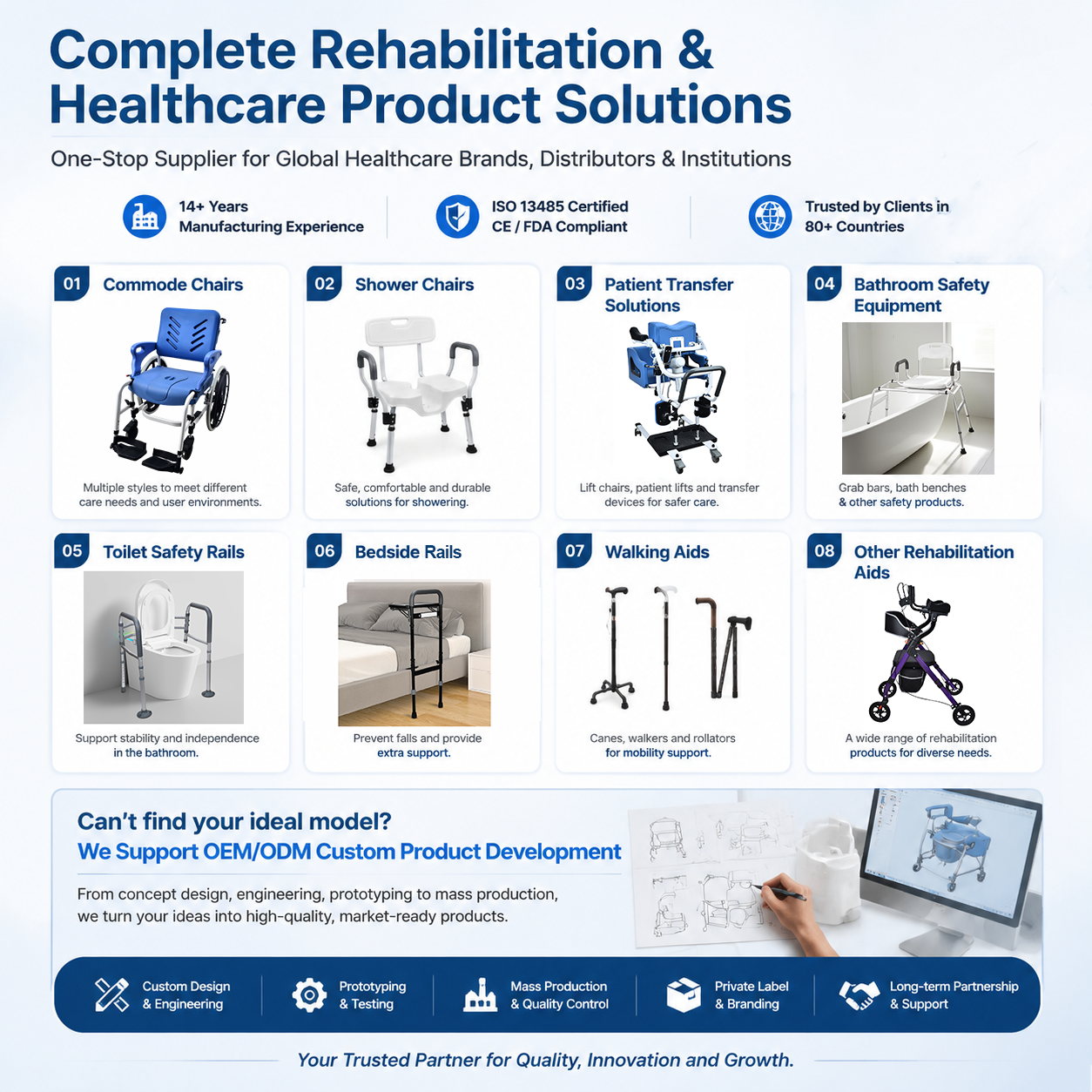
A coordinated portfolio could include:
-
Commode chairs
-
Shower chairs
-
Toilet safety rails
-
Bedside rails
-
Walking frames
-
Rollators
-
Patient-care accessories
The correct mix should be based on the distributor’s buyers and sales channels rather than the number of products available from the supplier.
More Informed Scaling
Once a model demonstrates repeat demand, the buyer can increase the order quantity and negotiate a more efficient production and packaging arrangement.
Slower-moving products can remain at a limited quantity or be removed from the next purchasing plan.
Greater Flexibility During Product Development
Working from an existing platform allows the buyer and supplier to improve the product in stages.
Possible later adjustments may include:
-
Revised packaging
-
Updated instructions
-
Different accessories
-
More efficient carton dimensions
-
Market-specific labels
-
Product configuration changes
Any change affecting product safety, intended use, materials or compliance documentation must be reviewed before implementation.
Low MOQ Does Not Mean Every Customization Is Available
Buyers should distinguish between light customization and engineering customization.
Usually More Suitable for Lower Quantities
Depending on the model, these changes may be easier to support:
-
Logo application
-
Product labels
-
Carton markings
-
Standard color selection
-
Instruction manuals
-
Existing accessories
-
Packaging based on an available structure
Usually Requires Separate MOQ Evaluation
These requirements may involve additional engineering, tooling or material commitments:
-
New frame dimensions
-
New load-capacity targets
-
Exclusive plastic components
-
New molds
-
Non-standard tubing
-
Custom upholstery materials
-
New wheel or brake systems
-
Major structural modifications
-
New product claims or intended uses
A supplier should review these requirements before quoting instead of promising that every customization can be completed at the same MOQ.
Compliance Considerations for Private-Label Products
Private labeling does not automatically allow a buyer to use the supplier’s existing documents without review.
Before confirming the branding arrangement, both parties should clarify:
-
Who is the legal manufacturer?
-
Whose name appears on the product and packaging?
-
Which models are covered by the existing documentation?
-
Does the branding arrangement change regulatory responsibilities?
-
Are the target-market labels and instructions complete?
-
Are technical-document updates required?
-
Who manages complaints and post-market information?
-
Who approves changes to materials or components?
ISO 13485 certification relates to the supplier’s quality-management system. CE documentation, FDA requirements and other market-access documents must be evaluated separately for the exact product and target country.
Growing brands should confirm the regulatory arrangement before printing private-label packaging or placing a bulk order.
How to Evaluate a Low-MOQ ODM Partner
1. Existing Product Platforms
A supplier with existing molds, tested structures and established components is more likely to support practical small-batch projects than a supplier starting every design from zero.
KDB Health has developed more than 500 product molds across rehabilitation and homecare equipment categories, providing a broad starting point for selected ODM projects.
2. Clear MOQ Conditions
A credible supplier should explain why a particular MOQ applies.
Buyers should ask for separate requirements covering:
-
Standard products
-
Logo application
-
Color customization
-
Printed packaging
-
Component changes
-
New tooling
-
Mixed-model orders
KDB Health can evaluate selected ODM projects from 50 pieces, while many standard commercial orders begin at approximately 300 pieces. The final MOQ must be confirmed according to the model and customization requirements.
3. Sample and Engineering Support
A sample should be used to verify product configuration, dimensions, appearance, labeling and packaging before bulk production.
KDB Health can support sample development in approximately 15 days for qualified projects, depending on the scope of modification and component availability.
4. Quality-Control Consistency
A low first-order quantity should not result in lower quality standards.
Buyers should review:
-
Incoming-material controls
-
Production inspection
-
Assembly checks
-
Stability and load testing
-
Packaging inspection
-
Nonconforming-product procedures
-
Traceability
-
Complaint handling
5. Documentation Capability
The supplier should be able to explain which documents are available for each model and destination market.
Broad statements such as “all products are fully certified” should not replace model-specific document verification.
6. Ability to Support Future Volume
The purpose of a low-MOQ launch is not to remain permanently at a trial quantity. The supplier should have the capacity, components and quality system required to support repeat orders when the product gains traction.
Professional buyers can review how to evaluate a medical equipment OEM manufacturer before selecting a long-term production partner.
Managing the Total Cost of a Small-Batch Order
A low-MOQ order normally has a higher unit cost than a larger production run. Buyers should compare the total business cost rather than the unit price alone.
Use Existing Components and Tooling
Selecting an existing frame, seat, armrest and accessory configuration can reduce tooling and development costs.
Limit the First Round of Customization
Focus on the branding and product features required to test the market. Additional changes can be introduced after the product has demonstrated demand.
Request Tiered Pricing
Ask the supplier to quote several quantity levels. This shows how the unit cost may change as the business scales.
Review Packaging Efficiency
For bulky rehabilitation products, carton size, disassembly level, loading quantity and product protection can materially affect landed cost.
Evaluate Mixed-Model Shipping Carefully
Combining several models in one shipment may help a distributor test a broader product range. However, buyers should also evaluate minimum quantities per model, carton differences, handling fees and LCL freight costs.
Mixed loading is useful only when it improves the total purchasing plan.
A Practical Launch-to-Scale Process
A growing healthcare brand can structure a low-MOQ project in six stages:
Stage 1: Define the Market
Identify the country, buyer group, sales channel, intended use and target price range.
Stage 2: Select an Existing Platform
Review available models and choose the closest match to the market requirement.
Buyers evaluating bathroom-safety categories can explore KDB Health’s bathroom safety solutions before choosing the initial product group.
Stage 3: Confirm Essential Customization
Separate necessary branding and functional requirements from changes that can wait until a later order.
Stage 4: Approve the Sample
Confirm the product, label, manual, packaging and inspection requirements before production.
Stage 5: Test the Market
Track sales performance, customer feedback, packaging results and after-sales issues.
Stage 6: Scale the Proven Models
Increase the quantity of successful products, improve purchasing efficiency and review whether deeper customization is commercially justified.
For distributors beginning with shower-chair products, our guide to low-MOQ custom shower chairs for distributors provides more category-specific considerations.
Brands developing their own commode-chair range can also review OEM and ODM commode chairs for medical brands.
How KDB Health Supports Growing Healthcare Brands
KDB Health works with healthcare distributors, importers, private-label brands, project suppliers and e-commerce businesses.
Our product and manufacturing resources include:
-
More than 14 years of rehabilitation equipment experience
-
An 18,000-square-meter manufacturing facility
-
Monthly capacity of up to 80,000 commode chairs
-
A 12-member R&D team
-
More than 500 existing product molds
-
ISO 13485 quality-management processes
-
Sample support in approximately 15 days for qualified projects
-
OEM and ODM support across multiple rehabilitation categories
-
Branding, packaging and documentation coordination
Our objective is to help buyers select an appropriate starting model, define a workable customization scope and build a purchasing plan that can grow with verified market demand.
Frequently Asked Questions
What does low MOQ mean for medical equipment?
Low MOQ refers to an order quantity that is smaller than the supplier’s normal production requirement. The actual quantity depends on the model, materials, components, packaging and customization scope.
Is ODM always cheaper than OEM?
Not necessarily. An existing ODM platform may reduce tooling and development costs, but the total price still depends on the product, quantity and requested changes.
Can a growing brand add its own logo and packaging?
Selected models may support private labeling, logo application, manuals and packaging customization. The MOQ and regulatory arrangement must be confirmed before production.
Can several rehabilitation products be combined in one order?
Mixed-model purchasing may be possible, subject to the minimum quantity for each model, component availability and shipping plan.
Does private labeling require new compliance documentation?
It depends on the target market, legal-manufacturer arrangement, labeling and extent of the changes. The responsibilities and required documentation should be reviewed before branding is finalized.
When should a buyer invest in a new mold?
New tooling is more appropriate when market demand has been validated and an existing platform cannot meet the required structure, function or market positioning.
Start with a Manageable Product Plan
Low-MOQ medical equipment sourcing gives growing healthcare brands a more controlled way to enter new markets, test product categories and build a private-label portfolio.
The strongest projects begin with a clearly defined market, an appropriate existing product platform and a limited first-round customization scope. Sales and customer feedback can then guide future product improvements and larger orders.
Contact the KDB Health team to discuss suitable models, current MOQ requirements, product catalogs, OEM/ODM options, sample development and a customized quotation.
Table of Contents
- Why MOQ Creates Pressure for Growing Healthcare Brands
- What Does Low-MOQ ODM Manufacturing Mean?
- ODM, OEM and Existing-Platform Customization
- How Low MOQ Supports Market Testing
- Business Benefits of a Low-MOQ Product Strategy
- Low MOQ Does Not Mean Every Customization Is Available
- Compliance Considerations for Private-Label Products
- How to Evaluate a Low-MOQ ODM Partner
- Managing the Total Cost of a Small-Batch Order
- A Practical Launch-to-Scale Process
- How KDB Health Supports Growing Healthcare Brands
- Frequently Asked Questions
- Start with a Manageable Product Plan