
 EN
EN
Published: [Original Publication Date] | Last Updated: September 18, 2026
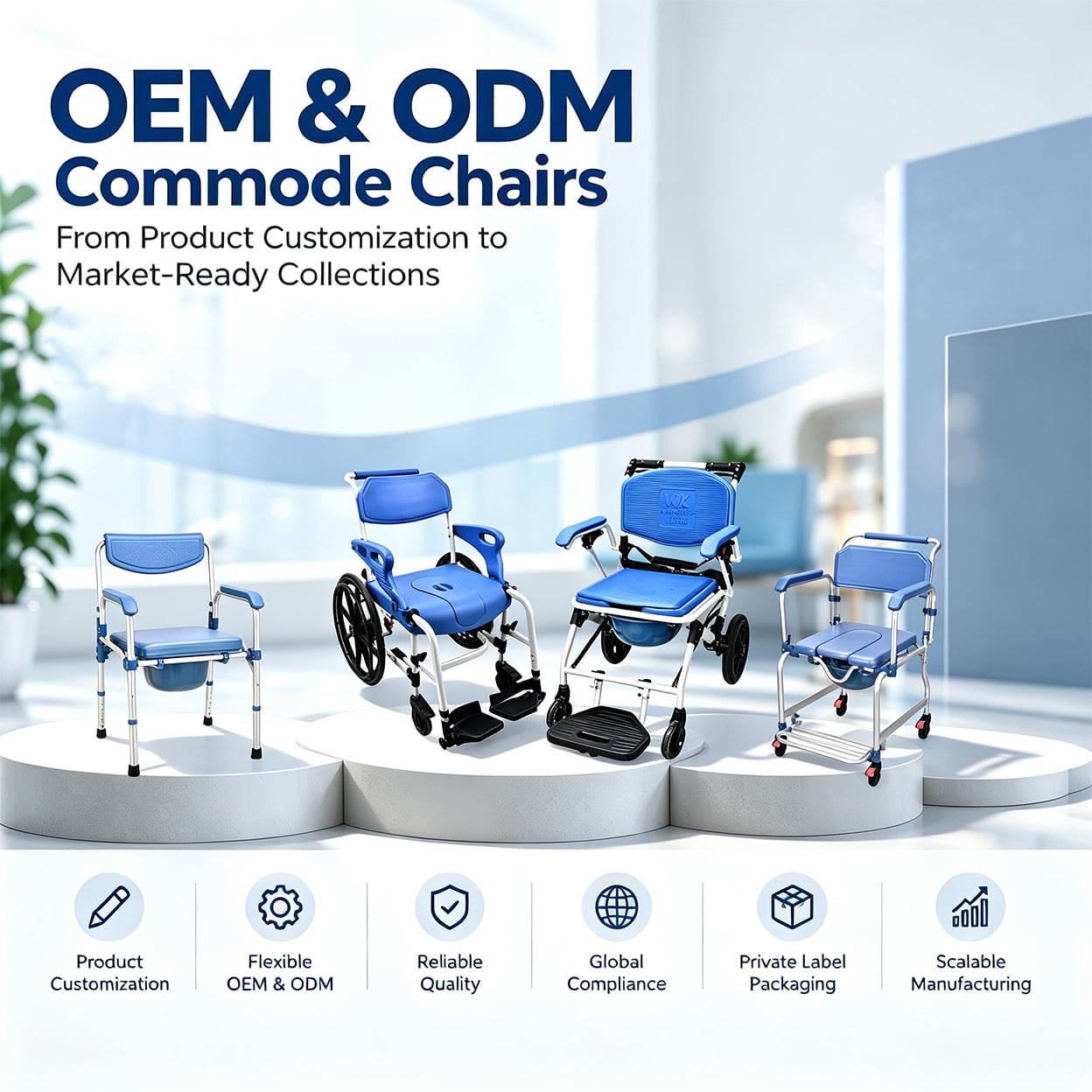
For medical brands, building a competitive commode chair range is not simply a matter of adding a logo to an existing product.
Different markets, sales channels and customer groups may require different frame structures, seat widths, materials, mobility configurations, packaging formats and price positioning. A successful product line therefore needs to balance market differentiation, manufacturing feasibility and long-term scalability.
KDB Health works with healthcare brands, distributors, importers and rehabilitation equipment suppliers to develop customized commode chair collections through OEM and ODM manufacturing.
Rather than treating customization as a list of optional features, the goal is to help buyers turn market requirements into products that can be manufactured consistently and expanded into a commercially viable product range.
1. Start With the Market, Not the Customization List
One of the most common mistakes in product development is deciding what to customize before defining where the product will be sold.
A commode chair developed for institutional procurement may have very different priorities from one intended for homecare distribution or e-commerce.
Before selecting a product platform, buyers should first define:
- Target country or region
- Primary sales channel
- Target customer group
- Intended care environment
- Expected retail or wholesale positioning
- Required functions
- Target purchasing cost
- Expected initial and future order volumes
These factors determine which product characteristics deserve investment.
For example, a distributor serving institutional customers may prioritize durability, easy cleaning and standardized configurations. An e-commerce healthcare brand may place greater emphasis on compact packaging, assembly experience, visual differentiation and product features that are easy to communicate online.
Customization becomes more effective when every change has a clear commercial purpose.
2. Build Different Product Positions From Existing Commode Chair Platforms
A medical brand does not necessarily need to develop every commode chair from zero.
Existing platforms can often be configured into different market positions by changing selected materials, components and functions.
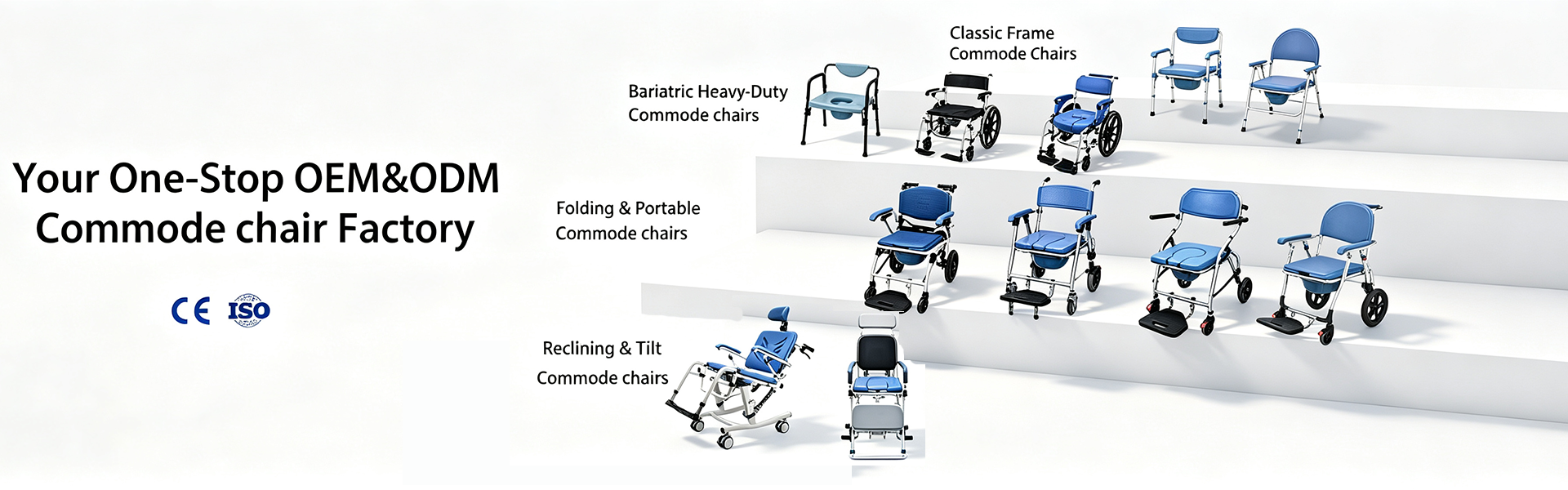
A product range might include:
Entry-Level Bedside Commode
Designed around straightforward functionality and competitive procurement cost.
Typical priorities may include:
- Stable frame construction
- Height adjustment
- Removable commode bucket
- Compact packaging
- Simple maintenance
- Cost-efficient material selection
Folding Commode Chair
Suitable for distributors where storage, transportation and space efficiency are important.
Development priorities may include:
- Folding structure
- Reduced packing volume
- Easy assembly
- Product weight
- Transport efficiency
Wheeled Shower Commode
Developed for care environments where toileting and shower assistance need to be combined.
Configurations may include:
- Lockable casters
- Waterproof seating
- Flip-up or removable armrests
- Footrests
- Corrosion-resistant materials
- Different wheel configurations
Heavy-Duty or Wider Commode Chair
For markets requiring greater seat width or load-bearing capability, the frame and supporting structure may need to be evaluated as a complete system rather than simply increasing one dimension.
By using a platform-based approach, brands can create a coordinated product collection while reducing unnecessary development work.
Buyers can explore the KDB Health commode chair range to compare available structures before defining a customization project.
3. Where OEM Customization Creates Brand Differentiation
OEM customization works best when an existing product already meets the main functional requirements but needs to fit a particular brand or market position.
Customization can take place at several levels.
Product Appearance
Brand identity can be reflected through:
- Frame colors and finishes
- Seat and backrest appearance
- Logo application
- Product labels
- Selected component combinations
These details can help products across the same portfolio maintain a more consistent visual identity.
Functional Configuration
Depending on the existing platform, buyers may select or adjust:
- Seat configurations
- Armrests
- Backrests
- Footrests
- Casters
- Large rear wheels
- Commode buckets
- Height-adjustment options
- Accessories
The objective is not to add as many functions as possible. Each configuration should correspond to the intended application and price position.
Private-Label Packaging
Packaging is another important part of OEM development, particularly for brands selling through distributors, retail channels or e-commerce.
Private-label support can include:
- Brand artwork
- Carton design
- Product labels
- Instruction manuals
- Shipping marks
- Packaging configuration
Packaging should be considered early because carton dimensions, product disassembly and accessory placement can influence both logistics costs and customer experience.
4. When OEM Is No Longer Enough
Some product ideas cannot be achieved by changing colors, components or packaging.
When a project requires modifications to the underlying product architecture, it moves closer to ODM development.
This may include:
- New frame dimensions
- Different seat width or height
- Structural reinforcement
- New folding mechanisms
- Modified armrest or footrest structures
- New transfer functions
- Newly designed components
- Different load-bearing requirements
- New molds or tooling
At this stage, customization becomes an engineering project.
The manufacturer needs to consider not only whether the requested feature can be produced, but also how the change affects stability, usability, materials, manufacturing processes, packaging and repeat production.
For this reason, a reference image alone is rarely enough for a serious ODM project.
Buyers should explain the problem the new design is intended to solve.
5. Turn Buyer Requirements Into an Engineering Brief
A clear development brief can significantly improve communication between a healthcare brand and its manufacturing partner.
Useful information includes:
- Target market
- Intended application
- Existing product or reference model
- Required dimensions
- Target weight capacity
- Preferred materials
- Required functions
- Features that must remain unchanged
- Features that should be improved
- Target price positioning
- Estimated annual purchasing volume
- Packaging expectations
- Reference drawings or images
The engineering team can then determine whether the requirement can be achieved through an existing platform, component modification or new development.
This step helps prevent unnecessary tooling and reduces the risk of developing features that add cost without creating meaningful market value.
6. Prototype Decisions Should Focus on Commercially Important Details
A prototype is not only used to confirm whether a product can be manufactured.
It should help the buyer answer a more important question:
Is this product ready for the intended market and sales channel?
During sample evaluation, buyers should review areas such as:
- Overall dimensions
- Seat dimensions
- Transfer space
- Product stability
- Folding or adjustment mechanisms
- Casters and brakes
- Armrest and footrest operation
- Surface finish
- Assembly
- Product appearance
- Branding
- Packaging
- Instructions and labels
For customized projects based on existing platforms, sample preparation can typically take around 15 days, depending on the model and level of customization.
Major ODM development may require additional engineering, prototype iterations or tooling.
Feedback should be consolidated before mass production rather than introducing multiple uncoordinated changes during production.
7. Design a Product Family Instead of a Single SKU
For growing medical brands, one of the greatest advantages of working with an OEM/ODM partner is the ability to think beyond one product.
A successful base model can become the foundation of a broader product family.
For example, a brand might begin with a standard bedside commode and later develop:
Standard Model → Folding Model → Wheeled Model → Shower Commode → Wider or Heavy-Duty Model
This approach creates several commercial advantages.
The brand can cover different price points and care environments while maintaining recognizable product positioning.
Distributors can also offer customers more choices without sourcing every variation from a different manufacturer.
From the manufacturing side, sharing selected platforms, components or production processes can make future development more manageable.
The objective is therefore not simply to customize one commode chair.
It is to create a product architecture that can grow with the brand.
8. Consider Packaging and Logistics During Product Development
A technically successful product is not automatically a commercially efficient product.
For international distributors, packaging can have a significant impact on total procurement cost.
Product development should therefore consider:
- Folded or disassembled dimensions
- Carton dimensions
- Protective materials
- Accessory placement
- Assembly requirements
- Container utilization
- Product protection during transport
This is particularly important for bulky rehabilitation products.
A structural change that appears minor at the product level may increase carton size and affect shipping efficiency across hundreds or thousands of units.
For this reason, packaging should be evaluated as part of product development rather than after the product design has already been finalized.
9. Plan Customization Around Future Production
A customized product needs to remain reproducible after the first successful order.
Before approving a project, buyers should consider:
- Whether customized components can be supplied consistently
- Whether materials are suitable for repeat production
- Whether specifications are clearly documented
- Whether packaging can be reproduced consistently
- Whether the design can support higher future quantities
- Whether product variations can share components
KDB Health operates an 18,000 m² manufacturing facility with production capacity of up to 80,000 units per month.
Our product-development resources include a 12-person R&D team, approximately 15 new product developments per month, 500+ existing molds and 19+ patents.
This combination of existing platforms and development capability allows projects to begin with practical customization while leaving room for future product-line expansion.
Typical bulk production lead time is approximately 30–45 days, depending on product configuration, order quantity and production requirements.
10. Quality Management Should Follow the Approved Product
Customization creates additional variables, which makes specification control especially important.
KDB Health operates under an ISO 13485 quality management system.
For OEM and ODM projects, buyers and manufacturers should clearly confirm the approved:
- Product specifications
- Materials
- Components
- Dimensions
- Functions
- Branding
- Labels
- Packaging
- Inspection requirements
The approved sample and confirmed specifications provide an important reference for repeat production.
This becomes increasingly valuable as a customized product moves from an initial launch into regular purchasing.
11. From One Commode Chair to a Broader Rehabilitation Portfolio
Commode chairs are often only one part of a distributor or medical brand's rehabilitation product strategy.
KDB Health also develops shower chairs, patient transfer equipment, walkers, bedside safety products and other bathroom safety and mobility solutions.
A brand that establishes a clear product-development process can gradually apply the same market positioning across related categories.
For example, a bathroom safety portfolio might combine:
- Commode chairs
- Shower chairs
- Toilet safety products
- Transfer solutions
A broader rehabilitation portfolio may then extend into mobility and bedside support products.
This allows buyers to build a more coordinated product offering rather than purchasing unrelated products solely on the basis of individual quotations.
Frequently Asked Questions
Can KDB Health customize an existing commode chair with my brand?
Yes. Depending on the model and order requirements, OEM customization may include logos, colors, product labels, instruction manuals, carton artwork, packaging and selected product configurations.
Do I need to develop a new mold for a customized commode chair?
Not necessarily. Many projects can begin with an existing product platform. New tooling is generally considered when the requested structure or component cannot be achieved using existing designs.
Can dimensions such as seat width or seat height be customized?
Certain dimensions can be evaluated according to the product structure. Structural changes need engineering review because changing one dimension may affect stability, components, packaging or other product characteristics.
What is the MOQ for customized commode chairs?
For selected existing models, OEM customization can start from approximately 50 pieces. Actual MOQ depends on the model, components, branding, packaging and requested changes. Many standard configurations are more suitable for quantities of 300 pieces or above. ODM projects requiring new tooling or structural development are evaluated separately.
Can I evaluate a customized sample before mass production?
Yes. Sample evaluation is an important part of customized product development. Buyers can review dimensions, functions, appearance, branding and packaging before confirming bulk production.
How long does sample development take?
For selected existing platforms and standard customization, sample preparation is typically around 15 days. More complex ODM projects may require additional time for engineering, prototypes or tooling.
Can one existing model be developed into several market versions?
In many cases, yes. A base platform may support different materials, components, functions, packaging or positioning. The feasibility of each version should be reviewed according to the product structure and intended market.
Can KDB Health support production after the customized product grows in volume?
Yes. Product development should consider future repeat production from the beginning. KDB Health's manufacturing capacity of up to 80,000 units per month supports both customized projects and subsequent volume production, subject to product configuration and production planning.
Build Your Next Commode Chair Collection With KDB Health
A successful OEM or ODM project should do more than create a different-looking product.
It should connect market demand, brand positioning, engineering feasibility, packaging, manufacturing and future product-line growth.
KDB Health works with medical brands, distributors, importers and rehabilitation equipment suppliers to turn these requirements into manufacturable commode chair solutions.
Whether you are adapting an existing platform, developing a differentiated model or planning a complete commode chair collection, our team can evaluate the project from both product-development and manufacturing perspectives.
Contact KDB Health today for product catalogs, MOQ evaluation, pricing, OEM/private-label options or an ODM development proposal.
Table of Contents
- 1. Start With the Market, Not the Customization List
- 2. Build Different Product Positions From Existing Commode Chair Platforms
- 3. Where OEM Customization Creates Brand Differentiation
- 4. When OEM Is No Longer Enough
- 5. Turn Buyer Requirements Into an Engineering Brief
- 6. Prototype Decisions Should Focus on Commercially Important Details
- 7. Design a Product Family Instead of a Single SKU
- 8. Consider Packaging and Logistics During Product Development
- 9. Plan Customization Around Future Production
- 10. Quality Management Should Follow the Approved Product
- 11. From One Commode Chair to a Broader Rehabilitation Portfolio
-
Frequently Asked Questions
- Can KDB Health customize an existing commode chair with my brand?
- Do I need to develop a new mold for a customized commode chair?
- Can dimensions such as seat width or seat height be customized?
- What is the MOQ for customized commode chairs?
- Can I evaluate a customized sample before mass production?
- How long does sample development take?
- Can one existing model be developed into several market versions?
- Can KDB Health support production after the customized product grows in volume?
- Build Your Next Commode Chair Collection With KDB Health