
 EN
EN
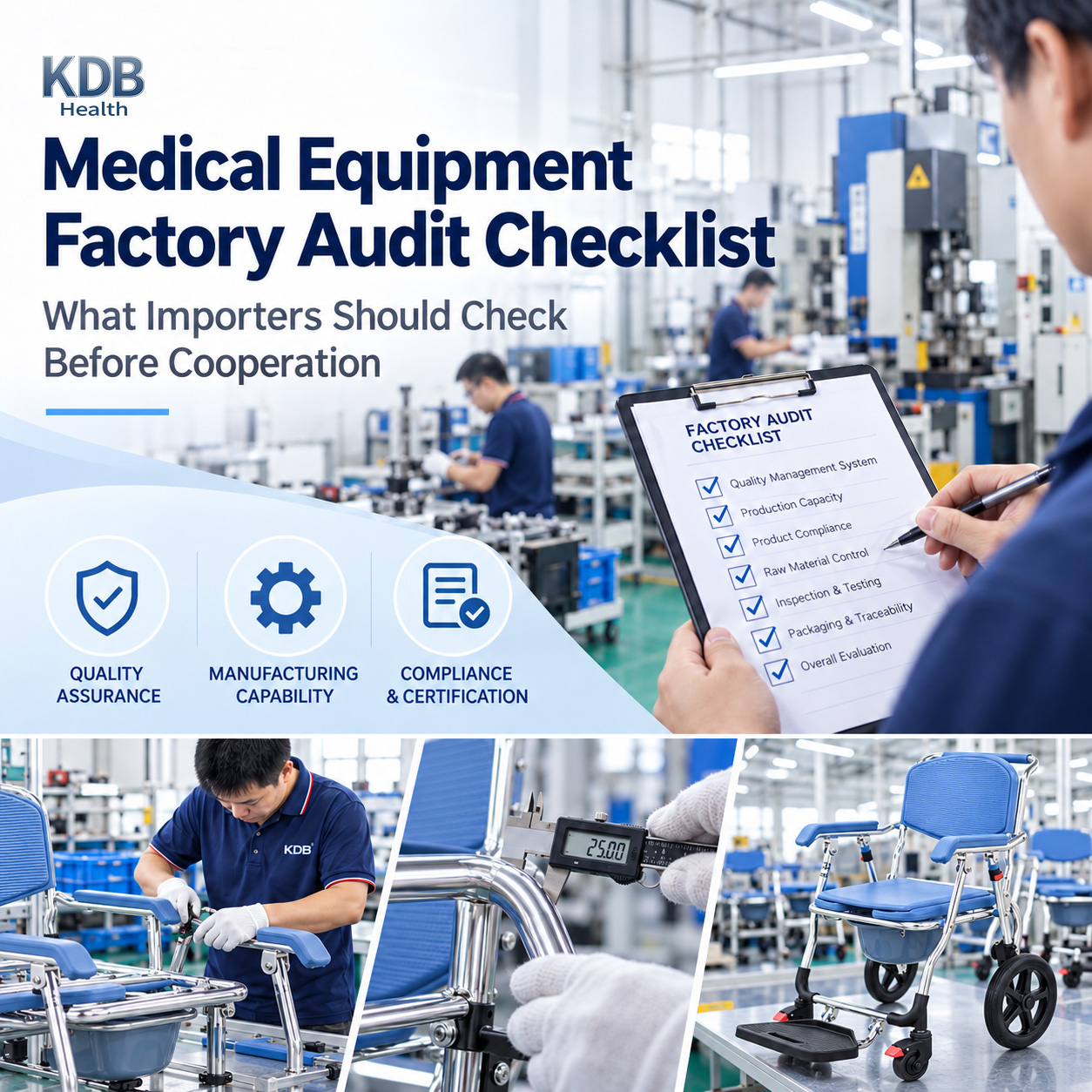
For medical equipment importers, distributors, healthcare brands and project buyers, choosing a supplier involves more than comparing quotations, product catalogs and certificates.
A supplier may appear competitive on paper, but professional buyers still need to answer a more important question:
Can this factory consistently manufacture, inspect, document and deliver the products required for your market?
A factory audit helps buyers verify that question through direct evidence.
For rehabilitation equipment such as commode chairs, shower chairs, walkers, patient transfer equipment and bedside safety products, an effective audit should examine not only compliance documents, but also production processes, material control, engineering resources, quality management and supply capacity.
The following framework can be used as a practical supplier evaluation checklist before placing a trial order, launching a private-label product or entering a long-term supply agreement.
1. Confirm Who Is Actually Manufacturing the Product
The first step is to verify the supplier's real manufacturing role.
Many sourcing problems begin because the buyer assumes a company is a factory when some or most production is actually subcontracted.
During the audit, confirm:
-
 Factory location
 -
Manufacturing area
-
Main product categories
-
Processes completed in-house
-
Processes outsourced to external partners
-
Number of production lines
- Main production equipment
- Warehouse and material-storage areas
- Quality-control areas
- R&D and engineering resources
A professional supplier should be able to explain clearly which processes it controls directly.
For rehabilitation products with metal frames, this may include tube cutting, bending, welding, machining, assembly, inspection and packaging.
The buyer should also verify whether the production environment observed during the audit is consistent with the products shown in the supplier's catalog.
2. Evaluate the Quality Management System in Practice
Certificates provide useful background information, but they do not show how quality is controlled every day.
For medical and rehabilitation equipment suppliers, buyers should review the actual implementation of the quality-management system.
Key areas include:
-
Incoming inspection
-
In-process inspection
-
Final inspection
-
Non-conforming product control
-
Corrective and preventive actions
-
Document control
-
Product specification control
-
Equipment calibration
-
Inspection records
-
Production traceability
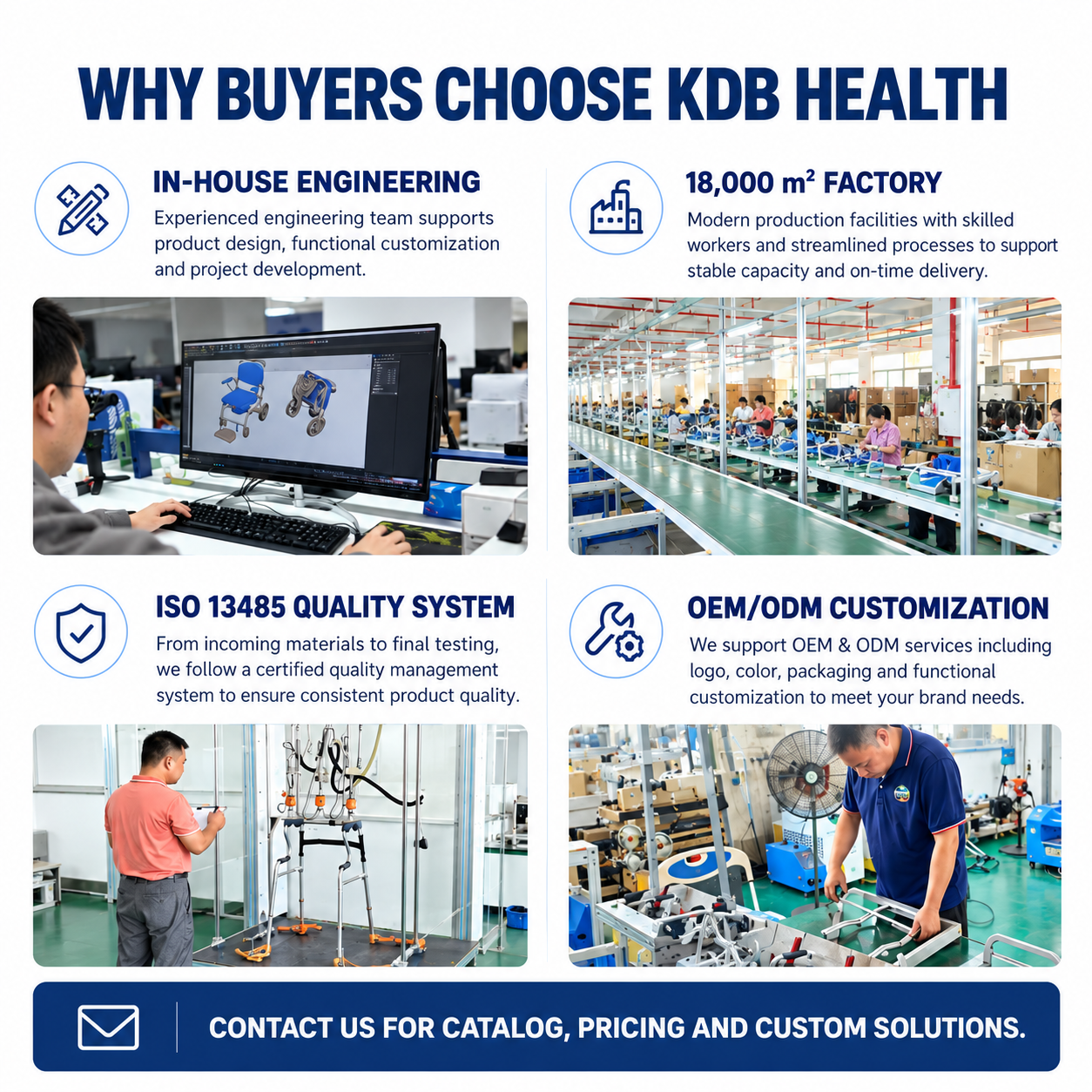
KDB Health operates under an ISO 13485 quality management system, but professional buyers should still evaluate how procedures are implemented during an audit.
The important question is not:
Does the factory have a quality certificate?
It is:
Can the factory show how that quality system affects the products I am purchasing?
3. Verify Product Documentation Against the Actual Product
One of the most common sourcing mistakes is reviewing a certificate without checking whether it applies to the exact product being purchased.
Documentation requirements vary by product category and destination market.
Buyers should confirm:
-
Product classification
-
Destination market
-
Applicable declarations or certificates
-
Product specifications
-
Relevant test reports
-
Labels
-
User instructions
-
Packaging information
-
Importer or distributor requirements
For products intended for the European market, buyers should review applicable CE documentation and the Declaration of Conformity for the relevant product.
Do not assume that documentation for one product automatically covers another product in the same factory.
This becomes even more important when the buyer requests structural or functional customization.
4. Follow One Product From Raw Material to Finished Goods
A useful audit should not stay in the meeting room.
Select a product relevant to your purchasing program and follow it through the production process.
For example, when auditing a commode chair factory, inspect the stages involved in producing the frame, installing components, assembling the product and completing final inspection.
Key areas may include:
Frame Preparation
Check how tubing and structural components are cut, formed and prepared.
Welding and Structural Connections
Review consistency and workmanship at important joints.
Surface Condition
Look for visible defects, scratches, inconsistent finishes or damage during production.
Assembly
Observe whether components are installed according to specifications and whether assembly instructions are available where necessary.
Moving Components
For applicable products, test:
-
Casters
-
Brakes
-
Folding mechanisms
-
Height adjustment
-
Armrests
-
Footrests
-
Locking systems
The purpose is not to perform a complete product test during the audit.
The objective is to understand whether the production process is controlled and repeatable.
5. Audit Incoming Material Control
Product quality begins with incoming materials.
For rehabilitation equipment, these materials may include:
-
Aluminum tubing
-
Steel tubing
-
Plastic components
-
Casters
-
Wheels
-
Fasteners
-
Seats
-
Backrests
-
Armrest components
-
Packaging materials
Ask how incoming materials are inspected and approved.
Useful questions include:
-
Are material suppliers qualified?
-
Are incoming dimensions checked?
-
Are materials identified by batch?
-
Are rejected materials separated?
-
Are inspection results recorded?
-
Are materials stored appropriately?
If you are purchasing a customized product, material control becomes particularly important because changes in materials or components can affect the approved specification.
6. Check How Quality Is Controlled During Production
Buyers should understand where critical inspections take place during manufacturing.
Depending on the product, in-process checks may include:
-
Frame dimensions
-
Joint quality
-
Surface finish
-
Component fit
-
Assembly
-
Adjustable mechanisms
-
Braking systems
-
Product stability
-
Accessories
Ask the supplier to show recent inspection records.
This helps verify whether quality checks are part of normal production rather than something prepared only for a customer visit.
For customized products, buyers should also ask how the approved sample is converted into production specifications and inspection requirements.
7. Review Final Inspection Before Shipment
Before products are packed and shipped, the factory should have a clear final-inspection process.
Typical checks may include:
-
Product dimensions
-
Appearance
-
Assembly
-
Functional operation
-
Adjustable parts
-
Casters and brakes
-
Accessories
-
Labels
-
Manuals
-
Packaging
-
Shipping marks
If your company uses its own pre-shipment inspection criteria or third-party inspection standards, these requirements should be agreed before production begins.
Do not assume that every supplier uses the same inspection sampling method or acceptance criteria.
The correct standard is the one agreed for the specific project.
8. Evaluate Engineering and Product Development Capability
For buyers purchasing only standard products, engineering capability may not appear to be the first priority.
For buyers planning private-label, OEM or ODM products, however, it becomes much more important.
During the audit, evaluate whether the supplier has internal resources for:
-
Product design
-
Structural evaluation
-
Drawings
-
Prototype development
-
Tooling coordination
-
Component development
-
Product improvement
-
Engineering change control
-
Production-process optimization
Instead of simply asking how many engineers the factory employs, ask the engineering team to explain a recent development project.
Useful questions include:
-
What problem was the buyer trying to solve?
-
Was an existing platform used?
-
What changes were required?
-
Was new tooling needed?
-
How many prototype revisions were made?
-
How was the final design transferred into production?
This provides a much clearer picture of actual engineering capability.
KDB Health currently operates with a 12-person R&D team, approximately 15 new product developments per month, more than 500 existing molds and 19+ patents.
For suitable projects based on existing platforms, sample development is typically around 15 days.
Buyers who want to evaluate this area in greater detail can also read our guide to engineering capability in rehabilitation equipment suppliers.
9. Verify Whether Production Capacity Is Realistic
Monthly production capacity should not be accepted as a marketing number without context.
Buyers should understand how the supplier calculates capacity.
Check:
-
Number of lines
-
Equipment availability
-
Current production load
-
Key bottleneck processes
-
Workforce availability
-
Material lead times
-
Peak-season planning
-
Capacity expansion options
KDB Health operates an 18,000 m² manufacturing facility with production capacity of up to 80,000 units per month.
However, actual lead time still depends on product type, quantity, customization level and production schedule.
Typical bulk production lead time is approximately 30–45 days.
For large programs, buyers should provide forecasts early so that capacity and materials can be planned in advance.
10. Check Whether the Factory Can Support Repeat Orders
A supplier may be able to complete one successful order but still struggle with long-term consistency.
For importers and distributors, repeat-order capability is just as important as first-order performance.
Ask how the factory controls:
-
Product specifications
-
Approved materials
-
Customized components
-
Packaging
-
Labels
-
Manuals
-
Drawings
-
Revision history
One of the most useful audit questions is:
If I reorder this product six months later, how will you ensure it is produced to the same approved specification?
This question reveals how seriously the factory manages documentation and product continuity.
11. Evaluate Packaging as Part of the Product
Packaging is not only a logistics issue.
For rehabilitation equipment, carton design can affect:
-
Transport damage
-
Container utilization
-
Freight cost
-
Assembly experience
-
Accessory protection
-
Product presentation
During the audit, inspect:
-
Carton quality
-
Internal protection
-
Product positioning
-
Accessory placement
-
Labels
-
Shipping marks
-
Finished-goods storage
For folding or partially disassembled products, ask whether the factory has evaluated different packaging configurations.
A small improvement in packing efficiency can create significant savings when purchasing container quantities.
12. Check Customized Product Control
If your purchasing program involves OEM or ODM products, the audit should include the way customized requirements are managed.
Review how the factory controls:
-
Customer drawings
-
Approved samples
-
Customized dimensions
-
Colors
-
Logos
-
Components
-
Packaging artwork
-
Labels
-
Manuals
-
Engineering changes
The supplier should be able to explain how these requirements move from sales to engineering, production and quality inspection.
This is particularly important when several customized versions of the same base product are being manufactured for different markets.
For medical brands developing customized commode chair programs, our guide to OEM & ODM commode chair development for medical brands explains how existing product platforms, engineering changes and product-family planning can work together.
13. Review Supply Chain Risk and Continuity
No factory can eliminate every supply-chain risk.
What buyers should evaluate is whether the supplier recognizes risk and manages it systematically.
Discuss:
-
Long-lead-time components
-
Key material suppliers
-
Alternative sources
-
Equipment maintenance
-
Production bottlenecks
-
Seasonal demand
-
Unexpected volume increases
-
Material shortages
-
Delivery delays
A mature supplier should be able to explain where its main risks are and what practical measures are used to reduce disruption.
14. Observe Workplace and Operational Discipline
Factory management can often be seen in everyday working conditions.
During the audit, observe:
-
Emergency exits
-
Fire-safety equipment
-
Machine areas
-
PPE where required
-
Material organization
-
Workstation order
-
Finished-goods storage
-
Operator instructions
If your company has specific social-compliance requirements, provide the audit criteria in advance.
Do not assume that one particular third-party social-compliance certificate is required for every purchasing project.
15. Evaluate Communication Before You Evaluate Price
A technically capable supplier can still become difficult to work with if communication is weak.
During the audit process, evaluate whether the supplier:
-
Answers technical questions clearly
-
Documents changes
-
Confirms specifications in writing
-
Coordinates between sales and engineering
-
Escalates problems quickly
-
Responds to quality issues
-
Provides realistic lead-time information
For long-term supply relationships, communication quality can directly affect project speed and purchasing risk.
A 5-Part Factory Audit Framework for Procurement Teams
For procurement teams that want a faster way to structure an audit, the entire process can be grouped into five areas.
| Area | Main Question |
|---|---|
| Capability | Can this factory actually manufacture the product? |
| Quality | Can it produce consistently to the required specification? |
| Compliance | Is the documentation appropriate for the product and market? |
| Engineering | Can it support customization and future product development? |
| Supply | Can it deliver repeatedly as volume grows? |
If a supplier performs strongly in all five areas, the buyer has a much stronger foundation for long-term cooperation.
Red Flags Buyers Should Not Ignore
During a factory audit, several warning signs deserve closer investigation.
Examples include:
-
The production floor does not match the claimed product range
-
Certificates cannot be linked to the actual products
-
Inspection records are incomplete or inconsistent
-
Incoming materials are poorly identified
-
Customized requirements rely only on verbal communication
-
Engineering questions cannot be answered technically
-
Capacity claims cannot be supported by actual equipment or production lines
-
Production specifications are not clearly controlled
-
Rejected products are not separated
-
Different versions of the same product are not clearly identified
One red flag does not always mean a supplier should be rejected.
But several unresolved issues in critical areas should affect the buyer's risk assessment.
Questions to Ask During a Factory Audit
Professional buyers can use questions such as:
-
Which processes for this product are completed in-house?
-
Which materials or components are outsourced?
-
How are incoming materials inspected?
-
How are customized specifications controlled?
-
Can you show recent inspection records?
-
How are engineering changes approved?
-
How long does sample development usually take?
-
What is the main production bottleneck for this product?
-
How do you manage repeat-order consistency?
-
What happens when a product fails final inspection?
-
How do you handle urgent quality issues after shipment?
-
How far in advance should buyers provide volume forecasts?
The quality of the supplier's answers often provides as much information as the documents themselves.
Frequently Asked Questions
What should be checked during a medical equipment factory audit?
Buyers should evaluate the manufacturing site, quality system, documentation, material control, production processes, final inspection, engineering capability, capacity, packaging and supply continuity.
Is ISO 13485 enough to approve a supplier?
No single certificate should replace supplier evaluation. ISO 13485 is an important quality-management credential, but buyers should also verify how the quality system is applied to the actual products and production processes.
How can buyers verify whether a company is really a manufacturer?
Review the production floor, manufacturing equipment, process flow, raw-material areas, engineering resources and finished-goods operations. Ask which processes are performed in-house and which are subcontracted.
Why is engineering capability important in a factory audit?
Engineering capability becomes important when the buyer requires customization, product improvement or future product development. It also helps determine whether the supplier can transfer an approved design into repeatable production.
How should buyers evaluate production capacity?
Compare the supplier's stated monthly capacity with its actual lines, equipment, workload, bottlenecks and lead-time commitments.
Can a remote factory audit be useful?
Yes. A live video audit can support initial supplier screening by showing manufacturing areas, warehouses, inspection processes and engineering resources. For strategic purchasing programs, buyers may also conduct an on-site or independent third-party audit.
Use the Audit to Verify, Not Assume
The purpose of a factory audit is not to find a supplier that looks perfect.
It is to verify whether the supplier's manufacturing capability, quality system, documentation, engineering resources and supply capacity are suitable for your purchasing program.
For medical equipment importers and distributors, this reduces the risk of selecting suppliers based only on price, catalogs or marketing claims.
KDB Health welcomes professional buyers, distributors, healthcare brands and project partners to evaluate our manufacturing and product-development capabilities through agreed factory visits and audit arrangements. Buyers can also explore our bathroom safety solutions to review product categories available for distribution, private label and project sourcing.
Contact KDB Health to request product information, factory details, pricing, OEM/ODM evaluation or to discuss a factory visit.
Table of Contents
- 1. Confirm Who Is Actually Manufacturing the Product
- 2. Evaluate the Quality Management System in Practice
- 3. Verify Product Documentation Against the Actual Product
- 4. Follow One Product From Raw Material to Finished Goods
- 5. Audit Incoming Material Control
- 6. Check How Quality Is Controlled During Production
- 7. Review Final Inspection Before Shipment
- 8. Evaluate Engineering and Product Development Capability
- 9. Verify Whether Production Capacity Is Realistic
- 10. Check Whether the Factory Can Support Repeat Orders
- 11. Evaluate Packaging as Part of the Product
- 12. Check Customized Product Control
- 13. Review Supply Chain Risk and Continuity
- 14. Observe Workplace and Operational Discipline
- 15. Evaluate Communication Before You Evaluate Price
- A 5-Part Factory Audit Framework for Procurement Teams
- Red Flags Buyers Should Not Ignore
- Questions to Ask During a Factory Audit
-
Frequently Asked Questions
- What should be checked during a medical equipment factory audit?
- Is ISO 13485 enough to approve a supplier?
- How can buyers verify whether a company is really a manufacturer?
- Why is engineering capability important in a factory audit?
- How should buyers evaluate production capacity?
- Can a remote factory audit be useful?
- Use the Audit to Verify, Not Assume