
 EN
EN
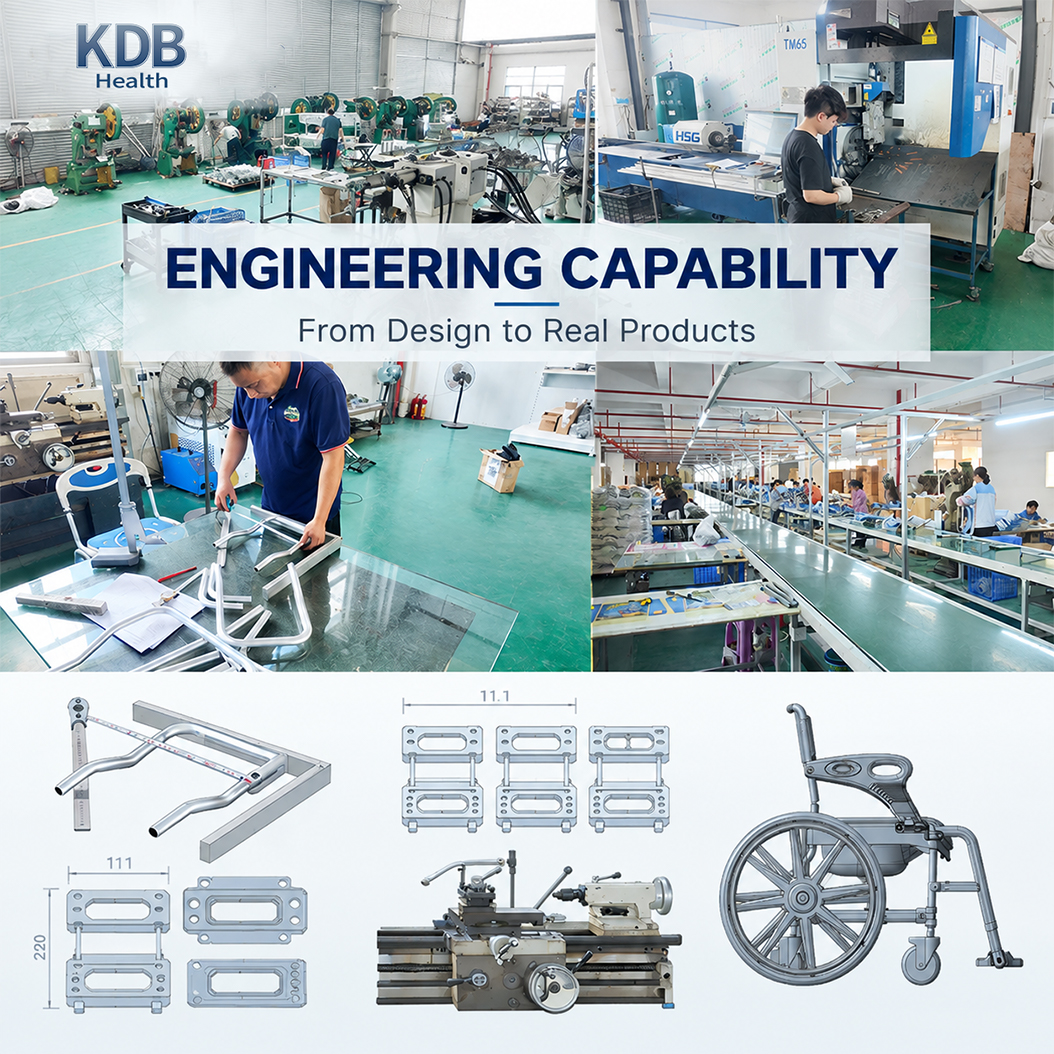
When distributors, medical brands and project buyers evaluate a rehabilitation equipment supplier, price, certifications and product range are usually among the first factors considered.
But these factors alone do not show how well a supplier can respond when a product needs to be improved, adapted for a particular market or developed into a long-term product line.
This is where engineering capability becomes important.
For rehabilitation products such as commode chairs, shower chairs, patient transfer equipment, walkers and bedside safety products, engineering decisions influence product structure, material selection, usability, manufacturing consistency, packaging and future customization.
KDB Health works with healthcare brands, distributors, importers and project buyers that need more than existing products. Supported by an experienced manufacturing and R&D system, we help buyers evaluate how product requirements can be translated into practical, manufacturable solutions.
1. Engineering Starts With Understanding the Product Application
A rehabilitation product should not be designed around features alone.
The first question should be:
Where, how and by whom will the product be used?
A shower chair intended for bathroom use has different material and structural considerations from a bedside commode. A transfer chair has different mobility and operating requirements from a static bathroom safety product. A folding product also introduces different considerations for joints, locking mechanisms, packaging and repeated use.
For professional buyers, this means a supplier should be able to discuss more than dimensions and unit prices.
Engineering evaluation may consider:
- Intended care environment
- Product dimensions and user space
- Frame structure
- Material selection
- Stability
- Weight capacity
- Adjustment mechanisms
- Folding or locking structures
- Casters and brakes
- Armrest and footrest configurations
- Cleaning and maintenance
- Assembly requirements
- Packaging and transportation
Understanding these relationships helps prevent a common sourcing problem: improving one feature while unintentionally creating problems elsewhere in the product.
2. A Large Product Platform Can Reduce Unnecessary Development
Not every market requirement needs a completely new product.
For distributors and medical brands, one sign of useful engineering capability is whether a supplier can identify an existing platform that already solves most of the requirement.
KDB Health has developed a broad portfolio of rehabilitation and bathroom safety products supported by more than 500 existing molds.
This gives buyers several possible starting points.
For example, instead of developing a new commode chair from the beginning, an existing platform may already provide the required:
- Frame structure
- Seat dimensions
- Height adjustment
- Folding mechanism
- Wheel configuration
- Armrest structure
- Footrest system
The engineering team can then evaluate which elements should remain standard and which require modification.
This platform-based development approach can reduce unnecessary tooling, shorten development time and make initial product evaluation more practical.
Buyers sourcing bathroom safety products can review the KDB Health bathroom safety solutions to understand the range of available product platforms.
3. Engineering Capability Helps Buyers Define What Should Be Customized
Customization is useful only when it creates meaningful value.
Adding features without considering their commercial purpose can increase product cost, weight, packaging size and manufacturing complexity.
A capable rehabilitation equipment supplier should therefore help buyers distinguish between three different types of requirements.
Configuration Changes
These use existing structures and components.
Examples may include different casters, armrests, footrests, seats, accessories or available configurations.
Brand and Market Adaptation
These may include colors, labels, manuals, packaging and other private-label requirements.
Engineering Changes
These affect the underlying product design and may include:
- Frame dimensions
- Seat dimensions
- Structural reinforcement
- Folding mechanisms
- New components
- Different transfer functions
- New tooling
Separating these requirements early helps buyers understand where engineering resources are actually needed.
It also prevents a project from becoming unnecessarily complex.
4. Engineering Should Balance Performance and Manufacturability
A product can look good in a drawing and still be difficult to manufacture consistently.
This is why Design for Manufacturing (DFM) matters.
During product development, engineering decisions should consider not only the intended function but also how the product will be produced repeatedly.
Questions may include:
- Can the structure be manufactured consistently?
- Are the selected materials appropriate for production?
- Are components practical to source over the long term?
- Is assembly unnecessarily complicated?
- Can important dimensions be controlled during production?
- Can the product be inspected efficiently?
- Will the design remain practical when order volume increases?
For B2B buyers, manufacturability directly affects cost, consistency and repeat-order reliability.
The objective is not simply to develop a prototype that works once.
The objective is to create a product that can move from sample approval to stable production.
5. Material Selection Is an Engineering Decision, Not Just a Cost Decision
Rehabilitation equipment commonly uses materials such as aluminum, carbon steel, plastics, waterproof seating materials and different surface treatments.
The lowest-cost material is not automatically the most appropriate choice.
Material selection should reflect the intended application.
For example, bathroom safety products may require greater consideration of moisture exposure and cleaning, while mobility products may need to balance structural requirements with product weight.
Engineering teams therefore need to evaluate the relationship between:
material → structure → function → manufacturing → target cost
This is particularly important when a buyer requests changes to weight capacity, dimensions or product weight.
Changing one specification may require corresponding changes elsewhere in the structure.
6. Prototyping Turns Product Requirements Into Something Buyers Can Evaluate
For customized rehabilitation products, the sample stage is an important bridge between an idea and mass production.
A prototype allows the buyer and engineering team to evaluate whether the proposed solution works as intended.
Depending on the project, evaluation may cover:
- Dimensions
- Product structure
- Stability
- Adjustment mechanisms
- Folding functions
- Casters and brakes
- Armrest or footrest operation
- Materials
- Appearance
- Assembly
- Packaging
KDB Health's typical sample development time for suitable projects is approximately 15 days, depending on the product and level of customization.
More complex development involving new structures, components or tooling may require additional time.
The purpose of rapid prototyping should not be speed alone. It should allow problems to be identified and corrected before they become mass-production problems.
7. Engineering Capability Also Affects Packaging and Logistics
Engineering does not stop when the product itself is complete.
For international buyers, packaging and logistics can significantly affect the total landed cost of rehabilitation equipment.
This is especially relevant for products with relatively large assembled dimensions.
During development, manufacturers and buyers may need to consider:
- Folding dimensions
- Disassembly options
- Carton size
- Component placement
- Protective packaging
- Assembly requirements
- Shipping efficiency
A small structural adjustment can sometimes make a meaningful difference to packaging dimensions.
Conversely, adding a feature without considering its effect on carton size may increase logistics costs across an entire shipment.
For distributors and e-commerce healthcare brands, packaging should therefore be considered during engineering rather than after product development is complete.
8. Engineering and Quality Management Need to Work Together
Product development and quality management should not operate independently.
Once a customized product is approved, the manufacturer needs clear specifications that can be followed during production and inspection.
These may include:
- Approved dimensions
- Materials
- Components
- Functional requirements
- Assembly requirements
- Product appearance
- Labels
- Packaging
- Inspection requirements
KDB Health operates under an ISO 13485 quality management system.
The combination of engineering documentation, approved samples and quality management helps create a clearer reference for production and future repeat orders.
For professional buyers, this is particularly important when a customized product becomes part of a long-term product portfolio.
9. R&D Capacity Matters When Product Requirements Keep Changing
Healthcare markets do not remain static.
Distributors receive feedback from customers. Brands identify new market segments. Project specifications change. New sales channels may create different packaging or configuration requirements.
A supplier with internal product-development resources is better positioned to respond to these changes.
KDB Health's product-development resources include:
- A 12-person R&D team
- Approximately 15 new product developments per month
- 500+ existing molds
- 19+ patents
- An 18,000 m² manufacturing facility
- Production capacity of up to 80,000 units per month
These capabilities support both existing-product optimization and more extensive product-development projects.
The value for buyers is not simply access to more product designs.
It is the ability to continue developing the product portfolio as market requirements evolve.
10. What Should Buyers Ask When Evaluating Engineering Capability?
Engineering capability can be difficult to judge from a supplier profile or product catalog.
Professional buyers can make the evaluation more practical by asking specific questions.
Does the supplier have an internal R&D team?
Determine who actually evaluates and develops product changes.
Can the supplier explain why a requested modification is or is not practical?
A technical team should be able to discuss the effect of changes rather than simply accepting every request.
Does the supplier have existing platforms that can shorten development?
A mature product library can provide useful starting points for customized projects.
Can the supplier develop and evaluate prototypes?
Ask how sample development and feedback are handled before production.
Does engineering consider manufacturing?
A successful prototype should also be suitable for consistent mass production.
Can the supplier document approved specifications?
Clear product specifications become increasingly important for repeat orders.
Can production scale after the product succeeds?
Engineering and manufacturing resources should support future volume rather than only the initial sample.
These questions help buyers distinguish between a supplier that primarily offers existing products and one capable of supporting ongoing product development.
For buyers planning product customization rather than simply selecting existing models, engineering capability also becomes an important part of OEM and ODM development. Our guide to OEM & ODM commode chair development for medical brands explains how existing product platforms, engineering modifications and product-family planning can work together in a customized product program.
11. Engineering Capability Becomes More Valuable in Long-Term Partnerships
The importance of engineering capability increases as a supplier relationship develops.
For a first order, a buyer may only need an existing product.
Later, market feedback may create requests for:
- A wider seat
- A more compact folding structure
- Different wheel configurations
- Improved packaging
- New accessories
- Different materials
- A related model for another price segment
When the same supplier understands the original product, its manufacturing process and the buyer's market positioning, these future developments can become easier to coordinate.
Engineering capability therefore supports more than product innovation.
It can also support product continuity, portfolio expansion and long-term supply planning.
Frequently Asked Questions
Why should buyers evaluate engineering capability when choosing a rehabilitation equipment supplier?
Engineering capability affects how effectively a supplier can evaluate product structures, materials, customization requests, prototypes, manufacturability and future product improvements. It becomes particularly important for buyers developing differentiated or long-term product lines.
What is the difference between a standard product supplier and an engineering-oriented supplier?
A standard supplier may primarily offer existing configurations. An engineering-oriented supplier can also evaluate how product requirements affect structure, materials, components, manufacturing and future production.
Does every customized rehabilitation product require new tooling?
No. Many requirements can be addressed through existing platforms, components or configurations. New tooling is generally considered when the required structure or component cannot be achieved with existing designs.
How long does KDB Health take to develop a sample?
For suitable projects based on existing platforms, typical sample development is approximately 15 days. More complex projects involving new structures, components or tooling may require additional development time.
Can KDB Health support both product development and mass production?
Yes. KDB Health combines internal R&D resources with an 18,000 m² manufacturing facility and production capacity of up to 80,000 units per month. Actual production planning depends on the selected product, customization requirements and order quantity.
What information should buyers provide for an engineering evaluation?
Useful information includes the target market, intended application, required dimensions, functions, materials, expected quantity, target positioning and any reference drawings, photos or existing products.
Evaluate More Than the Product Catalog
Choosing a rehabilitation equipment supplier should involve more than comparing similar products and quotations.
For medical brands, distributors, importers and project buyers, engineering capability helps determine whether a supplier can understand changing requirements, develop practical solutions and carry an approved product into repeat production.
KDB Health combines product-development resources, existing product platforms, ISO 13485 quality management and scalable manufacturing to support long-term B2B product development.
Contact KDB Health for product catalogs, engineering evaluation, pricing, OEM/ODM requirements or a customized rehabilitation equipment solution.
Table of Contents
- 1. Engineering Starts With Understanding the Product Application
- 2. A Large Product Platform Can Reduce Unnecessary Development
- 3. Engineering Capability Helps Buyers Define What Should Be Customized
- 4. Engineering Should Balance Performance and Manufacturability
- 5. Material Selection Is an Engineering Decision, Not Just a Cost Decision
- 6. Prototyping Turns Product Requirements Into Something Buyers Can Evaluate
- 7. Engineering Capability Also Affects Packaging and Logistics
- 8. Engineering and Quality Management Need to Work Together
- 9. R&D Capacity Matters When Product Requirements Keep Changing
-
10. What Should Buyers Ask When Evaluating Engineering Capability?
- Does the supplier have an internal R&D team?
- Can the supplier explain why a requested modification is or is not practical?
- Does the supplier have existing platforms that can shorten development?
- Can the supplier develop and evaluate prototypes?
- Does engineering consider manufacturing?
- Can the supplier document approved specifications?
- Can production scale after the product succeeds?
- 11. Engineering Capability Becomes More Valuable in Long-Term Partnerships
-
Frequently Asked Questions
- Why should buyers evaluate engineering capability when choosing a rehabilitation equipment supplier?
- What is the difference between a standard product supplier and an engineering-oriented supplier?
- Does every customized rehabilitation product require new tooling?
- How long does KDB Health take to develop a sample?
- Can KDB Health support both product development and mass production?
- What information should buyers provide for an engineering evaluation?
- Evaluate More Than the Product Catalog