
 EN
EN
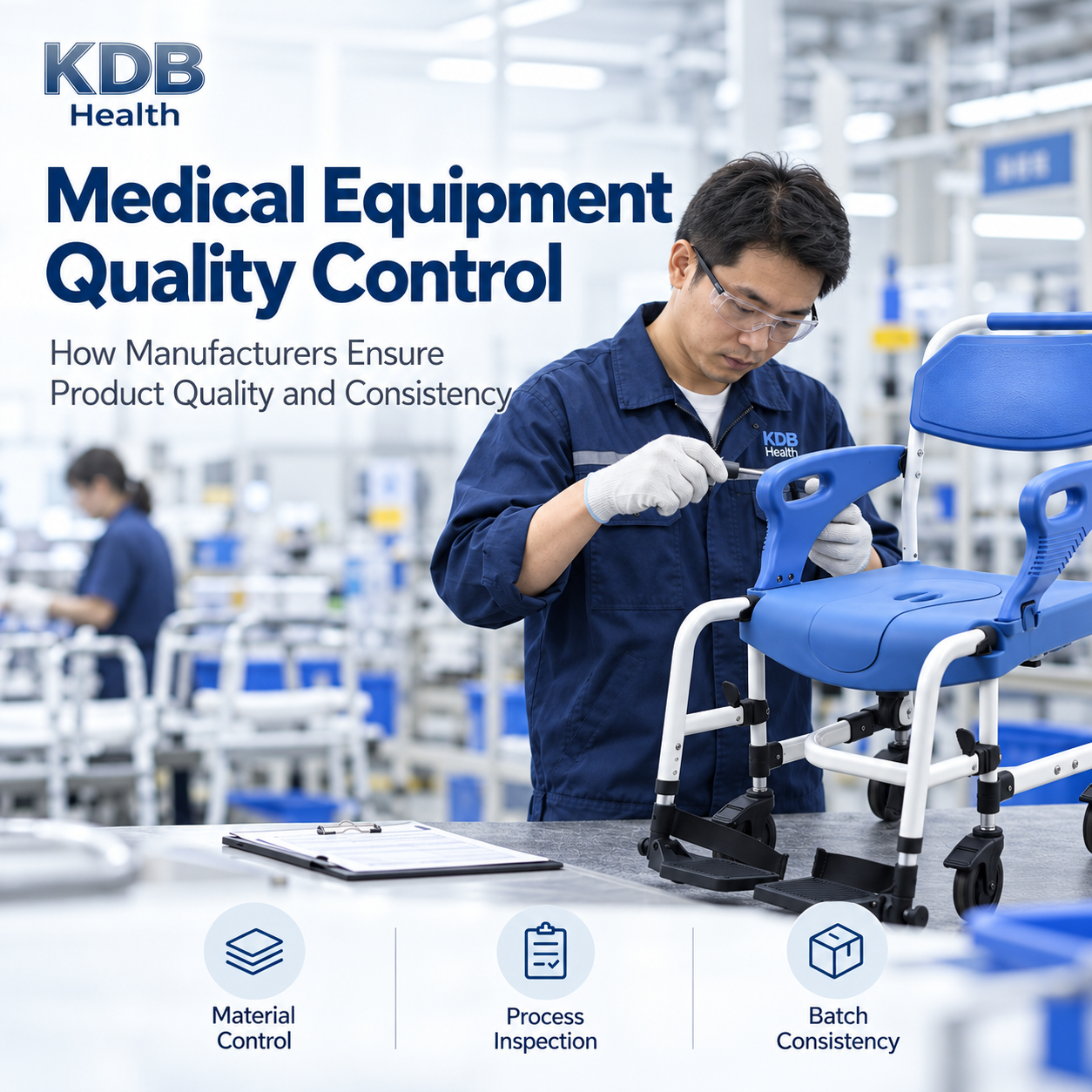
For medical equipment buyers, product quality is not only about whether the first sample looks good.
The more important question is whether the manufacturer can produce the same product consistently across repeated orders.
For rehabilitation equipment such as commode chairs, shower chairs, walkers, patient transfer equipment and bedside safety products, consistency depends on more than final inspection. It begins with material control and continues through production specifications, process inspection, assembly, packaging and quality records.
KDB Health works with medical brands, distributors, importers and project buyers that need reliable product quality across both initial orders and long-term purchasing programs.
This guide explains how a structured medical equipment quality-control system helps manufacturers reduce variation and maintain consistency from one production batch to the next.
1. Quality Starts With Clear Product Specifications
Consistent manufacturing begins before production starts.
The manufacturer and buyer should first agree on what the approved product actually is.
For standard and customized rehabilitation products, the production specification may include:
▪ Product dimensions
▪ Materials
▪ Components
▪ Weight capacity
▪ Adjustable functions
▪ Frame structure
▪ Casters or wheels
▪ Armrests and footrests
▪ Surface finish
▪ Accessories
▪ Labels
▪ Instruction manuals
▪ Packaging
▪ Inspection requirements
If these details are not clearly documented, different production teams may interpret the same order differently.
For customized products, an approved sample can also provide an important physical reference.
The goal is to establish one controlled product specification before mass production begins.
2. ISO 13485 Provides the Quality-Management Framework
A quality-management system helps manufacturers control how specifications, processes, inspection records and corrective actions are managed.
KDB Health operates under an ISO 13485 quality management system.
For professional buyers, the value of ISO 13485 is not simply the certificate itself.
What matters is whether the quality system is reflected in daily production activities such as:
▪ Incoming inspection
▪ In-process quality control
▪ Final inspection
▪ Non-conforming product control
▪ Document control
▪ Equipment calibration
▪ Corrective and preventive action
▪ Supplier management
▪ Quality records
▪ Complaint handling
A strong quality system creates a framework for repeatability.
It helps ensure that product quality is managed as a process rather than depending only on individual operator experience.
3. Incoming Material Control Reduces Variation Before Production
Finished-product consistency depends heavily on the consistency of incoming materials and components.
For rehabilitation equipment, these may include:
▪ Aluminum or steel tubing
▪ Plastic components
▪ Seats and backrests
▪ Casters and wheels
▪ Fasteners
▪ Armrest components
▪ Footrests
▪ Commode buckets
▪ Packaging materials
Incoming materials should be checked against the relevant specifications before entering production.
Depending on the component, inspection may include:
▪ Dimensions
▪ Appearance
▪ Material identification
▪ Component fit
▪ Surface condition
▪ Quantity
▪ Packaging
▪ Supplier information
If incoming materials do not meet requirements, the issue should be identified before those components are assembled into finished products.
This reduces the risk of discovering material-related problems late in production.
4. Approved Suppliers Are Part of Quality Control
A manufacturer cannot maintain consistent finished products if key component suppliers change frequently without control.
Supplier management is therefore an important part of quality consistency.
Manufacturers should evaluate whether key suppliers can provide:
▪ Stable material specifications
▪ Consistent dimensions
▪ Reliable delivery
▪ Repeatable component quality
▪ Appropriate documentation
▪ Corrective action when problems occur
For customized products, this becomes even more important.
A buyer may approve a particular caster, armrest, seat material or packaging component. If that component changes later without evaluation, the finished product may no longer match the approved sample.
Quality consistency therefore depends not only on the factory itself, but also on how the factory manages its supply chain.
5. In-Process Quality Control Prevents Defects From Moving Forward
Waiting until final inspection to discover production problems is inefficient.
In-process quality control allows manufacturers to identify issues while the product is still moving through production.
Depending on the rehabilitation product, inspection points may include:
▪ Frame dimensions
▪ Welding and connection areas
▪ Surface finish
▪ Component installation
▪ Adjustable mechanisms
▪ Folding mechanisms
▪ Casters and brakes
▪ Armrest movement
▪ Footrest operation
▪ Product assembly
▪ Appearance
These checks help prevent one process error from affecting an entire production batch.
For example, if an important frame dimension begins to drift outside the approved specification, identifying the issue during production allows corrective action before more units are assembled.
6. Fixtures, Tools and Controlled Processes Improve Repeatability
Product consistency does not depend only on inspection.
Manufacturing methods also need to be repeatable.
Fixtures, jigs, calibrated measuring equipment and standardized work instructions can help reduce variation between operators and production batches.
For rehabilitation equipment with metal frames and multiple components, controlled production methods may help maintain:
▪ Frame dimensions
▪ Component positioning
▪ Assembly alignment
▪ Hole locations
▪ Adjustable mechanisms
▪ Product symmetry
▪ Repeatable assembly
This is one reason engineering capability and production capability need to work together.
Buyers interested in how product design affects manufacturing consistency can also review our guide to engineering capability in rehabilitation equipment suppliers.
7. Final Inspection Confirms the Finished Product
After assembly is complete, finished products should be checked against the approved specification before packaging and shipment.
The inspection plan depends on the product and project requirements, but may include:
▪ Dimensions
▪ Appearance
▪ Assembly
▪ Adjustable functions
▪ Folding functions
▪ Casters and brakes
▪ Accessories
▪ Product labels
▪ Instruction manuals
▪ Packaging
▪ Shipping marks
▪ Other agreed functional requirements
For customized orders, the approved sample and confirmed specifications should be available as references.
If the buyer has specific pre-shipment inspection requirements, these should be agreed before production rather than introduced after the order is completed.
8. Product Testing Should Match the Product and Market
Not every rehabilitation product requires the same testing.
Testing should be based on the product type, intended use, applicable requirements and target market.
Depending on the product, evaluation may include areas such as:
▪ Stability
▪ Structural performance
▪ Weight capacity
▪ Folding mechanisms
▪ Adjustment functions
▪ Braking performance
▪ Casters and wheels
▪ Packaging performance
▪ Materials
▪ Product-specific functional requirements
For customized products, structural changes may also require additional engineering or testing evaluation.
KDB Health supports relevant product documentation and evaluation according to the specific product and project requirements.
The important principle is simple:
Testing should correspond to the actual product, not to a generic checklist applied to every medical device.
9. Sampling Plans Should Be Agreed With the Buyer
For mass production, professional buyers may use sampling inspection to evaluate finished goods before shipment.
The inspection method should be defined according to the product, order size, buyer requirements and purchasing agreement.
This may include:
▪ Sampling quantity
▪ Inspection items
▪ Acceptance criteria
▪ Critical requirements
▪ Functional checks
▪ Packaging checks
▪ Re-inspection procedures
If the buyer uses a third-party inspection company or its own AQL requirements, those requirements should be communicated before production.
The objective is not to apply one fixed AQL number to every product.
The objective is to establish a clear inspection standard that both buyer and manufacturer understand.
10. Traceability Helps Investigate Quality Problems
Even with a strong quality system, problems can still occur.
When they do, traceability helps the manufacturer determine what happened and which products may be affected.
Depending on the product and production system, traceability records may include:
▪ Production date
▪ Production batch
▪ Material or component information
▪ Inspection records
▪ Operators or production lines
▪ Approved specifications
▪ Packaging information
▪ Shipment records
The level of traceability should correspond to the product and applicable quality requirements.
For buyers, traceability provides confidence that quality issues can be investigated systematically rather than relying only on memory or informal communication.
11. Non-Conforming Products Must Be Controlled
A mature quality system does not assume that every product will always pass inspection.
The important question is how problems are handled when they occur.
Non-conforming products should be identified and separated to prevent them from moving forward unintentionally.
The manufacturer may need to determine whether the issue requires:
▪ Rework
▪ Re-inspection
▪ Component replacement
▪ Process adjustment
▪ Supplier feedback
▪ Engineering review
▪ Rejection
The decision should be documented according to the quality-management process.
This prevents rejected or questionable products from being mixed with accepted goods.
12. CAPA Turns Quality Problems Into Process Improvements
Corrective and Preventive Action, or CAPA, is an important part of continuous quality improvement.
When a recurring or significant problem occurs, the manufacturer should not simply repair the affected units.
The deeper objective is to understand why the problem happened.
A corrective process may include:
▪ Problem identification
▪ Root-cause investigation
▪ Immediate containment
▪ Corrective action
▪ Process improvement
▪ Verification of effectiveness
▪ Follow-up monitoring
For example, if the same assembly issue appears repeatedly, the solution may involve more than reworking finished products.
It may require a fixture change, component modification, work-instruction update or additional inspection point.
This is how quality systems improve over time.
13. Engineering Change Control Protects Batch Consistency
Product improvements are often necessary, but uncontrolled changes can create inconsistency.
If a component, dimension, material or structure changes, the manufacturer should determine whether the change affects the approved product.
Engineering change control may involve:
▪ Documenting the proposed change
▪ Evaluating the reason for the change
▪ Reviewing technical impact
▪ Reviewing production impact
▪ Updating drawings or specifications
▪ Confirming buyer approval when required
▪ Updating inspection requirements
This is especially important for OEM and ODM products.
A customized product may remain in production for years, so changes need to be controlled rather than introduced informally.
14. Packaging Is Part of Product Quality
Quality control does not end when the product passes functional inspection.
A correctly manufactured product can still arrive damaged if packaging is inadequate.
Packaging control may include:
▪ Carton specifications
▪ Product protection
▪ Accessory placement
▪ Product positioning
▪ Labels
▪ Instruction manuals
▪ Shipping marks
▪ Packaging quantity
▪ Carton appearance
For folding or partially disassembled rehabilitation products, packaging also needs to protect adjustable parts and components during transport.
Consistent packaging is particularly important for distributors and brands that sell through multiple markets or channels.
15. Repeat Orders Are the Real Test of Consistency
A supplier can produce one good sample.
The greater challenge is producing the same approved product repeatedly over time.
For repeat orders, the manufacturer should maintain control over:
▪ Product specifications
▪ Approved materials
▪ Drawings
▪ Components
▪ Colors and finishes
▪ Labels
▪ Manuals
▪ Packaging
▪ Inspection requirements
One useful question for professional buyers is:
If we reorder this product six months from now, how will you ensure that it matches the version we approved today?
The answer reveals a great deal about the manufacturer's quality and document-control systems.
For buyers conducting broader supplier due diligence, our medical equipment factory audit checklist provides a practical framework for evaluating quality systems, manufacturing, engineering and supply capabilities before cooperation.
16. Third-Party Inspection Can Add an Independent Verification Layer
Some buyers use independent inspection companies before shipment, particularly for larger orders, new suppliers or customized products.
A transparent manufacturer should be able to cooperate with agreed third-party inspection arrangements.
Depending on the buyer's requirements, the inspection may review:
▪ Quantity
▪ Appearance
▪ Dimensions
▪ Product functions
▪ Accessories
▪ Labels
▪ Packaging
▪ Shipping marks
Third-party inspection does not replace the manufacturer's own quality-control system.
It provides an additional verification layer for the buyer.
17. Quality Consistency Requires Cooperation Between Departments
Reliable product quality is rarely created by the QC department alone.
Engineering, purchasing, production, quality and sales all influence the final product.
Engineering defines how the product should be built.
Purchasing controls materials and components.
Production controls how the product is manufactured.
Quality verifies whether requirements are met.
Sales and project teams ensure buyer requirements are communicated correctly.
When these functions work from the same approved specification, product consistency becomes much easier to maintain.
Frequently Asked Questions
What is medical equipment quality control?
Medical equipment quality control includes the processes used to verify that materials, production, finished products and packaging meet approved specifications and applicable requirements.
Why is ISO 13485 important for medical equipment manufacturers?
ISO 13485 provides a structured quality-management framework for medical-device-related organizations. Buyers should evaluate not only whether a supplier holds the certification, but also how the quality system is implemented in actual production.
How can manufacturers maintain consistency between production batches?
Consistency depends on controlled specifications, approved materials, standardized processes, in-process inspection, final inspection, change control and quality records.
Is final inspection enough to guarantee product quality?
No. Final inspection is only one stage. Quality should also be controlled through incoming materials, manufacturing processes, engineering specifications and supplier management.
Does every rehabilitation product use the same testing standard?
No. Testing requirements depend on the product, intended use, destination market and applicable requirements.
Can buyers request third-party inspection before shipment?
Yes. Professional buyers may arrange independent inspection according to the purchasing agreement and project requirements.
How should customized products be controlled during repeat production?
The manufacturer should maintain approved specifications, drawings, materials, components, packaging and inspection criteria. Any significant engineering change should be evaluated before implementation.
Quality Should Be Designed Into the Process
For medical brands, distributors, importers and project buyers, product consistency is not created by one final inspection.
It is created through a connected system of material control, engineering specifications, process inspection, finished-product verification, document control and continuous improvement.
KDB Health operates under an ISO 13485 quality management system and supports quality control across rehabilitation and homecare product manufacturing.
Buyers can also explore our bathroom safety solutions to review product categories available for distribution, private label and project sourcing.
Contact KDB Health for product catalogs, quality-management information, pricing, OEM/ODM evaluation or a customized rehabilitation equipment solution.
Table of Contents
- 1. Quality Starts With Clear Product Specifications
- 2. ISO 13485 Provides the Quality-Management Framework
- 3. Incoming Material Control Reduces Variation Before Production
- 4. Approved Suppliers Are Part of Quality Control
- 5. In-Process Quality Control Prevents Defects From Moving Forward
- 6. Fixtures, Tools and Controlled Processes Improve Repeatability
- 7. Final Inspection Confirms the Finished Product
- 8. Product Testing Should Match the Product and Market
- 9. Sampling Plans Should Be Agreed With the Buyer
- 10. Traceability Helps Investigate Quality Problems
- 11. Non-Conforming Products Must Be Controlled
- 12. CAPA Turns Quality Problems Into Process Improvements
- 13. Engineering Change Control Protects Batch Consistency
- 14. Packaging Is Part of Product Quality
- 15. Repeat Orders Are the Real Test of Consistency
- 16. Third-Party Inspection Can Add an Independent Verification Layer
- 17. Quality Consistency Requires Cooperation Between Departments
-
Frequently Asked Questions
- What is medical equipment quality control?
- Why is ISO 13485 important for medical equipment manufacturers?
- How can manufacturers maintain consistency between production batches?
- Is final inspection enough to guarantee product quality?
- Does every rehabilitation product use the same testing standard?
- Can buyers request third-party inspection before shipment?
- How should customized products be controlled during repeat production?
- Quality Should Be Designed Into the Process