 EN
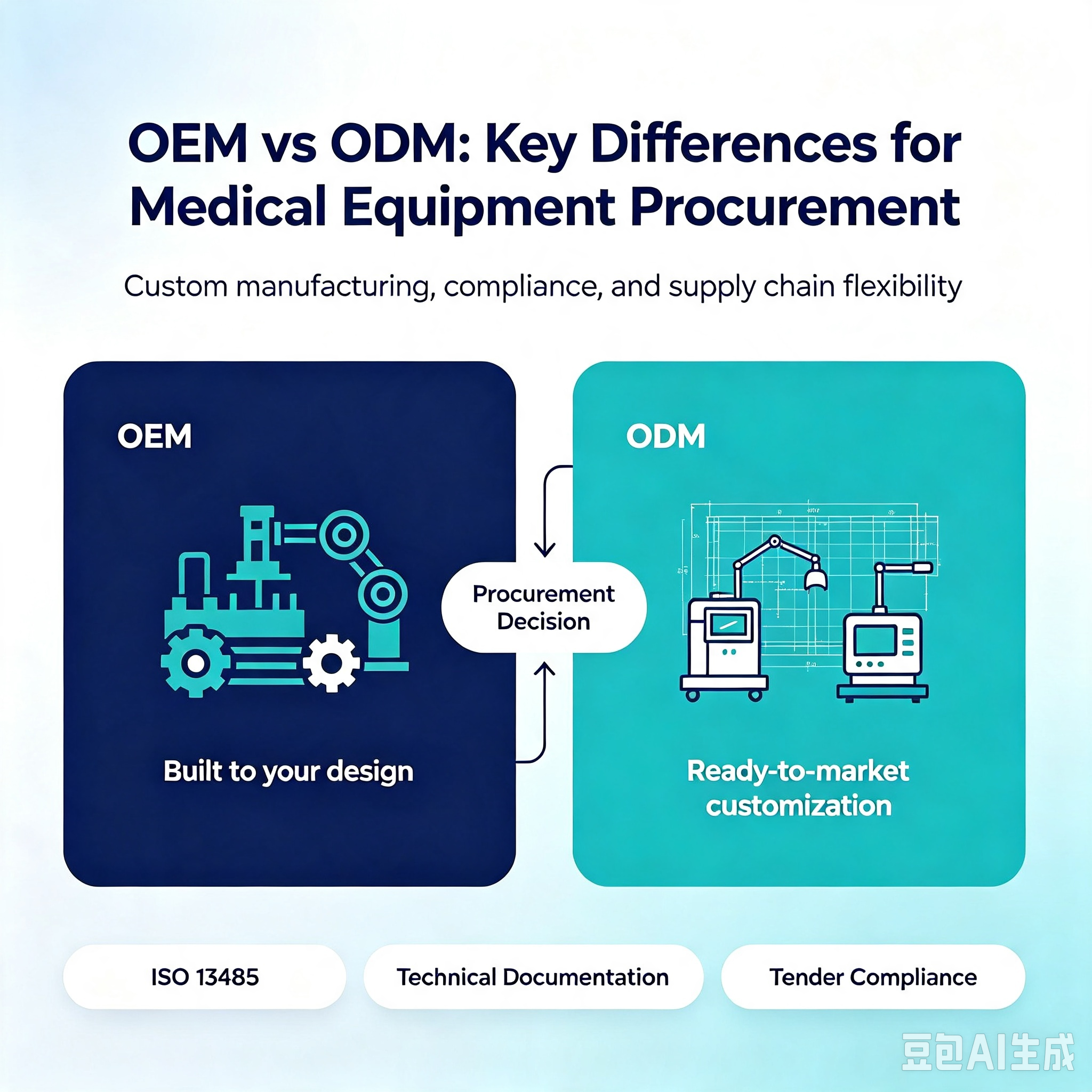
When healthcare brands and distributors begin a new product project, one of the first questions is often whether to choose OEM or ODM manufacturing.
The decision affects much more than the product logo. It can influence development investment, customization depth, tooling ownership, market-entry time, minimum order quantity and long-term product control.
However, OEM and ODM are not always as clearly separated as many sourcing guides suggest. Different manufacturers may use the terms in different ways, and many rehabilitation equipment projects fall somewhere between the two.
A practical decision should therefore begin with the actual project scope—not the label used by the supplier.
This guide explains the differences between private-label, ODM and OEM medical equipment manufacturing and helps healthcare brands, distributors, importers and e-commerce businesses choose the most appropriate route.
OEM and ODM Terms Can Be Misleading
In a simplified definition:
▪ OEM manufacturing normally begins with buyer-defined specifications, drawings or product requirements.
▪ ODM manufacturing normally begins with an existing product design or manufacturing platform developed by the supplier.
In practice, the boundary is less precise.
An OEM manufacturer may contribute engineering, material recommendations and design-for-manufacturing support. An ODM project may involve more than changing the logo or color; it can include structural modifications, new components and dedicated tooling.
Before selecting a manufacturing model, buyers should confirm:
▪ Who provides the original design?
▪ Who completes the engineering work?
▪ Which existing molds or components will be used?
▪ Who pays for new tooling?
▪ Who owns the drawings and molds?
▪ Can the same product be supplied to other customers?
▪ Which changes require buyer approval?
▪ Who is responsible for market-specific documentation?
These questions are more useful than relying on the words OEM or ODM alone.
Three Practical Medical Equipment Manufacturing Models
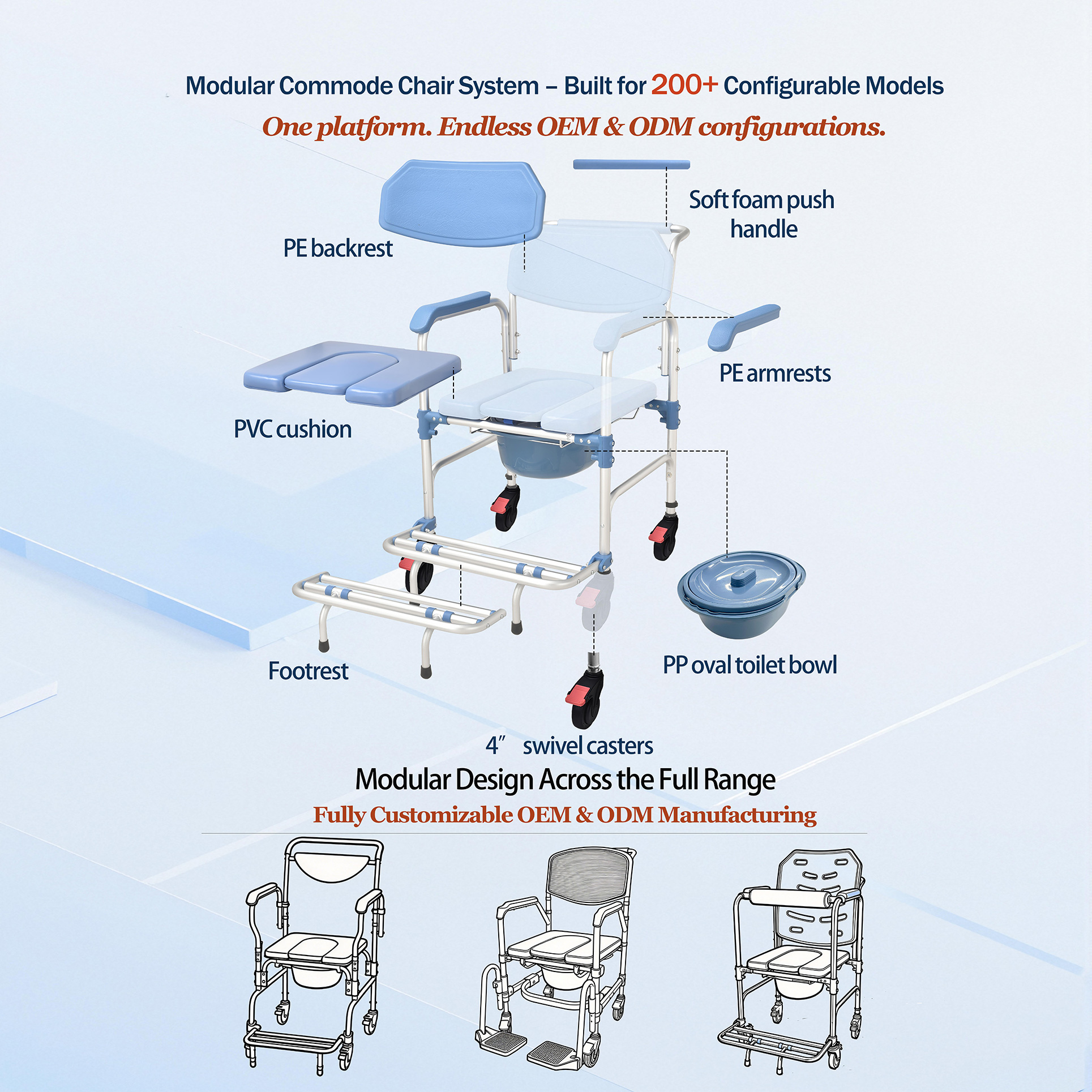
Most rehabilitation and home healthcare equipment projects can be divided into three practical cooperation models.
1. Standard Product and Private Label
Private-label manufacturing begins with an existing product that requires little or no structural modification.
The buyer may customize:
▪ Product logo
▪ Label information
▪ Instruction manual
▪ Packaging artwork
▪ Carton markings
▪ Product color
▪ Accessory combination
This model is suitable for buyers who want to launch products quickly without investing immediately in new engineering or tooling.
It is often used by:
▪ Healthcare distributors adding a new category
▪ Chain retailers developing store brands
▪ E-commerce sellers testing market demand
▪ Importers expanding their product portfolios
▪ Regional brands entering a new market
Private label is sometimes described as ODM, but the customization depth is normally more limited than a structural ODM project.
2. Platform-Based ODM
Platform-based ODM uses an existing manufacturer-developed product as the engineering foundation.
Instead of creating the entire product from zero, the buyer selects a suitable base model and modifies the parts that matter to the target market.
Possible ODM modifications include:
▪ Seat dimensions
▪ Product height
▪ Armrest or backrest configuration
▪ Casters and braking systems
▪ Footrests and accessories
▪ Folding or disassembly structure
▪ Frame materials and finishes
▪ Packaging dimensions
▪ Private-label appearance
▪ Market-specific product combinations
For example, a healthcare brand may begin with an existing wheeled commode chair but request different casters, a revised footrest, more compact packaging and brand-specific colors.
This approach can create meaningful differentiation while using an established product platform.
Platform-based ODM is often suitable for growing brands that need more than private labeling but are not ready to fund a completely new product.
KDB Health explains the development steps in its custom rehabilitation equipment ODM development guide.
3. Buyer-Led OEM and Custom Development
Buyer-led OEM development normally begins with a buyer-owned concept, technical specification, drawing or clearly defined product requirement.
The manufacturer may provide:
▪ Engineering feasibility assessment
▪ Product structure development
▪ Design-for-manufacturing recommendations
▪ Material and component selection
▪ CAD drawings
▪ Prototype development
▪ New molds, jigs or fixtures
▪ Testing and production preparation
▪ Pilot and mass production
This route provides greater control and differentiation, but it also requires more investment, technical decisions and development management.
OEM development is usually more appropriate when the product’s competitive advantage depends on:
▪ A new mechanical structure
▪ Proprietary dimensions or ergonomics
▪ A unique folding or adjustment mechanism
▪ Specialized user requirements
▪ Exclusive components
▪ Long-term sales volume that can support the development investment
The complete pathway is explained in our guide to the medical equipment product development process.
OEM vs ODM Medical Equipment: Key Differences
| Factor | Private Label | Platform-Based ODM | Buyer-Led OEM |
|---|---|---|---|
| Starting point | Existing finished product | Existing engineering platform | Buyer concept, specifications or drawings |
| Customization depth | Logo, color, labels and packaging | Functional and structural modifications | New or substantially customized product |
| Initial investment | Generally lower | Moderate, depending on changes | Generally higher |
| New tooling | Usually not required | May be partially required | Often required |
| Development time | Usually shortest | Depends on modification scope | Usually longest |
| MOQ | Often more flexible | Depends on components and changes | Usually influenced by tooling and production economics |
| Product exclusivity | Limited unless agreed | Can apply to selected modifications | Can be broader if contractually defined |
| IP ownership | Existing design normally belongs to supplier | Must be defined for new modifications | Must be defined by contract |
| Technical workload | Relatively limited | Shared between buyer and manufacturer | Higher buyer and manufacturer involvement |
| Best suited for | Market testing and portfolio expansion | Brand differentiation using an existing platform | Proprietary or highly differentiated products |
These are general patterns rather than fixed rules. The final arrangement depends on the product, manufacturer and written agreement.
When Should You Choose Private Label?
Private label may be the most practical starting point when:
▪ You are entering a new product category.
▪ You want to test demand before making a large development investment.
▪ The standard product already meets most customer requirements.
▪ Your main differentiation comes from branding, packaging, service or distribution.
▪ You need to manage initial inventory risk.
▪ Your team does not yet have dedicated engineering resources.
Private labeling is not necessarily a weak product strategy.
For many distributors and retail brands, the initial objective is to learn which price points, product configurations and packaging formats customers prefer. That market information can later support a more advanced ODM project.
Growing brands can also review our guide to low-MOQ medical equipment sourcing.
When Does Platform-Based ODM Make Sense?
ODM is suitable when an existing product provides a useful starting point, but the standard configuration does not fully support the brand’s market position.
Consider platform-based ODM when:
▪ You need functional differentiation rather than only a new logo.
▪ The manufacturer already has a relevant product structure.
▪ Your target market requires different dimensions or accessories.
▪ You want to reduce unnecessary development investment.
▪ You need a faster route than complete new-product development.
▪ You plan to build a coordinated product family.
▪ Your order volume can support modified components or packaging.
The buyer should still evaluate which changes are commercially worthwhile.
A feature that appears attractive may increase tooling cost, carton size, assembly complexity or quality-control requirements. A capable ODM manufacturer should explain these trade-offs instead of accepting every requested modification without assessment.
When Is Buyer-Led OEM Development Justified?
Full OEM or custom development is more appropriate when the product concept cannot be achieved through an existing platform.
Choose this route when:
▪ Your brand owns a defined product concept or drawing.
▪ The product requires a new structure or mechanism.
▪ Product exclusivity is commercially important.
▪ You have a clear target price and forecast volume.
▪ Your team can participate in technical reviews and sample approval.
▪ You can support the required tooling and testing investment.
▪ The expected product lifecycle justifies the development cost.
Full OEM development should not begin with a vague request such as “make a better commode chair.”
The project brief should clearly describe:
▪ Target market
▪ Intended users
▪ Required functions
▪ Critical dimensions
▪ Materials
▪ Weight-capacity expectations
▪ Packaging requirements
▪ Target purchasing price
▪ Estimated annual volume
▪ Required documentation
▪ Expected launch schedule
A clearer product brief enables a more reliable feasibility assessment and quotation.
Product Ownership Must Be Defined in Writing
One of the most common misunderstandings in OEM and ODM cooperation concerns intellectual property.
Using the word OEM does not automatically mean the buyer owns every drawing, mold and component. Similarly, an ODM manufacturer may agree to protect buyer-funded modifications or market-specific configurations.
Before development begins, the agreement should define:
▪ Ownership of the original design
▪ Ownership of new engineering drawings
▪ Ownership of molds, fixtures and tooling
▪ Use of buyer-funded components
▪ Product exclusivity
▪ Exclusive countries or sales channels
▪ Confidentiality obligations
▪ Conditions for tooling storage and maintenance
▪ Rights after the cooperation ends
▪ Whether the manufacturer may supply similar versions to other customers
If product exclusivity is important, it must be described clearly. Phrases such as “exclusive product” are not sufficient without defining the product, market, time period and purchasing obligations.
Existing ODM Products Do Not Automatically Guarantee Market Access
Using an existing ODM platform may reduce some development work, but it does not automatically make the buyer compliant in every destination market.
The parties still need to confirm:
▪ Exact product model and intended use
▪ Target country or region
▪ Product classification
▪ Legal manufacturer information
▪ Importer or representative responsibilities
▪ Labels and instructions for use
▪ Available declarations and reports
▪ Registration or listing requirements
▪ Language requirements
▪ Whether customization affects existing documentation
▪ Post-market and complaint responsibilities
ISO 13485 relates to a quality management system. CE marking, FDA establishment registration, device listing and other regulatory procedures have different purposes and should not be described collectively as product certification.
Documentation should always be evaluated for the exact model, configuration and destination market.
Development Time Depends on Scope, Not Just OEM or ODM
ODM is often faster than developing a completely new product, but neither model has a guaranteed development schedule.
A private-label project may move relatively quickly if it only involves existing products and confirmed packaging.
An ODM or OEM project may take longer when it requires:
▪ Structural modifications
▪ New molds or components
▪ Multiple prototype rounds
▪ Material testing
▪ Stability or load verification
▪ Packaging development
▪ Documentation updates
▪ Buyer review and approval
▪ Supply-chain qualification
At KDB Health, samples for qualified projects may begin from approximately 15 days. Actual timing depends on the product, modification scope, tooling requirements and component availability.
Mass-production timing is confirmed separately after sample approval and order requirements are finalized.
MOQ Depends on What Is Being Customized
ODM does not always mean low MOQ, and OEM does not always require extremely large orders.
MOQ is affected by:
▪ Existing or newly developed tooling
▪ Material purchasing quantities
▪ Plastic and metal components
▪ Custom colors
▪ Printing and packaging requirements
▪ Production setup
▪ Testing requirements
▪ Number of product variants
▪ Forecast order volume
A logo applied to an existing product may have a different MOQ from a custom-color plastic component. A new frame structure may require a different commercial arrangement from a packaging-only project.
For selected existing models, customization may begin from approximately 50 pieces. Many projects require higher quantities, and the final MOQ must be evaluated according to the exact configuration.
A Hybrid Strategy Often Works Best
Healthcare brands do not need to use the same manufacturing model for every product.
A practical product-development path may be:
Stage 1: Launch with private label
Select an existing product, establish branding and test customer demand.
Stage 2: Improve through ODM
Use sales feedback, returns and distributor comments to identify meaningful modifications.
Stage 3: Develop a more exclusive product
After demand becomes clearer, invest in dedicated components, tooling or a buyer-led OEM design.
This approach allows the brand to learn before committing substantial capital.
It can also help prevent over-engineering. Instead of adding features based on assumptions, the brand develops the product around real market feedback.
What Should You Confirm Before Requesting a Quotation?
A manufacturer cannot accurately assess an OEM or ODM project without sufficient information.
Include the following in your enquiry:
▪ Target country or market
▪ Buyer type and sales channel
▪ Product category
▪ Existing model or reference product
▪ Required modifications
▪ Product positioning
▪ Estimated initial quantity
▪ Expected annual volume
▪ Packaging requirements
▪ Branding requirements
▪ Required documentation
▪ Target launch date
▪ Target purchasing price, if available
For a completely new product, also provide sketches, drawings, photographs or a written product brief.
This information enables the manufacturer to recommend whether private label, ODM or OEM is the most practical route.
How to Evaluate an OEM or ODM Manufacturer
Regardless of the manufacturing model, buyers should evaluate whether the partner can support the product after the first sample.
Important areas include:
▪ Relevant category experience
▪ Internal engineering resources
▪ Existing product platforms
▪ Prototype capability
▪ Quality management
▪ Manufacturing capacity
▪ Sample-to-production control
▪ Product change management
▪ Documentation support
▪ Communication and corrective action
▪ Repeat-order consistency
KDB Health’s guide to medical equipment quality control explains how specifications, materials, production controls and inspections affect batch consistency.
A long-term partner should also support future product updates and supply continuity. Read more about building a long-term ODM manufacturing partnership.
How KDB Health Supports OEM, ODM and Private-Label Projects
KDB Health works with healthcare brands, distributors, importers, chain retailers, e-commerce businesses and project buyers.
Our medical equipment OEM and ODM solutions include:
▪ Existing product sourcing
▪ Private-label branding and packaging
▪ Product color and accessory customization
▪ Existing-platform ODM modifications
▪ Product structure optimization
▪ New mold and component development
▪ Prototype and sample development
▪ Pilot and mass-production support
KDB Health has more than 14 years of rehabilitation equipment experience, an approximately 18,000-square-meter manufacturing facility, an ISO 13485-certified quality management system, a 12-member product development team and more than 500 existing molds.
Our rehabilitation equipment product portfolio includes commode chairs, shower chairs, bathroom safety equipment, patient transfer products, bedside safety products and walking aids.
Each project is evaluated according to the product, destination market, customization depth, documentation requirements and estimated order volume.
Frequently Asked Questions
Is private label the same as ODM?
Not always. Private label usually involves branding and packaging an existing product. ODM may involve functional, structural or component changes based on an existing manufacturer-developed platform.
Who owns the mold in an OEM project?
Mold ownership depends on the commercial agreement. Paying a development fee does not automatically determine ownership unless the contract clearly states it.
Does an ODM product automatically meet my market requirements?
No. Compliance and documentation must be confirmed for the exact model, configuration and destination market. Product modifications may also affect existing documents.
Can I start with ODM and develop an exclusive product later?
Yes. Many brands begin with an existing platform, collect market feedback and then invest in more substantial modifications or a dedicated product.
Which model normally offers a lower MOQ?
Existing products and private-label projects usually provide greater MOQ flexibility. New components, custom colors, structural modifications and tooling may increase the required quantity.
How long does an ODM sample take?
Timing depends on the modification scope. For qualified projects, KDB Health may support sample development from approximately 15 days. New tooling or structural development may require additional time.
What should I provide when starting an OEM or ODM enquiry?
Provide the target market, required product, modifications, estimated quantity, packaging requirements, documentation needs and expected launch date. Drawings, photographs and reference products are helpful for custom projects.
Conclusion
The right choice is not simply OEM or ODM.
Brands should first decide how much product control, differentiation, investment and development responsibility the project requires.
Private label offers an efficient way to test a market. Platform-based ODM supports product differentiation without beginning entirely from zero. Buyer-led OEM development provides greater control when a proprietary product can justify the additional investment.
A manufacturer should help buyers select the most practical route—not push every project into the most expensive development model.
To request a catalog, discuss private-label options or receive an OEM/ODM project evaluation, contact KDB Health.
Applying the Choice to Hospital Procurement
A hospital group standardizing equipment across facilities should first document the clinical and operational requirements, approved configuration and change-control process. An existing supplier platform may be practical when it meets those requirements. Buyer-led development may be justified where a defined requirement cannot be met by an available model.
In either case, confirm technical review, sample acceptance, documentation and post-market responsibilities explicitly. Neither the OEM nor ODM label automatically allocates intellectual-property rights, makes a product compliant or guarantees a launch date. The approved specification and written agreements should govern the project.
Table of Contents
- OEM and ODM Terms Can Be Misleading
- Three Practical Medical Equipment Manufacturing Models
- OEM vs ODM Medical Equipment: Key Differences
- When Should You Choose Private Label?
- When Does Platform-Based ODM Make Sense?
- When Is Buyer-Led OEM Development Justified?
- Product Ownership Must Be Defined in Writing
- Existing ODM Products Do Not Automatically Guarantee Market Access
- Development Time Depends on Scope, Not Just OEM or ODM
- MOQ Depends on What Is Being Customized
- A Hybrid Strategy Often Works Best
- What Should You Confirm Before Requesting a Quotation?
- How to Evaluate an OEM or ODM Manufacturer
- How KDB Health Supports OEM, ODM and Private-Label Projects
-
Frequently Asked Questions
- Is private label the same as ODM?
- Who owns the mold in an OEM project?
- Does an ODM product automatically meet my market requirements?
- Can I start with ODM and develop an exclusive product later?
- Which model normally offers a lower MOQ?
- How long does an ODM sample take?
- What should I provide when starting an OEM or ODM enquiry?
- Conclusion
- Applying the Choice to Hospital Procurement