
 EN
EN
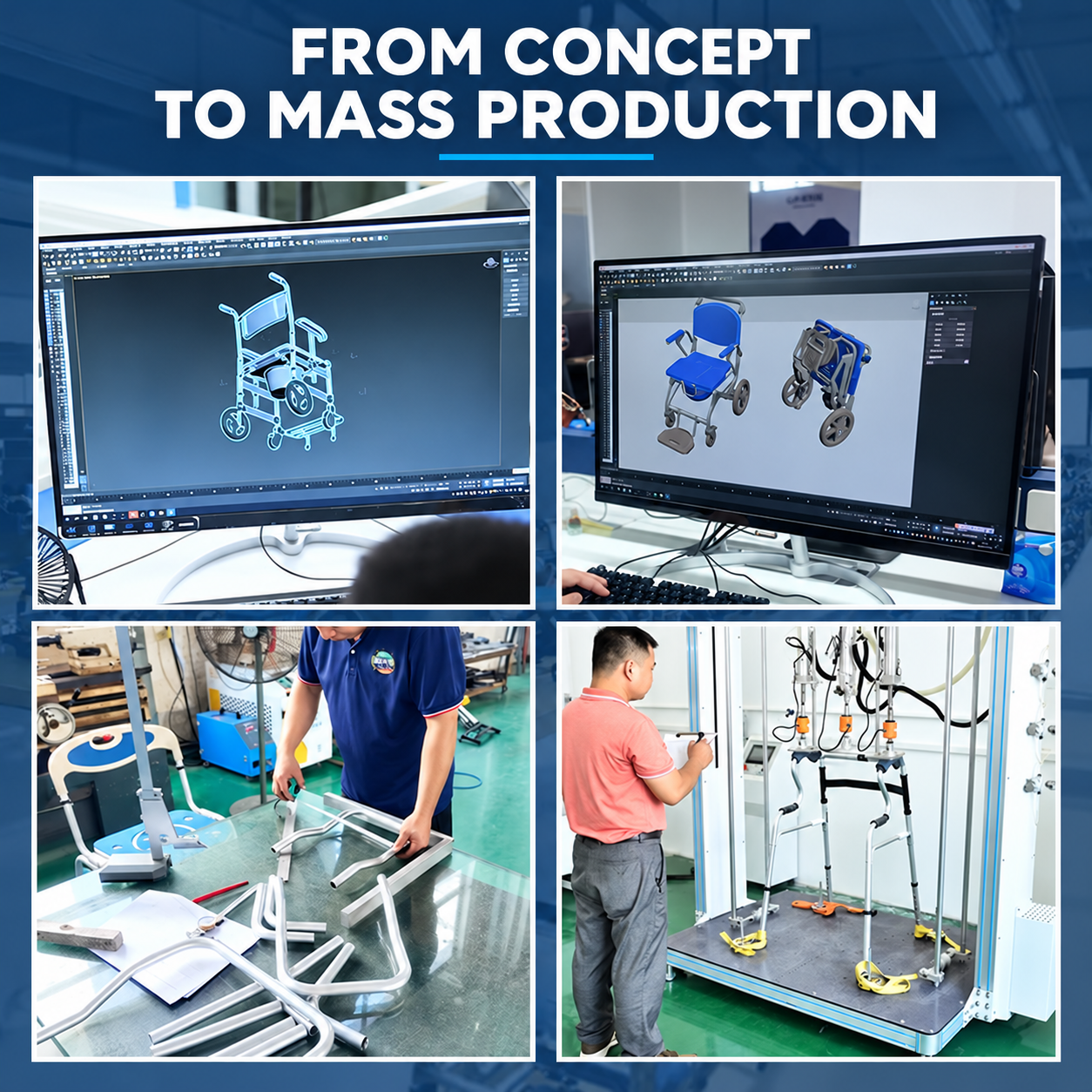
Developing a rehabilitation or homecare product involves much more than turning a sketch into a physical item.
For healthcare brands, distributors and product development teams, a successful project must balance user needs, product safety, market positioning, manufacturing feasibility, regulatory requirements and future production consistency.
A product may look promising at the concept stage but become difficult to manufacture, test, package or scale if these requirements are not considered early enough.
This guide explains the medical equipment product development process, from the initial market brief through engineering, prototypes, validation, pilot production and full-scale manufacturing.
1. Define the Market Need and Intended Use
Product development should start with the problem the product is expected to solve, not with a list of features.
For rehabilitation equipment such as commode chairs, shower chairs, patient transfer equipment, bedside rails and walking aids, the development team should first define:
▪ Target country or region
▪ Intended user group
▪ Primary sales channel
▪ Intended care environment
▪ Product purpose and expected functions
▪ Target price range
▪ Initial and future order quantities
▪ Applicable market-access requirements
A product intended for institutional procurement may have different priorities from one developed for e-commerce or homecare distribution.
Hospital and nursing-home buyers may prioritize durability, cleaning access, standardized configurations and replacement parts. E-commerce brands may focus more heavily on compact packaging, straightforward assembly, visual differentiation and product features that can be communicated clearly online.
Defining these requirements early prevents the project from developing into a product that is technically possible but commercially unsuitable.
2. Convert User Needs into Measurable Design Inputs
After the market opportunity has been defined, general ideas must be converted into specific product requirements.
A statement such as “the chair should be safer” is not precise enough for engineering. The development team needs to determine what safety means for that particular product.
Design inputs may cover:
▪ Intended function
▪ Overall dimensions
▪ Seat width and height
▪ Target load capacity
▪ Frame material
▪ Stability requirements
▪ Wheel and brake configuration
▪ Folding or adjustment mechanisms
▪ Armrest and footrest structures
▪ Cleaning and maintenance needs
▪ Packaging limitations
▪ Labeling and instruction requirements
▪ Applicable technical standards
These inputs should be measurable, internally consistent and linked to the product’s intended use.
FDA design-control guidance similarly distinguishes between design inputs, design outputs, verification and validation. Design inputs describe what the product must achieve, while later stages confirm whether the design meets those requirements and the needs of its intended users.
At KDB Health, the product-development team works with buyers to clarify these requirements before committing resources to drawings, prototypes or tooling.
3. Evaluate Technical and Commercial Feasibility
Not every requested feature should move directly into development.
Before engineering begins, the manufacturer should evaluate whether the concept is technically feasible, commercially realistic and suitable for repeat production.
The feasibility review may consider:
▪ Whether an existing product platform can be adapted
▪ Whether new structural development is required
▪ Availability of suitable materials and components
▪ Tooling requirements
▪ Expected development cost
▪ Target purchasing price
▪ Estimated order volume
▪ Testing and documentation needs
▪ Packaging and loading efficiency
▪ Intellectual-property considerations
▪ Future production scalability
This stage helps determine whether the project should use an existing model, modify an established platform or proceed as a new ODM development.
Using an existing structure may shorten the development cycle and reduce tooling investment. A new product can offer greater differentiation but normally requires more engineering, testing, tooling and commercial commitment.
Buyers considering these options can review our guide to OEM and ODM commode chair development for medical brands.
4. Develop the Engineering Design
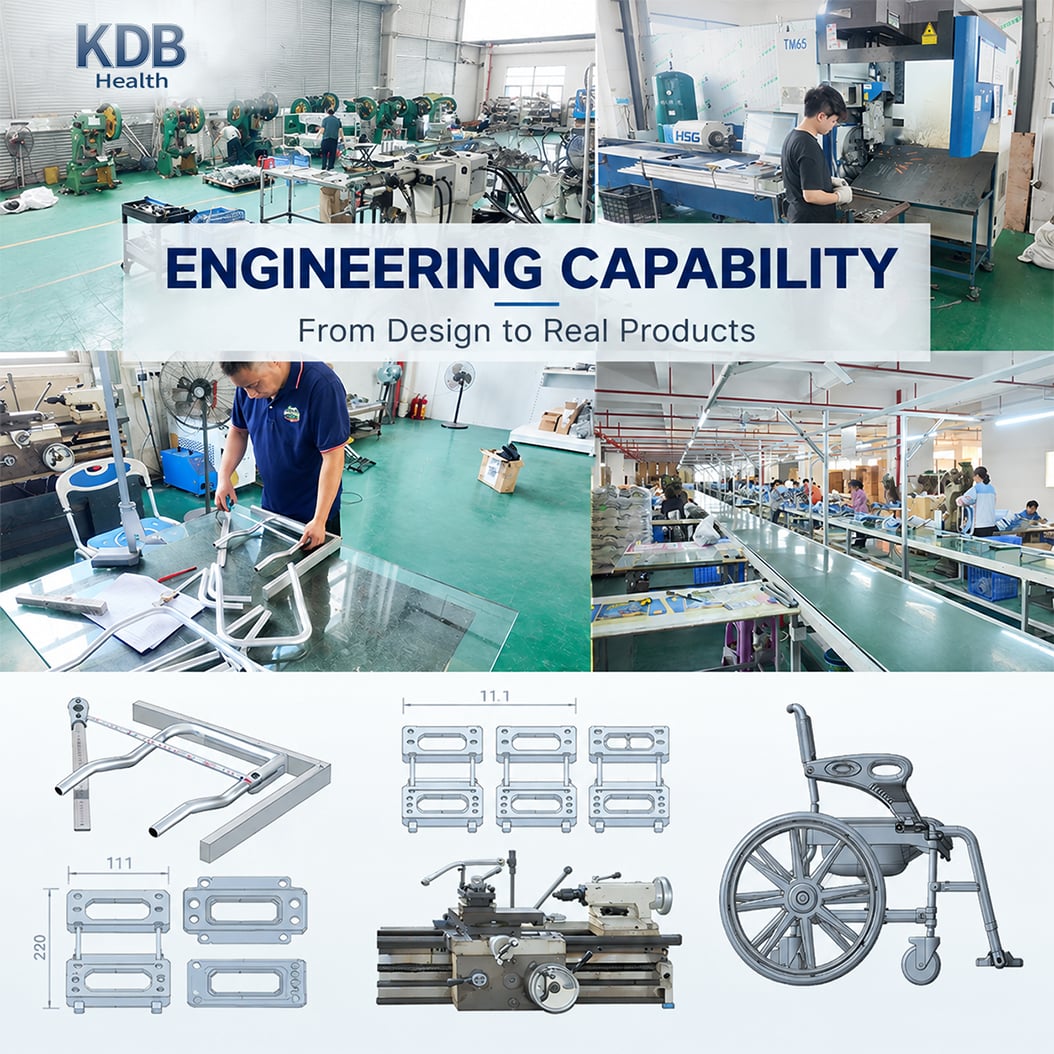
Once the concept and requirements are approved, engineers begin translating the product brief into a controlled design.
Depending on the project, engineering work may include:
▪ Two-dimensional drawings
▪ Three-dimensional CAD models
▪ Product dimensions and tolerances
▪ Material specifications
▪ Component selection
▪ Structural calculations
▪ Folding and locking mechanisms
▪ Wheel and brake arrangements
▪ Assembly methods
▪ Packaging considerations
▪ Preliminary risk analysis
For a commode or shower chair, changing one dimension can influence several other parts of the product.
A wider seat may require changes to the frame, cross-bracing, packaging and loading quantity. A different wheel may affect overall height, maneuverability, brake position and stability. A new folding structure may introduce additional joints, pinch points or inspection requirements.
Engineering decisions should therefore be evaluated as part of the complete product system.
This is also where design for manufacturing becomes important. A product should not only perform as intended; it should also be possible to manufacture, assemble, inspect and reproduce consistently.
Our article on engineering capability in rehabilitation equipment suppliers explains why this capability matters when buyers require more than standard catalog products.
5. Build and Review the Prototype
A prototype turns the controlled design into a physical product that can be inspected and evaluated.
The first sample is not automatically the final production version. Its purpose is to identify whether the proposed design works as intended and where improvements are still required.
Prototype evaluation may include:
▪ Overall dimensions
▪ Product appearance
▪ Assembly sequence
▪ Frame alignment
▪ Folding and adjustment functions
▪ Armrest and footrest operation
▪ Wheel and brake positioning
▪ Bucket or seat installation
▪ Accessibility for cleaning
▪ Packaging arrangement
▪ Label and instruction placement
▪ Initial stability and load assessment
Comments should be documented clearly so that the next version reflects approved changes rather than informal verbal instructions.
For selected existing platforms and standard modifications, KDB Health can typically prepare a sample in approximately 15 days. Completely new structures, new molds or complex mechanisms may require a longer development cycle.
The sample schedule should therefore be confirmed after the engineering scope has been reviewed.
6. Verify the Design and Validate Its Intended Use
Verification and validation answer two different questions.
Design verification asks:
 Did we design the product according to the approved specifications?
Design validation asks:
Does the resulting product meet the needs of the intended users and intended use?
Depending on the product, risk analysis and destination market, verification activities may include:
▪ Dimensional inspection
▪ Static-load testing
▪ Stability testing
▪ Durability or cycle testing
▪ Brake and caster evaluation
▪ Folding and locking tests
▪ Corrosion-related testing
▪ Material evaluation
▪ Packaging testing
▪ Label and instruction review
Not every test applies to every product. The testing plan should be based on the device configuration, intended use, identified risks, applicable standards and target market.
Validation may use production-equivalent units under defined actual or simulated conditions. It should confirm that the complete product, including relevant packaging, labeling and instructions, is suitable for its intended purpose.
Product managers should not confuse a successful prototype demonstration with completed verification and validation.
7. Prepare Regulatory and Technical Documentation
Regulatory planning should begin during development rather than after the product has been completed.
The documentation required depends on:
▪ Target country
▪ Intended use
▪ Product classification
▪ Legal manufacturer arrangement
▪ Product claims
▪ Branding structure
▪ Applicable standards
▪ Product configuration
For the EU market, relevant work may include classification, risk management, technical documentation, clinical evaluation, labeling, post-market planning and an EU Declaration of Conformity under the applicable requirements of Regulation (EU) 2017/745.
For the United States, the manufacturer and importer must determine the correct FDA classification, product code, registration, listing, quality-system and premarket requirements for the particular device.
FDA’s Quality Management System Regulation took effect on February 2, 2026 and incorporates ISO 13485:2016 by reference together with additional FDA requirements.
ISO 13485 certification demonstrates that an organization operates a medical-device quality-management system within its certified scope. It is not, by itself, a product approval or proof that every product meets the requirements of every market.
KDB Health coordinates available documentation according to the model, configuration and destination market. Buyers should identify their target market at the start of the project so documentation requirements can be evaluated before packaging and production are finalized.
8. Finalize Tooling and Pilot Production
After the design and prototype have been approved, the project moves toward production preparation.
Depending on the product, this stage may involve:
▪ Production molds
▪ Welding fixtures
▪ Bending fixtures
▪ Assembly jigs
▪ Inspection gauges
▪ Work instructions
▪ Inspection criteria
▪ Packaging specifications
▪ Approved component lists
▪ Supplier and material confirmation
A pilot or pre-production run helps determine whether the approved design can be reproduced using the intended materials, tooling, workers and production sequence.
The team should compare pilot units with the approved specifications and sample. Any problem involving fit, finish, assembly, function, labeling or packaging should be corrected before full production begins.
Process validation is required where the result of a manufacturing process cannot be fully verified through subsequent inspection and testing. The validation approach should match the process and applicable quality-system requirements rather than applying the same qualification terminology mechanically to every production step.
9. Transfer the Approved Design to Manufacturing
Design transfer converts engineering information into the documents and controls required by production.
Before mass production, the manufacturing team should have access to controlled versions of:
▪ Product drawings
▪ Material specifications
▪ Bill of materials
▪ Approved samples
▪ Assembly instructions
▪ Inspection standards
▪ Testing requirements
▪ Label artwork
▪ User instructions
▪ Packaging specifications
▪ Change records
This step is particularly important for OEM and ODM projects. Without clear design-transfer records, the bulk order may differ from the approved sample even when the changes appear small.
A strong development partner should maintain continuity between engineering, purchasing, production and quality teams.
10. Control Mass Production and Product Consistency
Once production begins, the focus changes from developing one successful sample to reproducing the approved product consistently.
Quality control may include:
▪ Incoming-material inspection
▪ First-article confirmation
▪ In-process checks
▪ Welding and frame inspection
▪ Assembly verification
▪ Functional testing
▪ Final inspection
▪ Packaging checks
▪ Lot and production records
▪ Nonconforming-product control
▪ Pre-shipment inspection
KDB Health operates an 18,000-square-meter manufacturing facility with monthly production capacity of up to 80,000 commode chairs.
Our development and manufacturing resources include a 12-member R&D team, approximately 15 new product developments per month, more than 500 existing molds and an ISO 13485 quality-management system.
Typical bulk-production lead time is approximately 30–45 days, depending on product configuration, quantity, materials, packaging and the production schedule.
Our guide to medical equipment quality control explains how manufacturers manage consistency from incoming materials through production and final inspection.
11. Plan Packaging and Logistics During Development
Packaging should not be left until the end of the project.
For bulky rehabilitation equipment, packaging design can affect:
▪ Product protection
▪ Assembly experience
▪ Carton dimensions
▪ Container-loading quantity
▪ LCL shipping costs
▪ Warehouse efficiency
▪ E-commerce fulfilment
▪ Product presentation
▪ Labeling compliance
▪ Damage and return rates
A small change to the folding structure or component arrangement may materially improve carton efficiency. At the same time, excessive disassembly can make the customer’s assembly process more difficult.
The development team should balance logistics efficiency with product protection and the needs of the intended sales channel.
12. Use Market Feedback for Controlled Product Improvement
Product development does not end when the first order is shipped.
After launch, healthcare brands and distributors should monitor:
▪ Sales performance
▪ Distributor feedback
▪ Assembly questions
▪ Product complaints
▪ Return reasons
▪ Packaging damage
▪ Spare-part demand
▪ Requests for new configurations
▪ Changes in market requirements
This information can support improvements to the next production batch or the development of related models.
However, changes should be reviewed and documented. Replacing a material, component or supplier without proper evaluation may affect product performance, test evidence, regulatory documentation or production consistency.
Controlled iteration allows a successful product to develop into a stable product family rather than a series of unrelated modifications.
How KDB Health Supports Product Development
KDB Health works with healthcare brands, distributors, importers and project buyers developing rehabilitation and homecare equipment.
Depending on the project, our support can include:
▪ Existing-platform selection
▪ Product-requirement review
▪ Engineering feasibility assessment
▪ Two-dimensional and three-dimensional design
▪ Prototype and sample development
▪ Material and component evaluation
▪ OEM and ODM customization
▪ Tooling and production preparation
▪ Quality and documentation coordination
▪ Packaging development
▪ Pilot and mass-production support
For selected existing platforms, customization projects can start from approximately 50 pieces. Many standard commercial configurations are more suitable for quantities of approximately 300 pieces or above. New tooling and structural ODM projects require separate evaluation.
The objective is not simply to create an attractive prototype. It is to develop a product that can be documented, manufactured consistently and scaled according to verified market demand.
Frequently Asked Questions
How long does medical equipment product development take?
The timeline depends on whether the project uses an existing product platform, requires structural modification or begins with a completely new design. Tooling, testing and documentation requirements also influence the schedule.
Can an existing product be customized instead of developing a new one?
Yes. Many projects begin with an existing platform and add selected changes to structure, components, color, branding or packaging. Feasibility and MOQ should be evaluated for each request.
Is a prototype ready for immediate mass production?
Not necessarily. A prototype must be reviewed against the approved requirements, followed by applicable verification, validation, documentation and production-preparation activities.
Can KDB Health prepare a sample in 15 days?
Approximately 15-day sample preparation may be available for selected existing platforms and standard modifications. Completely new structures or tooling require a separate schedule.
What information should a buyer provide before development begins?
Buyers should provide the target market, intended users, care environment, required functions, target price range, estimated quantity, branding requirements and available reference drawings or samples.
Can production scale after a successful trial order?
Yes, provided the product has been designed around repeatable components, controlled specifications and scalable manufacturing processes. Production planning remains subject to the model, material availability and confirmed order schedule.
Turn Your Product Concept into a Manufacturable Solution
Moving from concept to mass production requires clear product requirements, practical engineering, controlled prototypes, appropriate testing and consistent manufacturing.
Contact KDB Health for an engineering evaluation, product-development proposal, sample plan, OEM/ODM options, MOQ assessment or customized quotation.
Table of Contents
- 1. Define the Market Need and Intended Use
- 2. Convert User Needs into Measurable Design Inputs
- 3. Evaluate Technical and Commercial Feasibility
- 4. Develop the Engineering Design
- 5. Build and Review the Prototype
- 6. Verify the Design and Validate Its Intended Use
- 7. Prepare Regulatory and Technical Documentation
- 8. Finalize Tooling and Pilot Production
- 9. Transfer the Approved Design to Manufacturing
- 10. Control Mass Production and Product Consistency
- 11. Plan Packaging and Logistics During Development
- 12. Use Market Feedback for Controlled Product Improvement
- How KDB Health Supports Product Development
-
Frequently Asked Questions
- How long does medical equipment product development take?
- Can an existing product be customized instead of developing a new one?
- Is a prototype ready for immediate mass production?
- Can KDB Health prepare a sample in 15 days?
- What information should a buyer provide before development begins?
- Can production scale after a successful trial order?
- Turn Your Product Concept into a Manufacturable Solution