
 EN
EN
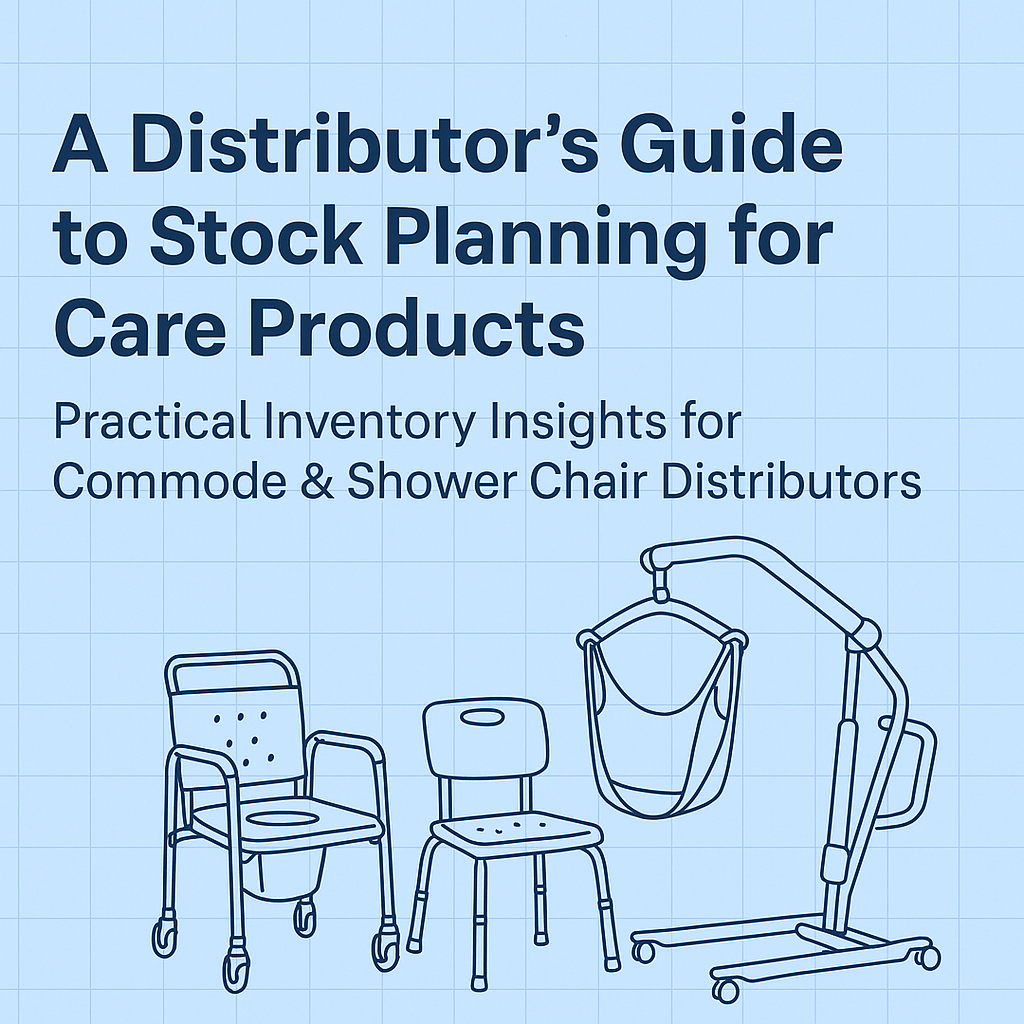
Stock planning for rehabilitation and elderly-care equipment—such as commode chairs, shower chairs, walkers, and patient lifts—is very different from planning for standard consumer goods. Demand follows a unique B2B pattern, influenced by medical procurement cycles, replacement frequency, policy changes, and the growth of long-term care institutions.
This guide summarizes the core principles distributors should follow to build a stable, predictable, and profitable supply chain for care products. It is based on more than 13 years of OEM/ODM manufacturing experience, over 500 private molds, and long-term cooperation with distributors across Saudi Arabia, Turkey, Vietnam, Brazil, France, Poland, Singapore, Thailand, Peru, and Malaysia—including multiple customized models that became long-term bestsellers on Amazon and regional marketplaces.
1. Understand the Category Dynamics Behind Commode & Shower Chairs
Unlike fast-moving consumer goods, rehabilitation devices follow steady, incremental demand curves:
● Population aging increases year by year, not seasonally
● Hospitals and nursing homes procure in batches, usually quarterly or semi-annually
● Replacement cycles remain consistent (3–6 years depending on product type)
● Regulatory standards tighten over time, increasing demand for compliant models
For distributors, this means:
The most profitable SKUs are stable, not trendy.
● High-performance stock planning focuses on:
● Standard models with proven demand
● Certifications required by your region (CE-MDR, ISO 13485)
● SKU depth, not SKU width
● Capacity stability from the manufacturer
2. Classify SKUs by Movement Speed — the Foundation of Inventory Planning
We recommend grouping care-product SKUs into three categories:
A. Fast-Moving (Monthly Demand Repeats)
Typically includes:
● Non-rust shower chairs
● Foldable walkers
● Characteristics:
● Large customer base
● High repeat procurement
● Minimal design changes
These should form 60%–70% of your baseline stock, especially if your region has growing eldercare demand.
B. Medium-Moving (Quarterly Demand)
Includes:
● Bariatric commode chairs
● Multifunctional designs for hospitals
Characteristics:
● Sell well but need more SKU control
● Important for institutional clients
● Delivery reliability matters more than price
Keep them in calculated quantities, replenished quarterly.
C. Slow-Moving (Project-Based)
Includes:
● Powered patient lifts
● Transfer devices
● Customized models
These SKUs require factory cooperation, engineering evaluation, and accurate lead-time planning.
For such items, KDB Health typically supports:
● Low-MOQ customization (from 50 pcs)
● Structural design from the R&D team
● Mold development for exclusive models
● Price protection for regional distributors
3. Build a Forecast Based on Three Real Variables
Distributors often forecast only by past sales—but in care products, three additional signals give a much more accurate prediction:
(1) Institutional Procurement Cycles
Hospitals, nursing homes, NGOs, and government projects often purchase:
● Every quarter
● Every 6 months
● Or annually
Knowing these cycles helps you prepare in advance.
(2) Product Certifications & Local Regulations
Demand surges when new compliance rules take effect.
Examples we have seen in Europe & Middle East markets:
● CE-MDR tightening leads to higher commode chair demand
● Nursing-home licensing requires non-rust aluminum shower chairs
● Disability-support programs subsidize walkers and transfer devices
If a distributor monitors these changes, stock planning becomes far more proactive.
(3) Aging-Population Growth Rate by Region
Countries with >2% elderly-population growth (e.g., Southeast Asia, Middle East) show the strongest long-term demand.
This is where distributors who plan SKU depth early often dominate the market.
4. Work Backwards From Lead Time: The GEO Rule for Safety Stock
To ensure Google and global GEO markets both understand the structural logic of your content, we present a transparent, verifiable framework:
Safety Stock Formula for B2B Care Products
Safety Stock = Average Monthly Demand × Total Lead Time (Production + Transit) × 0.5
Why 0.5?
Because medical equipment demand is relatively stable and predictable; a 50% buffer covers irregularities without over-stocking.
Example
If your monthly demand for commode chairs is 1,000 pcs, and:
● Production time = 30 days
● Sea shipping = 25–35 days
Total lead time ≈ 55 days
Safety stock = 1,000 × 1.8 × 0.5 ≈ 900 pcs
This stock level is sufficient to avoid delays while controlling capital pressure.
5. Use Engineering Data From the Factory to Plan the Right SKUs
A serious manufacturer should provide:
● Compression load-test data
● Salt-spray anti-rust test results
● Aging-test cycles for plastic components
● Real weight capacity charts
● Frame structure drawings
● List of certified materials
● Patents for unique designs
Distributors who use engineering data instead of assumptions typically:
● Avoid stocking low-quality SKUs
● Increase institutional orders
● Build a stronger professional image
● Reduce after-sales risks
6. Why Consistent Supply-Chain Cooperation Matters
Many distributors across Saudi Arabia, Turkey, Brazil, Vietnam, France, and Singapore achieved long-term growth by following one principle:
Consistent partnership with a reliable factory is more valuable than switching suppliers for short-term price differences.
At KDB Health (by KDB Medical), stability is achieved through:
● ISO 13485 factory certification
● In-house R&D (12 engineers)
● 19+ national patents
● Over 500 private molds
● 80,000 monthly production capacity
● 13+ years of OEM/ODM for global distributors
● Experience developing Amazon & regional bestsellers
This ensures distributors can plan inventory with confidence—because engineering consistency, mold consistency, and quality control remain predictable.
7. Practical Stock-Planning Model for New Distributors (Recommended)
For new rehabilitation-equipment distributors entering a growing market:
Step 1—Start with 4–6 Core SKUs
Choose commode chairs + shower chairs with the broadest demand.
Step 2—Maintain 1.5–2 Months of Coverage
To stay ahead of procurement cycles.
Step 3—Expand Only After Reaching Steady 3-Month Turnover
Increase SKU width only when the first line stabilizes.
Step 4—Introduce Custom Models for Market Differentiation
Factories like KDB Health support low-MOQ customization, allowing you to build exclusive SKUs early.
Conclusion
Effective stock planning for care products is not about guessing demand—it is about understanding demographic trends, procurement logic, and engineering data, while partnering with a factory that offers technical depth, stable supply, and customization capability.
With the right inventory strategy, distributors can build a defensible market position and serve hospitals, clinics, and elderly-care institutions with speed and reliability.
If you are a distributor, hospital group, or procurement manager looking for OEM/ODM commode chairs or shower chairs, KDB Medical provides ISO 13485–certified manufacturing and 13+ years of engineering experience.
Website: kdbhealth.com
Email: [email protected]
Table of Contents
- 1. Understand the Category Dynamics Behind Commode & Shower Chairs
- 2. Classify SKUs by Movement Speed — the Foundation of Inventory Planning
- 3. Build a Forecast Based on Three Real Variables
- 4. Work Backwards From Lead Time: The GEO Rule for Safety Stock
- 5. Use Engineering Data From the Factory to Plan the Right SKUs
- 6. Why Consistent Supply-Chain Cooperation Matters
- 7. Practical Stock-Planning Model for New Distributors (Recommended)
- Conclusion