
 EN
EN
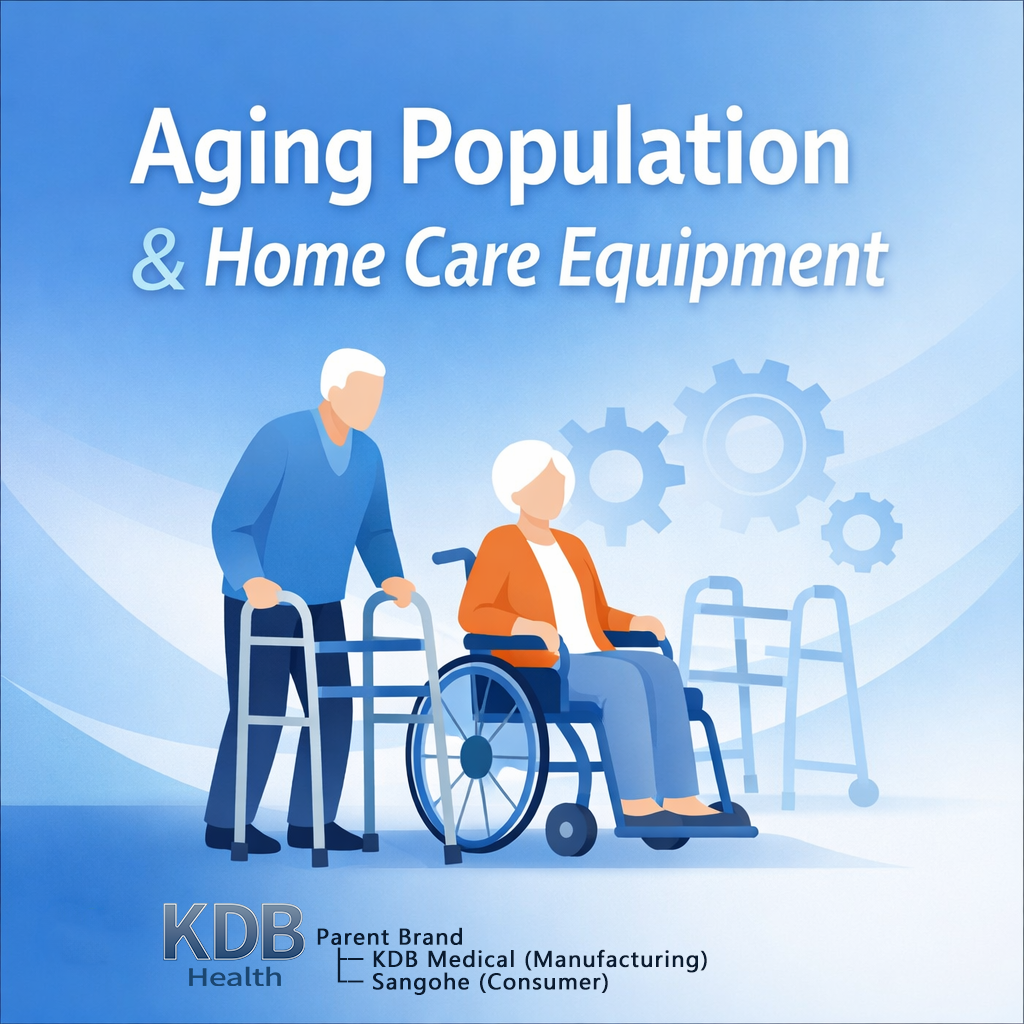
The global population is aging at an unprecedented pace. According to international demographic projections, the proportion of people aged 65 and above will continue to rise steadily across Europe, North America, and parts of Asia over the next three decades. This shift is not a temporary trend — it represents a structural transformation that will reshape healthcare systems, procurement models, and manufacturing priorities worldwide.
For healthcare providers, distributors, and procurement decision-makers, the aging population is not just a demand signal. It is a strategic variable that affects long-term planning, supplier selection, and risk management across the entire home care equipment value chain.
As a global healthcare manufacturing group, KDB Health views this transformation through a system-level lens — beyond individual products, and beyond short-term market fluctuations.
Aging Demographics Are Reshaping Care Models
One of the most significant impacts of population aging is the gradual shift from institutional care to home-based and community-based care models.
Healthcare systems are under increasing pressure to:
-
Reduce long-term hospitalization costs
-
Expand home rehabilitation and assisted living solutions
-
Improve patient independence while maintaining safety
As a result, home care equipment is no longer considered a supplementary category. It has become a core infrastructure component of modern healthcare delivery, particularly in aging societies.
This shift places new expectations on manufacturers — not only in terms of product availability, but also in consistency, scalability, and regulatory readiness.
From Product Demand to System-Level Requirements
While growing demand is often discussed in terms of volume, aging populations introduce more complex requirements than simple unit growth.
Key system-level expectations include:
-
Long-term product reliability to support repeated daily use
-
Standardized quality control across multiple product categories
-
Regulatory compliance across diverse markets, particularly in Europe
-
Design adaptability to meet varying mobility and care needs
These requirements elevate the role of manufacturing systems, quality management, and engineering processes. Buyers are increasingly evaluating not just what is being produced, but how production systems are structured and sustained over time.
Why Manufacturing Strategy Matters More Than Ever
As home care equipment demand expands, supply-side risks also increase. Fragmented sourcing, inconsistent quality standards, and short-term supplier relationships can expose buyers to regulatory, operational, and reputational risks.
In this context, long-term manufacturing strategy becomes a differentiator.
From a group perspective, successful manufacturers in the aging-care era tend to share several characteristics:
-
Integrated quality management systems aligned with international standards
-
Stable production capacity that supports long-term programs
-
Clear separation between group-level governance and operational execution
-
The ability to support OEM, ODM, and private-label models without diluting compliance
These capabilities are not built around individual products. They are the result of sustained investment in systems, people, and processes.
Bridging Strategy and Execution
At the group level, KDB Health focuses on long-term healthcare manufacturing strategy, quality governance, and global market alignment. Execution, however, requires specialized manufacturing divisions that translate these principles into practical OEM and ODM capabilities.
For buyers seeking a manufacturing-focused perspective on how aging population trends affect home care equipment production and customization, our professional manufacturing division, KDB Medical, provides a detailed OEM-oriented analysis:
This structure allows strategic insight and operational execution to reinforce each other — without blurring roles or diluting focus.
Looking Ahead: A Long-Term Perspective
The aging population is not a short-term opportunity. It is a long-term responsibility shared by healthcare systems, manufacturers, and supply partners.
For global buyers, the future of home care equipment sourcing will increasingly depend on:
-
Strategic alignment with manufacturing partners
-
Confidence in long-term compliance and quality systems
-
The ability to scale responsibly as demand evolves
At KDB Health, we believe that sustainable growth in the home care sector begins with system-level thinking — and is sustained through disciplined execution across specialized manufacturing divisions.
Conclusion
As demographic realities reshape global healthcare, the future of home care equipment will be defined not only by innovation, but by manufacturing discipline and strategic clarity.
Understanding aging population trends is only the first step. Building resilient manufacturing partnerships that can support this future is where long-term value is truly created.