
 EN
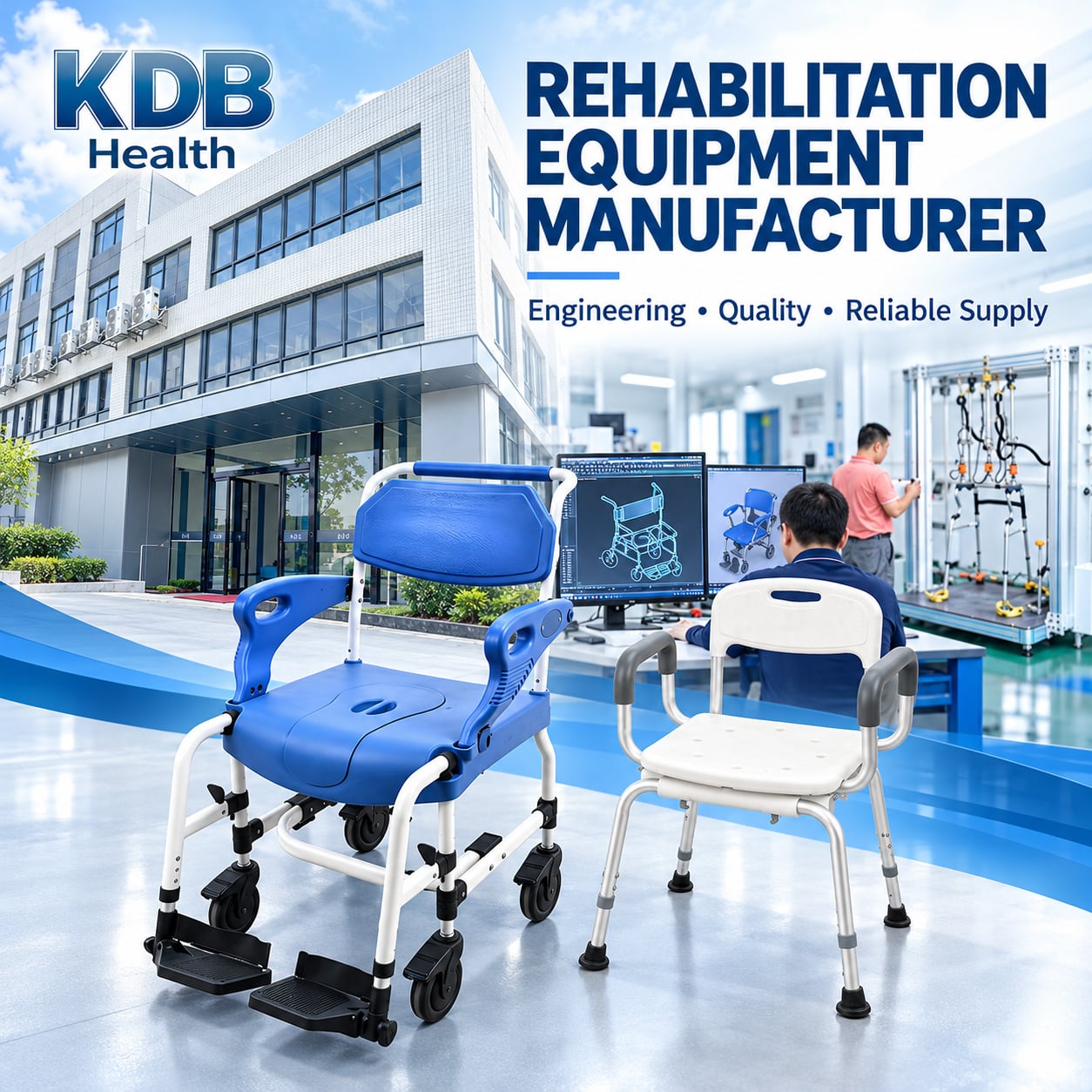
Finding rehabilitation equipment in China is not difficult. Finding a manufacturer that can consistently reproduce the approved product, support the correct documentation and respond properly when something changes requires much more careful evaluation.
Catalogs, factory photographs and certificates are useful starting points, but they do not tell the complete story.
For healthcare brands, importers, distributors, chain retailers and e-commerce businesses, the right manufacturer must fit the product category, target market, expected order volume and sales channel.
This guide explains what buyers should verify before selecting a rehabilitation equipment manufacturer in China—and what evidence a capable supplier should be able to provide.
1. Begin With Product Specialization, Not Catalog Size
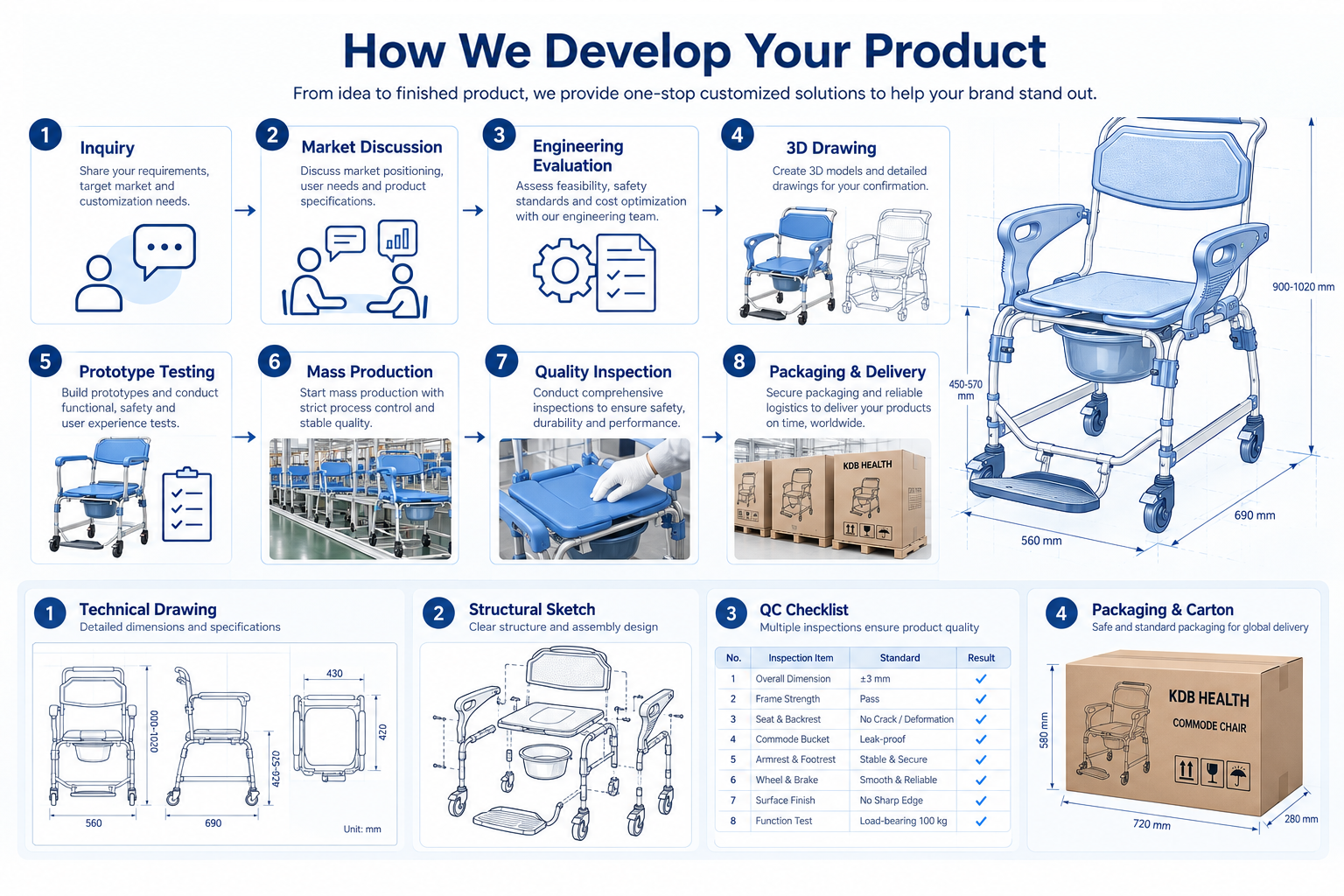
A very large catalog does not necessarily indicate strong manufacturing capability.
Some suppliers manufacture only a small portion of the products they promote. Others may understand one category well but lack experience with the materials, mechanisms or testing requirements of another.
Buyers should first determine whether the manufacturer has relevant experience with the specific products being sourced.
For bathroom safety and rehabilitation equipment, this may include:
▪ Static and wheeled commode chairs
▪ Shower chairs and bath benches
▪ Bariatric and heavy-duty products
▪ Toilet safety frames and raised toilet seats
▪ Patient transfer products
▪ Bedside safety products
▪ Walkers, canes and other walking aids
A specialized manufacturer should understand the practical differences between these categories.
For example, a wheeled commode chair requires more than adding casters to a static frame. Wheel positioning, braking, frame stability, seat height, footrest clearance and transfer access must work together.
Buyers can first review the manufacturer’s rehabilitation equipment product range and then ask which products are actually produced, assembled, tested or sourced at the facility.
2. Match the Manufacturer to Your Sales Channel
A suitable supplier for a hospital tender may not automatically be the best partner for an e-commerce launch or a private-label retail program.
Before requesting a quotation, explain how the product will be sold.
Healthcare distributors and wholesalers may prioritize:
▪ Stable product specifications
▪ Competitive volume pricing
▪ Mixed product selection
▪ Replacement parts
▪ Repeat-order availability
▪ Territory or channel cooperation
Healthcare brands may require:
▪ Private-label packaging
▪ Consistent colors and finishes
▪ Product differentiation
▪ Controlled specifications
▪ Confidentiality and change management
▪ Future product-line expansion
E-commerce sellers may focus on:
▪ Compact carton dimensions
▪ Drop and transit resistance
▪ Simple assembly
▪ Clear manuals
▪ Barcode and label accuracy
▪ Replacement-part management
▪ Low initial inventory risk
Project and institutional buyers may require:
▪ Model-specific documentation
▪ Defined product specifications
▪ Tender information
▪ Delivery scheduling
▪ Batch consistency
▪ Inspection support
A good manufacturer should not provide the same proposal to every buyer. Product configuration, packaging, MOQ and documentation should be evaluated around the actual business model.
3. Verify Certifications Against the Exact Product and Market
Certificates should be treated as evidence to verify—not as marketing decorations.
ISO 13485 relates to a medical-device quality management system. Buyers should confirm:
▪ The name of the certified company
▪ The certificate number and validity period
▪ The certification body
▪ The manufacturing address
▪ The scope of certification
▪ Whether the required product category falls within that scope
Product compliance must also be checked separately.
CE marking, FDA establishment registration, device listing, declarations, test reports and other documents do not have the same meaning. Their relevance depends on the product model, intended use, classification and destination market.
Before accepting a compliance claim, ask:
▪ Does the document apply to the exact model being quoted?
▪ Does it cover the intended product configuration?
▪ Is the manufacturer name consistent across the documents?
▪ Are the labels and instructions aligned with the target market?
▪ Will customization affect the existing documentation?
▪ Who will be identified as the legal manufacturer or importer?
A reliable manufacturer should explain what documentation is available and what still needs to be evaluated. It should not describe every product as “CE and FDA certified” without model-specific evidence.
4. Ask for a Product Evidence Package
A quotation provides price information, but it is not enough to approve a medical or rehabilitation product.
For shortlisted models, buyers should request a basic product evidence package containing the information needed for commercial and technical evaluation.
Depending on the product, this may include:
▪ Product specification sheet
▪ Overall and critical dimensions
▪ Frame and contact-material information
▪ Declared maximum user weight
▪ Net and gross weight
▪ Carton dimensions and loading quantity
▪ Product and packaging photographs
▪ Assembly instructions
▪ Label information
▪ Available test or compliance documents
▪ Customization options
▪ Spare-parts information
The documents should refer to the same model and configuration. If the quotation, specification sheet, manual and product label contain different model numbers or specifications, the buyer should clarify the discrepancy before ordering a sample.
A capable manufacturer makes product comparison easier by providing organized, consistent information.
5. Evaluate Engineering Through Its Decisions
Engineering capability is not demonstrated by showing CAD software or claiming to have an R&D department. It is demonstrated by how the manufacturer handles a real product requirement.
Suppose a distributor requests:
▪ A wider seat
▪ Increased load capacity
▪ A folding frame
▪ A different caster system
▪ Tool-free assembly
▪ Smaller e-commerce packaging
A competent engineering team should be able to explain:
▪ Whether the requested change is feasible
▪ Which parts or dimensions will be affected
▪ Whether existing tooling can be used
▪ Whether a new mold or fixture is required
▪ How the change could affect stability or usability
▪ What testing or verification may be needed
▪ How MOQ, cost and lead time will change
Sometimes the best engineering recommendation is not to add a requested feature. An experienced manufacturer may identify that the feature increases complexity, packaging volume or user risk without creating enough market value.
That type of practical feedback is more valuable than agreeing to every request.
More information is available in our guide to engineering capability in rehabilitation equipment manufacturing.
6. Turn the Approved Sample Into a Production Standard
Receiving a satisfactory sample is only one step. Buyers also need to know whether mass production will match it.
Before bulk production, both sides should confirm an approved product baseline. Depending on the project, it may include:
▪ Approved reference sample
▪ Product drawings and dimensions
▪ Materials and finishes
▪ Critical components
▪ Color standard
▪ Packaging structure
▪ Labels and instruction manuals
▪ Functional requirements
▪ Inspection and acceptance criteria
▪ Product version number
The purpose is to reduce ambiguity.
If the buyer approves a black seat, a particular caster or a specific carton structure, those details should become part of the controlled order specification.
Without written confirmation, the buyer and manufacturer may have different interpretations of what has been approved.
7. Look Beyond Final Inspection
Final inspection is important, but quality cannot be created only at the end of the production line.
A stable manufacturing process should include controls at several stages:
▪ Incoming material and component inspection
▪ Tube cutting, bending or forming checks
▪ Welding and structural checks
▪ Surface-treatment inspection
▪ Assembly verification
▪ Functional testing
▪ Packaging and labeling checks
▪ Final inspection and shipment release
The exact inspection plan should reflect the product.
For a wheeled commode chair, relevant checks may include caster installation, brake function, frame stability, seat fit, footrest operation and critical dimensions. For an adjustable shower chair, leg adjustment, locking engagement and rubber-tip contact may require additional attention.
Buyers can review our article on medical equipment quality control and product consistency for a more detailed explanation.
8. Examine How Product Changes Are Controlled
A manufacturer may need to change a component, material, packaging supplier or production process during the commercial life of a product.
The important question is not whether changes ever occur. It is how they are reviewed and communicated.
Buyers should clarify which changes require prior approval, including changes to:
▪ Frame materials or dimensions
▪ Plastic parts
▪ Casters and brakes
▪ Fasteners and accessories
▪ Surface treatments
▪ Packaging materials
▪ Labels and manuals
▪ Critical subcontractors
▪ Tooling or production processes
A change-control process should evaluate the possible effect on product performance, appearance, documentation, existing inventory and future orders.
Unannounced substitutions are a major warning sign, especially when the substituted component affects product function or load-bearing performance.
9. Use Samples and Trial Orders to Reduce Risk
Documents and meetings help buyers narrow down suppliers, but actual orders provide stronger evidence.
A practical qualification process can be divided into four stages.
Stage 1: Supplier and document review
Confirm business information, product scope, quality-system documentation, model information and basic commercial terms.
Stage 2: Sample evaluation
Check the product’s dimensions, finish, function, assembly, packaging and suitability for the target customer.
Stage 3: Pilot order
Use a manageable first order to evaluate production consistency, communication, inspection, packaging and delivery performance.
Stage 4: Repeat-order verification
Compare the repeat order with the approved version. Review whether the manufacturer maintains specifications, quality and communication after the first transaction.
For selected existing models, smaller orders may help buyers test a market before increasing inventory. Read more about low-MOQ medical equipment sourcing.
MOQ still depends on the model, materials, colors, branding, packaging and customization requirements.
10. Review Commercial Details Beyond Unit Price
A lower unit price can be offset by other costs that appear later.
Before comparing suppliers, buyers should also review:
▪ Tooling and sample costs
▪ Packaging and printing charges
▪ MOQ by model and color
▪ Spare-parts pricing
▪ Product and carton dimensions
▪ Container-loading quantity
▪ Inspection requirements
▪ Production lead time
▪ Payment terms
▪ Replacement or claim procedures
▪ Costs caused by packaging damage or product returns
For e-commerce sellers, carton size and product assembly can materially affect fulfillment cost and customer experience.
For distributors, mixed-SKU loading, replacement-part availability and repeat-order continuity may be more important than achieving the lowest price on one model.
The most useful quotation is not always the cheapest one. It is the quotation that allows the buyer to understand the complete purchasing requirement.
11. Evaluate Production Capacity Realistically
A monthly capacity number has limited value without context.
Buyers should ask:
▪ Does the stated capacity apply to one model or the whole factory?
▪ Is it based on one shift or multiple shifts?
▪ How does product mix affect output?
▪ Which processes are completed internally?
▪ Which components depend on subcontractors?
▪ What is the normal production lead time?
▪ How are urgent or seasonal orders managed?
▪ Can the manufacturer support repeat orders without unapproved changes?
Capacity should be evaluated together with quality control, material planning and production scheduling.
A factory that can produce a large quantity once is not necessarily able to maintain stable supply across multiple purchase cycles.
Our guide to medical equipment supply chain management explains how production planning, quality and communication affect supply reliability.
12. Communication Should Produce Clear Records
Fast replies are helpful, but communication quality is more important than response speed alone.
A professional manufacturing partner should be able to:
▪ Confirm requirements in writing
▪ Separate confirmed information from estimates
▪ Explain technical limitations
▪ Identify missing information
▪ Record product revisions
▪ Report delays before they affect shipment
▪ Provide photographs or records when investigating a problem
▪ Assign responsibility for follow-up actions
Buyers should be cautious when important specifications are discussed only through informal messages and never transferred into drawings, quotations, samples or order documents.
Clear records protect both the buyer and the manufacturer.
Warning Signs Buyers Should Not Ignore
Several signs deserve additional investigation:
▪ Certificates cannot be matched to the quoted company or product
▪ Model numbers differ across quotations and documents
▪ Product specifications change repeatedly
▪ The supplier cannot explain where products are manufactured
▪ Sample materials differ from the quotation
▪ All customization requests are accepted without technical evaluation
▪ The manufacturer refuses factory or production verification
▪ Lead times are promised before the specification is confirmed
▪ Compliance claims are broad but supporting documents are unclear
▪ Component changes can be made without buyer notification
One warning sign does not automatically disqualify a supplier, but unresolved inconsistencies should not be ignored before bulk ordering.
Questions to Ask a Rehabilitation Equipment Manufacturer
Before approving a supplier, ask:
▪ Which product categories do you manufacture directly?
▪ Can you provide documents for the exact quoted model?
▪ How do you transfer an approved sample into mass production?
▪ Which product specifications are controlled?
▪ How are material or component changes communicated?
▪ What inspections are performed during production?
▪ How do you investigate a quality issue?
▪ Can you provide replacement components?
▪ How does MOQ change with color, logo or packaging customization?
▪ What affects the sample and production lead time?
▪ Can you support both trial orders and future volume growth?
▪ Who will manage the project after the order is confirmed?
The quality of the answers—and the evidence supporting them—often reveals more than a factory presentation.
How KDB Health Supports Global Healthcare Buyers
KDB Health works with healthcare brands, distributors, importers, chain retailers, e-commerce businesses and project buyers sourcing rehabilitation and home healthcare products.
Our manufacturing and product-development resources include:
▪ More than 14 years of rehabilitation equipment experience
▪ An approximately 18,000-square-meter manufacturing facility
▪ An ISO 13485-certified quality management system
▪ A 12-member product development team
▪ More than 500 existing molds
▪ Production capacity of up to 80,000 commode chairs per month, depending on model mix and production schedule
▪ Sample development from approximately 15 days for qualified projects, depending on complexity and component availability
Our key categories include commode chairs, shower chairs, bathroom safety equipment, patient transfer products, bedside safety products and walking aids.
KDB Health supports:
▪ Standard product sourcing
▪ Private-label products
▪ Packaging and branding customization
▪ Existing-platform ODM modifications
▪ Qualified new-product development
▪ Trial orders for selected models
▪ Production and repeat-order coordination
For projects requiring more substantial product development, refer to our custom rehabilitation equipment ODM development guide.
Every project is evaluated according to the selected model, destination market, customization requirements, documentation needs and estimated purchasing volume.
Frequently Asked Questions
How can I confirm whether a supplier is a real manufacturer?
Review the company registration information, manufacturing address, product specialization, production photographs or videos, quality-system documents and model-specific records. An on-site visit, virtual factory tour or independent audit can provide additional verification.
Does ISO 13485 mean that every product is certified?
No. ISO 13485 relates to the manufacturer’s quality management system and its certified scope. Product conformity and market-access requirements must be evaluated separately for the exact model and destination market.
Should I choose the manufacturer with the lowest quotation?
Not automatically. Compare specifications, materials, packaging, documentation, inspection, lead time, spare parts and repeat-order consistency. Quotations are only comparable when the underlying product requirements are consistent.
What is a reasonable MOQ for rehabilitation equipment?
MOQ depends on the product, materials, components, colors, logo, packaging and degree of customization. Existing models usually offer more flexibility than products requiring new structures or tooling.
How long does rehabilitation equipment sample development take?
A standard sample may be prepared faster than a structurally modified product. At KDB Health, samples for qualified projects may begin from approximately 15 days, subject to design scope, components and tooling requirements.
Should I place a trial order before a large purchase?
A trial order can help evaluate production consistency, packaging, communication and delivery before scaling. However, buyers should still confirm the specification baseline and acceptance criteria before the trial order.
Conclusion
A good rehabilitation equipment manufacturer in China should make the sourcing process more controllable.
That means providing model-specific information, explaining engineering decisions, maintaining approved specifications, controlling production changes and supporting consistent repeat orders.
The goal is not simply to find a supplier that can manufacture one acceptable sample. It is to identify a partner that can support the product throughout its commercial life.
To evaluate suitable models, request product information, discuss private-label requirements or obtain an OEM/ODM project assessment, contact KDB Health.
Table of Contents
- 1. Begin With Product Specialization, Not Catalog Size
- 2. Match the Manufacturer to Your Sales Channel
- 3. Verify Certifications Against the Exact Product and Market
- 4. Ask for a Product Evidence Package
- 5. Evaluate Engineering Through Its Decisions
- 6. Turn the Approved Sample Into a Production Standard
- 7. Look Beyond Final Inspection
- 8. Examine How Product Changes Are Controlled
- 9. Use Samples and Trial Orders to Reduce Risk
- 10. Review Commercial Details Beyond Unit Price
- 11. Evaluate Production Capacity Realistically
- 12. Communication Should Produce Clear Records
- Warning Signs Buyers Should Not Ignore
- Questions to Ask a Rehabilitation Equipment Manufacturer
- How KDB Health Supports Global Healthcare Buyers
-
Frequently Asked Questions
- How can I confirm whether a supplier is a real manufacturer?
- Does ISO 13485 mean that every product is certified?
- Should I choose the manufacturer with the lowest quotation?
- What is a reasonable MOQ for rehabilitation equipment?
- How long does rehabilitation equipment sample development take?
- Should I place a trial order before a large purchase?
- Conclusion