
 EN
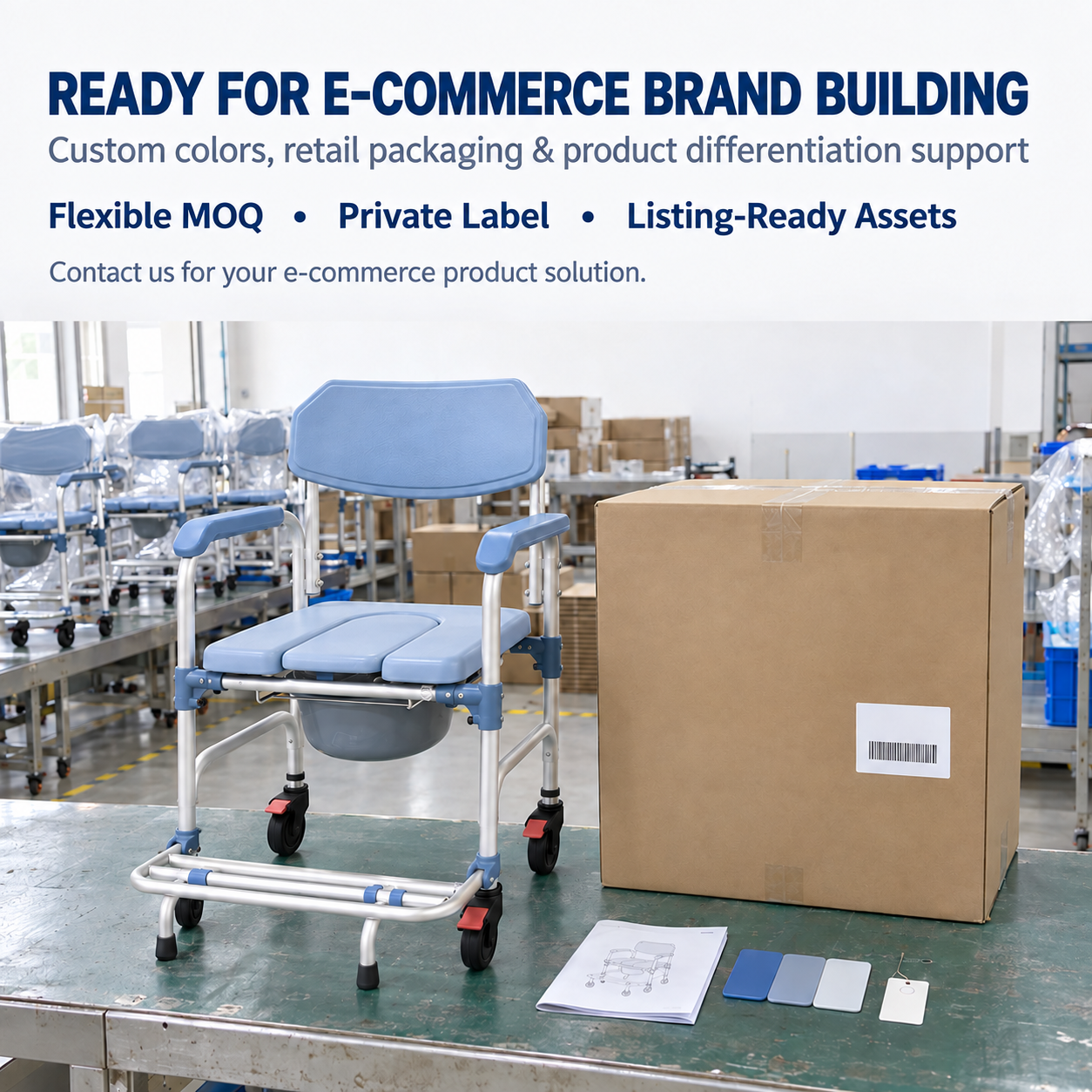
For an e-commerce healthcare business, selecting a medical equipment supplier involves more than comparing unit prices.
Product dimensions, shipping weight, packaging, assembly, marketplace requirements, documentation, customer returns and inventory turnover can all affect whether a product is commercially successful.
This is particularly important for growing online sellers. Placing a large order before confirming demand may tie up working capital and create unnecessary warehouse pressure. At the same time, choosing products only because they have a low MOQ can result in weak differentiation, poor packaging or inconsistent supply.
A more practical approach is to begin with selected products, test customer response and gradually expand the models that perform well.
KDB Health works with e-commerce businesses, healthcare brands, distributors and importers to develop scalable sourcing programs for commode chairs, shower chairs and related bathroom safety equipment.
This guide explains what online healthcare sellers should evaluate before launching their first product range.
Why E-Commerce Medical Equipment Sourcing Is Different
Traditional medical equipment distributors may supply hospitals, nursing homes or regional retailers through established procurement channels.
An e-commerce healthcare business usually operates differently. Products may be sold through an independent website, online marketplace, pharmacy platform or social-commerce channel and delivered directly to the customer.
This means the product must work commercially at several levels.
Online sellers should consider:
▪ Whether customers can understand the product quickly
▪ Whether its functions can be explained through photographs and video
▪ Whether the carton is suitable for parcel delivery
▪ Whether customers can assemble the product correctly
▪ Whether product dimensions and specifications are clearly documented
▪ Whether the product is sufficiently different from competing listings
▪ Whether spare parts and after-sales questions can be managed
▪ Whether the supplier can support repeat and larger orders
For online sales, the supplier, product, packaging and listing must work together.
1. Select Products That Are Suitable for Online Sales
Not every rehabilitation product is equally suitable for an early-stage e-commerce business.
Large or technically complex products may require more customer education, greater inventory investment and more complicated after-sales support. For a new online product line, it is often more practical to start with products that have clear functions, manageable packaging and relatively simple assembly.
Potential starting categories include:
▪ Adjustable shower stools
▪ Compact shower chairs
▪ Folding commode chairs
▪ Bedside commodes
▪ Toilet safety rails
▪ Raised toilet seats
▪ Bedside safety rails
▪ Walking aids
These categories address recognizable home-care and bathroom safety needs while remaining relatively easy to present online.
Buyers can review available product categories through the KDB Health product collection and shower chair range.
2. Start With a Focused Product Range
Launching too many products at once can make it difficult to identify which category is actually generating demand.
A more controlled approach is to select a small number of complementary products for the same target customer group.
For example, an initial bathroom safety range could include:
▪ One commode chair for toileting assistance
▪ One compact shower stool for bathing support
▪ One toilet safety rail for standing assistance
These products address related customer needs but have different price points, functions and packaging requirements.
The seller can then compare:
▪ Product-page traffic
▪ Inquiry or conversion rate
▪ Customer questions
▪ Product return rate
▪ Review content
▪ Preferred price range
▪ Cross-selling opportunities
▪ Repeat-order potential
This provides more useful commercial information than launching a large, unfocused catalogue.
3. Use a Pilot Order to Validate Demand
A pilot order allows an e-commerce business to collect real market information before making a larger inventory commitment.
The purpose is not simply to purchase the smallest possible quantity. A successful pilot should answer several commercial questions:
▪ Does the product attract the intended customer group?
▪ Is the selling price accepted by the market?
▪ Is the packaging suitable for delivery?
▪ Can customers assemble and use the product correctly?
▪ Which product features appear most important?
▪ What questions repeatedly appear before purchase?
▪ What causes returns or complaints?
▪ Is the product suitable for repeat ordering?
Pilot-order availability depends on the model, materials, packaging, component purchasing requirements and production schedule.
For businesses planning a controlled first launch, our guide to low-MOQ medical equipment sourcing explains how standard products, private-label customization and ODM projects affect order quantities.
E-commerce healthcare brands planning a controlled first launch can also review our E-Commerce Medical Equipment Sourcing Guide for product selection, packaging, landed-cost and pilot-order considerations.
4. Avoid Excessive Customization During the First Test
Growing healthcare brands often want a distinctive product from the beginning. However, structural customization before market validation can increase development cost and risk.
Custom colors, new molds, modified frames and specialized components may affect:
▪ MOQ
▪ Sample cost
▪ Development time
▪ Testing requirements
▪ Regulatory documentation
▪ Spare-parts management
▪ Production lead time
For a first-stage product test, it may be more practical to use:
▪ An existing product structure
▪ Standard materials and colors
▪ Standard components
▪ Existing tooling
▪ Limited label customization
▪ A standard or semi-customized package
Once the product has demonstrated stable demand, the buyer can consider deeper branding or structural differentiation.
5. Evaluate Packaging Before Calculating Profit
Packaging is especially important for e-commerce medical equipment.
A product with a competitive factory price may become commercially unsuitable if the carton is too large, internal protection is inadequate or marketplace fulfillment fees are higher than expected.
Before ordering, buyers should request:
▪ Individual carton dimensions
▪ Net and gross weight
▪ Units per master carton
▪ Product dimensions after folding or disassembly
▪ Internal protection method
▪ Assembly instructions
▪ Barcode and label positions
▪ Retail and export packaging options
▪ Loading quantity for LCL or full-container shipments
For parcel-delivered products, packaging should protect the frame, plastic components, wheels and accessories while also keeping the carton as efficient as possible.
The buyer should also confirm whether customized cartons, printed manuals or branded labels have separate MOQs.
6. Calculate the Total Landed Cost
The unit price does not represent the complete cost of selling healthcare products online.
A basic landed-cost calculation should include:
 Product cost + Packaging + Inland transportation + Inspection + International freight + Import duties + Warehousing + Fulfillment fees + Return allowance
E-commerce sellers should pay particular attention to:
▪ Dimensional shipping weight
▪ Oversize parcel charges
▪ Marketplace storage fees
▪ Last-mile delivery costs
▪ Packaging damage
▪ Missing components
▪ Customer returns
▪ Replacement-parts costs
▪ After-sales communication
A product with a slightly higher factory price may provide a better commercial result if it has more efficient packaging, clearer assembly and fewer return-related problems.
7. Test Samples From the Customer’s Perspective
Sample evaluation should not end with checking the product’s appearance.
The sample should be reviewed as though it had already been delivered to an online customer.
Product evaluation
▪ Frame stability
▪ Adjustment functions
▪ Seat and backrest installation
▪ Wheel and brake operation, where applicable
▪ Surface finish
▪ Accessory fit
▪ Cleaning access
▪ Product dimensions
▪ Consistency with the specification sheet
Packaging evaluation
▪ Carton condition after transportation
▪ Internal product protection
▪ Small-parts organization
▪ Instruction clarity
▪ Assembly time
▪ Risk of incorrect assembly
▪ Customer unboxing experience
▪ Ease of repacking if a return occurs
The buyer should document sample findings before approving bulk production. This process can also identify which functions should be explained through listing images or demonstration videos.
8. Prepare Listing Content Before the Products Arrive
An e-commerce launch should not begin only after inventory reaches the warehouse.
During the sample and production stage, the seller should prepare:
▪ Main product images
▪ Dimension graphics
▪ Feature images
▪ Assembly instructions
▪ Product demonstration videos
▪ Packaging photographs
▪ Frequently asked questions
▪ Cleaning and maintenance information
▪ Replacement-parts information
▪ Accurate product titles and descriptions
The listing must remain consistent with the approved product.
Sellers should avoid advertising unverified materials, load capacities, certifications or functions. Even when a supplier provides product content, the seller should review and adapt it for the target market and sales platform.
9. Confirm Market-Specific Documentation
Commode chairs, shower chairs and other rehabilitation products may be subject to different requirements depending on their intended use, product configuration and destination market.
Online sellers should request documentation for the exact model rather than relying on a general statement about the complete product range.
Depending on the product and destination, buyers may need to review:
▪ Product specifications
▪ User instructions
▪ Product labels
▪ Applicable declarations or registrations
▪ Test reports
▪ Material information
▪ Manufacturer information
▪ Importer or responsible-party information
▪ Traceability information
▪ Complaint and after-sales procedures
Private labeling may also change the information required on the product, packaging or instruction manual.
Our commode and shower chair compliance guide explains some of the issues professional buyers should examine.
10. A Pilot-Order Example From Singapore
A Singapore-based e-commerce start-up recently worked with KDB Health on an initial bathroom safety product order.
The buyer selected two related product types:
▪ KDB691A commode chair
▪ KDB797E rotating shower stool
The objective of the first order was not to build a large inventory immediately. The buyer wanted to test customer response, understand the performance of two related categories and evaluate their potential for repeat sales.
This approach allowed the company to:
▪ Introduce more than one bathroom safety solution
▪ Control its initial inventory investment
▪ Compare demand between two product types
▪ Evaluate packaging and delivery requirements
▪ Collect customer feedback before expanding
▪ Identify products with repeat-order potential
The customer’s name, order value and detailed purchasing terms remain confidential.
This case demonstrates that a focused mixed-product test can be more useful to a growing e-commerce company than immediately committing to a large, highly customized order.
11. Move From Testing to Private Label Development
Once a product has demonstrated stable market demand, the seller can gradually increase differentiation.
A practical development path may include three stages.
Stage 1: Market validation
▪ Existing product model
▪ Controlled initial inventory
▪ Standard materials and colors
▪ Standard packaging
▪ Basic product listing
▪ Customer-feedback collection
Stage 2: Commercial optimization
▪ Improved packaging
▪ Brand labels
▪ Customized instruction manuals
▪ Better listing content
▪ Selected accessories
▪ More efficient order quantities
Stage 3: Product differentiation
▪ Customized colors and finishes
▪ Exclusive product configurations
▪ Selected structural modifications
▪ New packaging systems
▪ Product-family development
▪ Regional distribution arrangements
Healthcare brands preparing for deeper product development can review KDB Health’s customized medical equipment solutions.
Structural modifications should only begin after engineering evaluation because changes to dimensions, frames, wheels, joints or load-bearing components may affect testing and documentation.
12. Evaluate Whether the Supplier Can Support Growth
A low MOQ does not automatically make a supplier suitable for long-term e-commerce cooperation.
Buyers should also evaluate:
▪ Experience in the relevant product category
▪ Consistency between samples and bulk production
▪ Quality-management procedures
▪ Packaging development capability
▪ Model-specific documentation
▪ Lead-time reliability
▪ Product specifications and drawings
▪ Spare-parts availability
▪ Communication efficiency
▪ Private-label capability
▪ Production capacity for repeat orders
▪ Ability to support additional product categories
An e-commerce business may begin with a small pilot order, but its supplier should still be capable of supporting larger and more complex orders if the product succeeds.
How KDB Health Supports E-Commerce Healthcare Brands
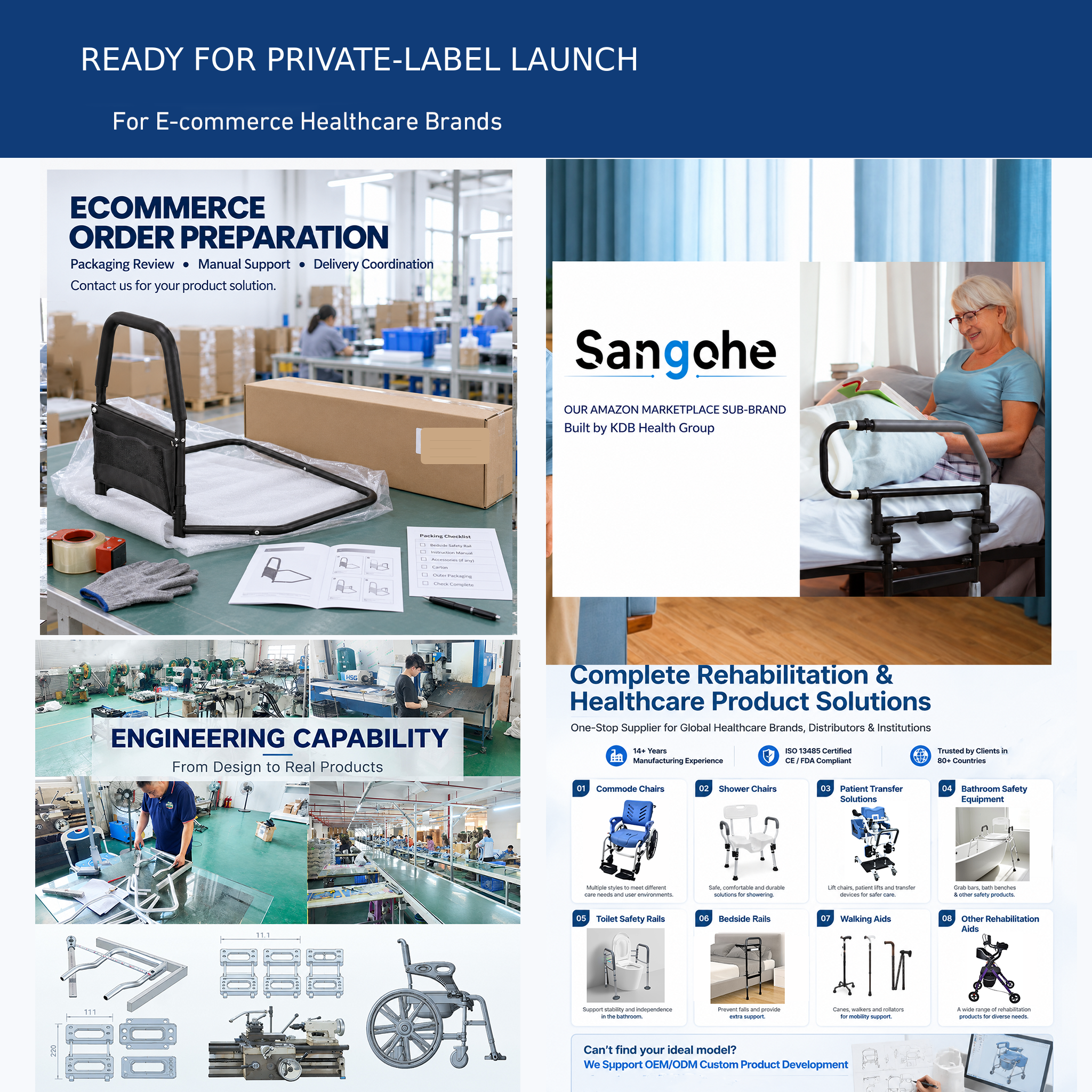
KDB Health provides rehabilitation and home healthcare equipment solutions for distributors, healthcare brands, importers, e-commerce businesses and project buyers.
Our resources include:
▪ More than 14 years of rehabilitation equipment experience
▪ An approximately 18,000 m² manufacturing facility
▪ Monthly production capacity of up to 80,000 commode chairs, depending on the model and production schedule
▪ A 12-member product development team
▪ More than 500 existing product molds
▪ An ISO 13485-certified quality management system
▪ Sample support in approximately 15 days for qualified projects
▪ OEM and ODM support across multiple rehabilitation categories
▪ Packaging, branding and documentation coordination
KDB Health can help buyers select an appropriate starting model, define a practical customization scope and build a sourcing plan that develops alongside verified market demand.
Frequently Asked Questions
Can a small e-commerce business order directly from KDB Health?
Yes, qualified e-commerce businesses can discuss sample, pilot-order and bulk purchasing options with KDB Health. Available quantities depend on the product model, stock, packaging and customization requirements.
Does every product have the same MOQ?
No. MOQ varies according to the product, components, materials, packaging and customization level. Standard products are generally more flexible than projects requiring new tooling or structural changes.
Can several product types be combined in one shipment?
In some projects, complementary products can be consolidated into one shipment. Carton quantities, production schedules, freight costs and customs requirements must be reviewed before confirmation.
Should an e-commerce brand begin with OEM or ODM?
For initial testing, an existing product platform with limited branding changes is often more practical. More extensive ODM development can be considered after the company has verified market demand.
Can KDB Health provide private-label packaging?
Yes. Available options may include labels, logos, manuals and packaging customization. MOQ and cost depend on the printing method, materials and packaging supplier requirements.
Which products are suitable for an initial online test?
Compact shower stools, folding commode chairs, toilet safety rails, raised toilet seats and other products with clear functions and manageable packaging may be suitable starting points. Final selection should be based on the target market and customer profile.
What information should buyers include in an inquiry?
Buyers should provide:
▪ Company name and website
▪ Target country
▪ Sales channel
▪ Interested product categories
▪ Estimated order quantity
▪ Branding requirements
▪ Packaging requirements
▪ Required documentation
▪ Preferred shipping method
This information helps KDB Health recommend a more realistic starting solution.
Build a Scalable E-Commerce Healthcare Product Range
Successful e-commerce medical equipment sourcing does not require launching a large product catalogue at once.
A focused pilot order can help a growing healthcare business control inventory, understand customer demand and identify which products deserve further investment.
Once demand has been validated, packaging, branding, product configuration and order quantities can be improved gradually.
If you operate an online healthcare store, marketplace business, pharmacy platform or home-care brand, contact KDB Health to request product recommendations, specifications, quotation, sample options, packaging information or an OEM/ODM proposal.
Table of Contents
- Why E-Commerce Medical Equipment Sourcing Is Different
- 1. Select Products That Are Suitable for Online Sales
- 2. Start With a Focused Product Range
- 3. Use a Pilot Order to Validate Demand
- 4. Avoid Excessive Customization During the First Test
- 5. Evaluate Packaging Before Calculating Profit
- 6. Calculate the Total Landed Cost
- 7. Test Samples From the Customer’s Perspective
- 8. Prepare Listing Content Before the Products Arrive
- 9. Confirm Market-Specific Documentation
- 10. A Pilot-Order Example From Singapore
- 11. Move From Testing to Private Label Development
- 12. Evaluate Whether the Supplier Can Support Growth
- How KDB Health Supports E-Commerce Healthcare Brands
-
Frequently Asked Questions
- Can a small e-commerce business order directly from KDB Health?
- Does every product have the same MOQ?
- Can several product types be combined in one shipment?
- Should an e-commerce brand begin with OEM or ODM?
- Can KDB Health provide private-label packaging?
- Which products are suitable for an initial online test?
- What information should buyers include in an inquiry?
- Build a Scalable E-Commerce Healthcare Product Range