 EN
Published: June 22, 2026 | Last Updated: November 13, 2026
Choosing between OEM and ODM manufacturing is one of the first strategic decisions a healthcare brand makes when developing a new product.
Both models involve working with an external manufacturer, but they differ in where the product design comes from, who controls the intellectual property, how much development investment is required, and how quickly the product can enter the market.
For healthcare brands, distributors, retailers, online sellers, and project procurement partners, the right choice is not simply the model with the lowest unit price. It is the model that best matches the company’s product idea, internal resources, target market, order volume, and development timeline.
This guide explains how OEM and ODM manufacturing work in rehabilitation and home healthcare equipment—and what buyers should clarify before selecting a manufacturing partner.
What Is OEM Medical Equipment Manufacturing?
OEM stands for Original Equipment Manufacturing.
In a typical OEM project, the buyer provides most or all of the product requirements, which may include:
▪ Product drawings
▪ Technical specifications
▪ Approved materials
▪ Component requirements
▪ Performance expectations
▪ Branding and packaging requirements
▪ Inspection standards
The manufacturer produces the product according to the agreed design and specifications.
OEM is generally suitable when the buyer already has a defined product, proprietary design, internal engineering resources, or a detailed development brief.
When OEM May Be the Better Choice
OEM manufacturing may be appropriate when:
▪ Your company owns an existing product design
▪ You require a product structure that is exclusive to your brand
▪ Your engineering team has already defined the main specifications
▪ The product uses a new mechanism or configuration
▪ You are prepared to invest in tooling, prototypes, testing, and documentation
▪ Expected purchasing volume can support the development investment
▪ You want greater control over product design and future revisions
For example, a healthcare brand may already have drawings for a commode chair with a proprietary folding mechanism. In this case, the manufacturer’s role is to evaluate manufacturability, prepare tooling, produce samples, confirm the process, and manufacture the approved product consistently.
What Buyers Must Clarify in an OEM Project
OEM does not automatically mean that the buyer owns every mold, component, or production method.
Ownership should be defined in the agreement, including:
▪ Product drawings
▪ Tooling and molds
▪ Custom components
▪ Design modifications
▪ Testing reports
▪ Technical documentation
▪ Rights to use or transfer the tooling
▪ Regional or customer exclusivity
These terms should be confirmed before development begins.
What Is ODM Medical Equipment Manufacturing?
ODM stands for Original Design Manufacturing.
In an ODM project, the manufacturer provides an existing product platform, engineering capability, or product design that the buyer can select and adapt for its target market.
Depending on the project, ODM customization may include:
▪ Product colors and finishes
▪ Seat or backrest configurations
▪ Armrests, footrests, casters, or accessories
▪ Frame dimensions
▪ Folding or adjustment mechanisms
▪ Product labels and logo application
▪ Instruction manuals
▪ Retail or e-commerce packaging
▪ More substantial structural improvements
ODM is not limited to adding a logo to a standard product. A serious ODM project can involve engineering evaluation, prototype development, component selection, tooling, verification, and production preparation.
When ODM May Be the Better Choice
ODM manufacturing may be appropriate when:
▪ You want to enter a product category more quickly
▪ You do not have a complete product design
▪ You want to begin with an existing manufacturing platform
▪ Your business needs engineering support
▪ You want to test market demand before making a larger investment
▪ The product category is already relatively mature
▪ You need private-label packaging and controlled product customization
▪ You want to reduce initial tooling and development costs
For example, a distributor may select an existing shower chair platform and request a different frame finish, seat configuration, retail package, instruction manual, and accessory combination.
This approach can create a product suitable for the distributor’s channel without requiring a completely new structure.
Private Label, OEM and ODM Are Not the Same
Private labeling is sometimes confused with OEM or ODM.
A private-label project normally begins with an existing product and focuses on:
▪ Brand logo
▪ Product label
▪ Packaging artwork
▪ Instruction manual
▪ Selected colors or accessories
It generally requires less engineering development than a structural OEM or ODM project.
The three models can be understood as follows:
| Factor | Private Label | OEM | ODM |
|---|---|---|---|
| Starting point | Existing finished product | Buyer-provided design | Manufacturer platform or jointly developed concept |
| Engineering work | Limited | Based mainly on buyer specifications | Manufacturer-supported development |
| Customization | Branding and packaging | Potentially extensive | From controlled modification to new development |
| Initial investment | Lower | Usually higher | Low to high, depending on scope |
| Time to market | Generally shortest | Usually longer | Normally shorter than a completely new OEM project |
| Design ownership | Manufacturer’s existing product | Usually buyer-owned, subject to contract | Depends on platform and development agreement |
| Suitable for | Market testing and line extension | Buyer-owned or exclusive designs | Brands needing engineering and customization support |
The exact model should be defined by the actual scope of work rather than the label used by the supplier.
OEM vs ODM: The Main Differences Buyers Should Evaluate
1. Product Design and Ownership
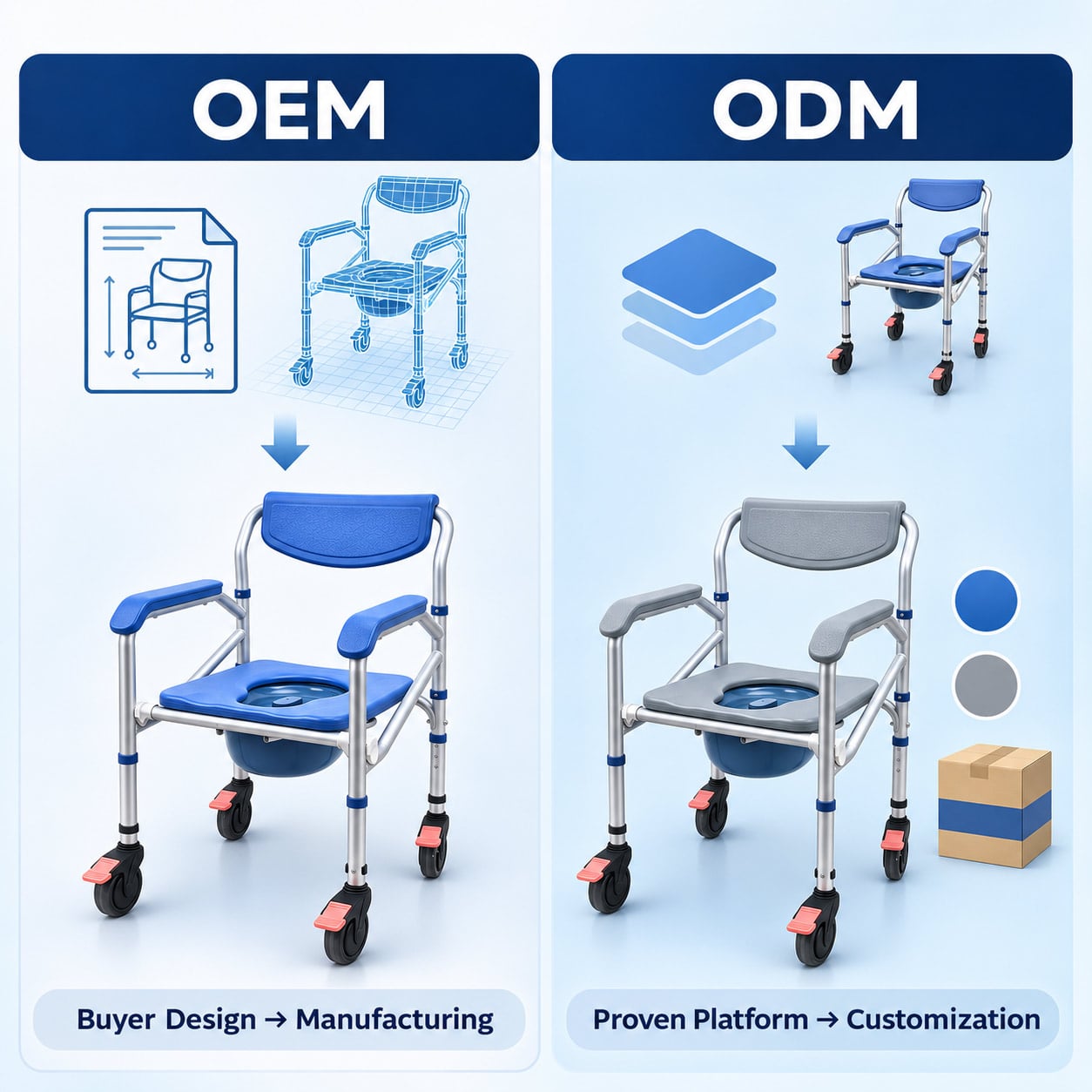
OEM normally begins with a buyer-controlled design.
ODM usually begins with a manufacturer-developed product platform or a product concept developed with the manufacturer’s engineering support.
However, intellectual-property ownership is not determined by the words OEM or ODM alone. It must be defined contractually.
Buyers should clarify who owns:
▪ Original drawings
▪ Revised drawings
▪ New molds
▪ Custom accessories
▪ Appearance designs
▪ Structural improvements
▪ Product documentation
2. Development Investment
OEM projects may require greater upfront investment because they can involve:
▪ New product design
▪ Engineering revisions
▪ Prototype development
▪ Molds, jigs, and fixtures
▪ Component sourcing
▪ Testing and verification
▪ Production-process preparation
ODM projects can reduce initial investment when the buyer uses an existing platform, tooling, and supply chain.
However, a structural ODM project involving new molds or major engineering changes may still require significant development investment.
3. Development Time
ODM is generally faster when the project begins with an existing product platform.
OEM usually takes longer when the product is developed from new drawings or requires new tooling.
Actual timelines depend on:
▪ Product complexity
▪ Material availability
▪ Tooling requirements
▪ Number of sample revisions
▪ Testing requirements
▪ Packaging development
▪ Buyer approval speed
For suitable projects, KDB Health can support sample development in approximately 15 days. More complex structural projects require individual evaluation.
A detailed explanation is available in our guide to the ODM medical equipment development process.
4. Minimum Order Quantity
ODM can sometimes support smaller trial orders because existing products, components, and tooling are already available.
OEM projects may require higher order quantities to support tooling, purchasing, and production setup.
However, MOQ is not determined by the manufacturing model alone. It can also depend on:
▪ Product model
▪ Materials and components
▪ Custom colors
▪ Packaging quantity
▪ Printing requirements
▪ Tooling investment
▪ Production-process changes
For selected products and customization projects, KDB Health supports orders starting from approximately 50 units. The final MOQ must be confirmed for the selected model and project scope.
5. Regulatory and Documentation Responsibilities
ODM should not be treated as a shortcut that automatically makes a private-label product compliant.
ISO 13485 relates to the manufacturer’s quality-management system. It does not mean that every product, configuration, or private-label version automatically has the same market-access status.
Before production, the buyer and manufacturer should clarify:
▪ Product classification
▪ Intended use
▪ Destination market
▪ Manufacturer and brand-owner responsibilities
▪ Product labeling
▪ Technical documentation
▪ Testing requirements
▪ Registration or listing responsibilities
▪ Post-market and complaint responsibilities
Changes to structure, materials, branding, labeling, or intended use may affect the documentation required for the final product.
Buyers can learn more from our article on medical equipment quality control.
Cost, Speed and Risk: Look Beyond Unit Price
The cheapest quotation does not always produce the lowest total project cost.
A sourcing decision should consider:
▪ Product-development fees
▪ Tooling and mold costs
▪ Sample revisions
▪ Testing and documentation
▪ Unit price
▪ MOQ
▪ Packaging
▪ Freight and warehousing
▪ Product returns
▪ Spare parts
▪ Warranty and quality claims
▪ Cost of future product changes
OEM may offer greater control and exclusivity, but it normally places more development responsibility on the buyer.
ODM may reduce development time and initial cost, but buyers must understand which parts of the design remain owned by the manufacturer and how much customization is commercially protected.
Choose OEM If
OEM may be the better option when:
▪ You already own a complete product design
▪ Your competitive advantage depends on a unique structure
▪ You require contractual product exclusivity
▪ Your company can manage technical and regulatory responsibilities
▪ Expected annual volume can support the investment
▪ You need greater control over future product revisions
▪ You are prepared for a longer development process
Choose ODM If
ODM may be the better option when:
▪ You want to launch a product more quickly
▪ You need engineering support from the manufacturer
▪ You want to start with an existing product platform
▪ You are entering a new product category
▪ You want to test demand with a controlled initial order
▪ Differentiation can be created through configuration, features, branding, or packaging
▪ You prefer to invest more resources in marketing, distribution, and customer service
A Hybrid Strategy Often Works Best
Healthcare companies do not always need to choose only one model.
A practical product portfolio may use:
▪ Private-label products for rapid market testing
▪ ODM products for differentiated core ranges
▪ OEM development for proprietary or high-volume products
For example, a growing healthcare brand might launch an existing commode chair under private label, use market feedback to develop an improved ODM version, and later invest in an exclusive OEM product after demand has been proven.
This phased approach can reduce risk while building stronger long-term product differentiation.
Questions to Ask Before Selecting a Manufacturer
Before deciding between OEM and ODM, ask:
▪ Who provides the original product design?
▪ Who owns the drawings and molds?
▪ What customization is included in the quotation?
▪ Which costs are one-time development costs?
▪ What is the expected sample-development process?
▪ How many sample revisions are included?
▪ What is the MOQ for the exact configuration?
▪ What product-specific documentation is available?
▪ Which regulatory responsibilities belong to each party?
▪ How will approved specifications be controlled during production?
▪ Can the supplier support spare parts and future improvements?
▪ How will quality issues and corrective actions be handled?
Clear answers help prevent misunderstandings after tooling or production begins.
How KDB Health Supports OEM and ODM Projects
KDB Health works with healthcare brands, distributors, retailers and online sellers, as well as care facilities and project partners developing rehabilitation and home healthcare equipment.
Our core product categories include:
▪ Commode chairs
▪ Shower chairs and bathroom safety equipment
▪ Patient transfer chairs and lifting equipment
▪ Bedside safety products
▪ Walking and mobility aids
Our manufacturing and development capabilities include:
▪ 18,000㎡ manufacturing facility
▪ ISO 13485-certified quality-management system
▪ More than 500 private molds
▪ Product engineering and sample development
▪ Private-label and packaging customization
▪ OEM and ODM manufacturing support
▪ Commode chair production capacity of up to 80,000 units per month
▪ Export experience across more than 30 countries
A typical project may include:
- Requirement and target-market review
- Existing-platform or development-route selection
- Engineering evaluation
- Drawing and sample development
- Sample review and specification confirmation
- Branding and packaging approval
- Production and inspection
- Shipment and improvement follow-up
Explore KDB Health’s bathroom safety and patient transfer solutions for product-development and private-label cooperation.
Frequently Asked Questions
Is OEM better than ODM?
No. OEM is generally better for buyers with their own defined product design, while ODM can be more suitable for businesses that need an existing platform and engineering support.
Does ODM always have a lower MOQ?
Not always. ODM can offer more flexible quantities when existing molds and components are available, but MOQ still depends on the product, materials, packaging, and customization requirements.
Who owns the product tooling?
Tooling ownership depends on who paid for it and what the development agreement states. Ownership, storage, maintenance, exclusivity, and transfer rights should be documented before development.
Does ISO 13485 mean the finished product is automatically CE or FDA compliant?
No. ISO 13485 relates to the manufacturer’s quality-management system. Product conformity, registration, labeling, and documentation must be reviewed for the specific model and destination market.
Can an existing product be customized for an online brand?
Yes. Depending on the product platform, customization may include branding, packaging, instructions, colors, components, accessories, and selected structural changes.
Can a company use both OEM and ODM products?
Yes. Many healthcare brands use ODM or private-label products for standard ranges and OEM development for exclusive or strategically important products.
Conclusion
The OEM versus ODM decision should be based on your product starting point, engineering resources, investment capacity, target market, order volume, and desired level of control.
OEM is usually suitable for companies that already own a defined design and want greater control or exclusivity.
ODM is generally suitable for companies that want to use an existing product platform, receive engineering support, reduce initial development work, and enter the market more efficiently.
The strongest manufacturing partner is not simply the one that identifies itself as OEM or ODM. It is the partner that clearly defines design ownership, development scope, documentation responsibilities, sample approval, quality control, and production expectations before the project begins.
Contact KDB Health to discuss your target market, product concept, estimated quantity, sample requirements, private-label packaging, or OEM/ODM development project.
Table of Contents
- What Is OEM Medical Equipment Manufacturing?
- What Is ODM Medical Equipment Manufacturing?
- Private Label, OEM and ODM Are Not the Same
- OEM vs ODM: The Main Differences Buyers Should Evaluate
- Cost, Speed and Risk: Look Beyond Unit Price
- Choose OEM If
- Choose ODM If
- A Hybrid Strategy Often Works Best
- Questions to Ask Before Selecting a Manufacturer
- How KDB Health Supports OEM and ODM Projects
- Frequently Asked Questions
- Conclusion