
 EN
EN
An ODM medical equipment project rarely begins with a finished product design.
In many cases, it starts with a market observation, a customer requirement, a procurement opportunity, or a practical problem with an existing product.
A healthcare distributor may identify an unmet need in its local market.
A rehabilitation brand may want to improve an existing product category.
A hospital project may require equipment with a different configuration.
A private-label company may want to develop a product that better fits its brand positioning.
The challenge is turning that initial requirement into a product that can be manufactured repeatedly and consistently.
This is where the ODM development process becomes important.
From the first product discussion to mass production, an ODM project typically moves through several stages. Each stage helps transform a general idea into a defined product specification and eventually into a production-ready manufacturing solution.
This article explains how that process works.
Stage 1: Identifying the Product Opportunity
Every successful ODM project begins with a reason for developing or modifying a product.
The starting point may be market feedback, a customer request, a product limitation, or a new business opportunity.
For rehabilitation and elderly care equipment, common starting points include:
A distributor receives repeated requests for a product configuration that is not widely available in its market.
A healthcare brand identifies an opportunity to improve an existing product design.
A project buyer requires specific dimensions, functions, or accessories.
A private-label business wants a product range with a different appearance or configuration.
A manufacturer receives feedback that an existing product could be improved for a particular application.
At this stage, the idea does not need to be a complete technical design.
The important objective is to clearly define the problem that the new or modified product is expected to solve.
For example, a buyer should be able to explain whether the project is intended to improve usability, adapt a product to a particular environment, add functionality, meet a specific market preference, or create a differentiated product line.
A clear starting point gives the engineering team a practical direction for the next stage.
Stage 2: Creating a Product Development Brief
Once the opportunity has been identified, the general idea needs to be converted into a more structured product development brief.
This does not always require a complete engineering drawing.
However, the manufacturer needs enough information to understand the intended product.
A product development brief may include the intended application, target users, preferred product dimensions, required functions, expected materials, reference products, desired appearance, accessories, branding requirements, and target market.
Reference images or existing products can also help communicate the buyer's expectations.
The purpose of the development brief is to reduce assumptions.
A statement such as "we need a better shower chair" is too general for engineering development.
A more useful requirement would explain what needs to be improved and why.
For example, the buyer may identify a need for easier cleaning, a different seat height, improved maneuverability, a folding structure, or compatibility with a particular care environment.
The clearer the requirement is at the beginning, the easier it becomes to evaluate possible development routes.
Stage 3: Engineering Feasibility Review
The next stage is determining whether the proposed product requirements can be achieved in practice.
The engineering team reviews the development brief and evaluates the requested changes.
This may involve reviewing product structure, dimensions, materials, components, manufacturing processes, and potential technical limitations.
At this stage, the manufacturer may determine that the project can follow one of several development paths.
The first possibility is adapting an existing product platform.
This approach may allow the manufacturer to modify selected components or configurations without redesigning the entire product.
The second possibility is developing new components that can be integrated into an existing structure.
The third possibility is a more extensive development project involving a new product structure or additional tooling.
These options can have very different development requirements.
For this reason, feasibility evaluation should take place before detailed production commitments are made.
The purpose is not simply to decide whether a product can be made.
It is to identify the most practical route from the original concept to a manufacturable product.
Stage 4: Product Concept and Engineering Direction
After the feasibility review, the project moves from a general requirement toward a more defined product concept.
Depending on the level of customization, this stage may involve technical drawings, structural proposals, component selection, dimensional adjustments, or design concepts.
The engineering team may also identify areas where the original requirement needs refinement.
For example, a requested feature may create additional structural complexity.
A preferred material may not be suitable for the intended manufacturing process.
A dimensional requirement may affect product stability or compatibility with other components.
These issues should be addressed during the engineering stage rather than after the product enters production.
The development process is therefore often iterative.
The buyer provides requirements.
The engineering team evaluates the requirements.
The proposed solution is reviewed.
The requirements are adjusted where necessary.
The concept gradually becomes more technically defined.
This stage creates the bridge between what the market wants and what can realistically be manufactured.
Stage 5: Prototype or Sample Development
Once the engineering direction is sufficiently clear, the project can move into prototype or sample development.
The purpose of the sample is to provide a physical reference for evaluating the proposed product.
Depending on the project, the sample may be used to review:
Product dimensions.
Structural configuration.
Functional features.
Component compatibility.
User interaction.
Appearance.
Assembly.
Practical application.
A prototype does not necessarily represent the final mass-production version.
During development, the first sample may reveal areas that require further adjustment.
For example, a component may need repositioning.
A dimension may need refinement.
An accessory may require modification.
A structural detail may need to be simplified.
This is one of the reasons why sample development is an important part of the ODM process.
It allows the product to be evaluated in physical form before the final specifications are prepared for production.
Stage 6: Product Evaluation and Revision
After receiving or reviewing the sample, the buyer can provide structured feedback.
This stage should focus on specific observations rather than general preferences.
For example, feedback may concern the product's dimensions, operating features, appearance, accessories, materials, or practical use.
The manufacturer can then evaluate which requested revisions are technically appropriate.
Some changes may be relatively simple.
Others may affect multiple components or require changes to the manufacturing process.
The revision process may therefore involve several rounds of evaluation depending on the complexity of the project.
The objective is to gradually move from an initial sample toward an agreed product configuration.
For more complex products, buyers should avoid approving a design before all important requirements have been reviewed.
Changes become more difficult to manage after production preparation has begun.
Stage 7: Finalizing the Product Specification
Once the product configuration has been agreed, the project needs to move from development discussions into controlled specifications.
This stage is sometimes referred to as specification freeze.
The term does not mean that the product can never be changed again.
It means that the current version has been formally defined as the reference for production preparation.
The final specification may include:
Product dimensions.
Materials.
Components.
Functional configuration.
Approved accessories.
Appearance requirements.
Branding requirements.
Packaging requirements.
Labels and product information.
Approved sample references.
The level of documentation depends on the product and project requirements.
However, the key objective is to ensure that both the buyer and manufacturer are working from the same product definition.
This stage is particularly important when the product moves from sample development to repeated production.
Without a clearly defined specification, different interpretations can create inconsistencies later.
Stage 8: Preparing the Product for Manufacturing
A product that works as a prototype is not automatically ready for mass production.
Before production begins, the manufacturer needs to prepare the manufacturing process.
This may involve confirming materials and components, preparing production equipment, developing assembly procedures, establishing process requirements, and organizing the necessary production resources.
For projects involving new components or structures, additional preparation may be required.
The objective is to make the product repeatable.
Manufacturing is different from producing a single sample.
A sample can sometimes be created through manual adjustment or special handling.
Mass production requires a process that can repeatedly produce the product according to the agreed specification.
This transition from prototype to manufacturable product is one of the most important stages of ODM development.
Stage 9: Production Trial and Process Confirmation
Depending on the product and development requirements, manufacturers may conduct an initial production run or production trial before moving into regular mass production.
The purpose is to observe how the approved design performs within the actual manufacturing process.
This stage can help identify practical issues involving assembly, component fit, production efficiency, or process consistency.
If adjustments are required, they should be evaluated in a controlled manner.
The objective is not to continuously redesign the product.
It is to confirm that the agreed design can be manufactured through a stable and repeatable process.
Once the manufacturing approach is confirmed, the project can move toward regular production.
Stage 10: Mass Production
Mass production begins after the product configuration and manufacturing process have been sufficiently established.
At this stage, the focus changes.
The earlier stages focused on creating and refining the product.
Mass production focuses on manufacturing the approved product repeatedly according to the established specifications.
The transition is important because ODM development does not end when the first sample is approved.
The real test of a development process is whether the product can move from an individual sample into repeatable manufacturing.
For buyers, this is the point where the original product idea becomes part of an ongoing commercial product program.
Stage 11: Product Improvement After Market Launch
Product development does not necessarily stop after mass production begins.
Once a product enters the market, distributors, healthcare professionals, caregivers, and end users may provide new feedback.
This information can help identify future improvement opportunities.
Possible feedback may involve usability, product configuration, accessories, packaging, or market preferences.
Not every piece of feedback requires an immediate product change.
However, a structured product development approach allows manufacturers and B2B partners to evaluate whether recurring market feedback should lead to future product iteration.
This creates a continuous development cycle:
Market Feedback → Product Review → Engineering Evaluation → Product Improvement → Updated Production
For healthcare brands and distributors, this process can help product portfolios evolve as market requirements change.
What Determines the Complexity of an ODM Project?
Not every ODM project follows exactly the same timeline or development process.
The complexity can depend on several factors.
A project involving a color change or packaging modification may require a different process from a project involving structural engineering changes.
Projects can become more complex when they involve:
New product structures.
New components.
Tooling development.
Multiple engineering revisions.
New materials.
Additional functional requirements.
Changes affecting manufacturing processes.
A practical ODM manufacturer should therefore evaluate each project individually rather than applying the same development route to every request.
Understanding the scope of development helps buyers establish more realistic expectations regarding engineering work, sample development, and production preparation.
The Difference Between a Product Idea and a Production-Ready Product
One of the most important concepts in ODM development is understanding that a product idea is not the same as a production-ready product.
A product idea describes what the market wants.
A production-ready product defines how that requirement can be repeatedly manufactured.
The development process connects these two stages.
A successful ODM project therefore needs to balance several considerations.
The product should address the original market or application requirement.
The design should be technically practical.
The components should work together.
The manufacturing process should be repeatable.
The final specifications should be clearly defined.
When these elements are aligned, the product has a stronger foundation for moving into mass production.
How KDB Health Supports ODM Product Development
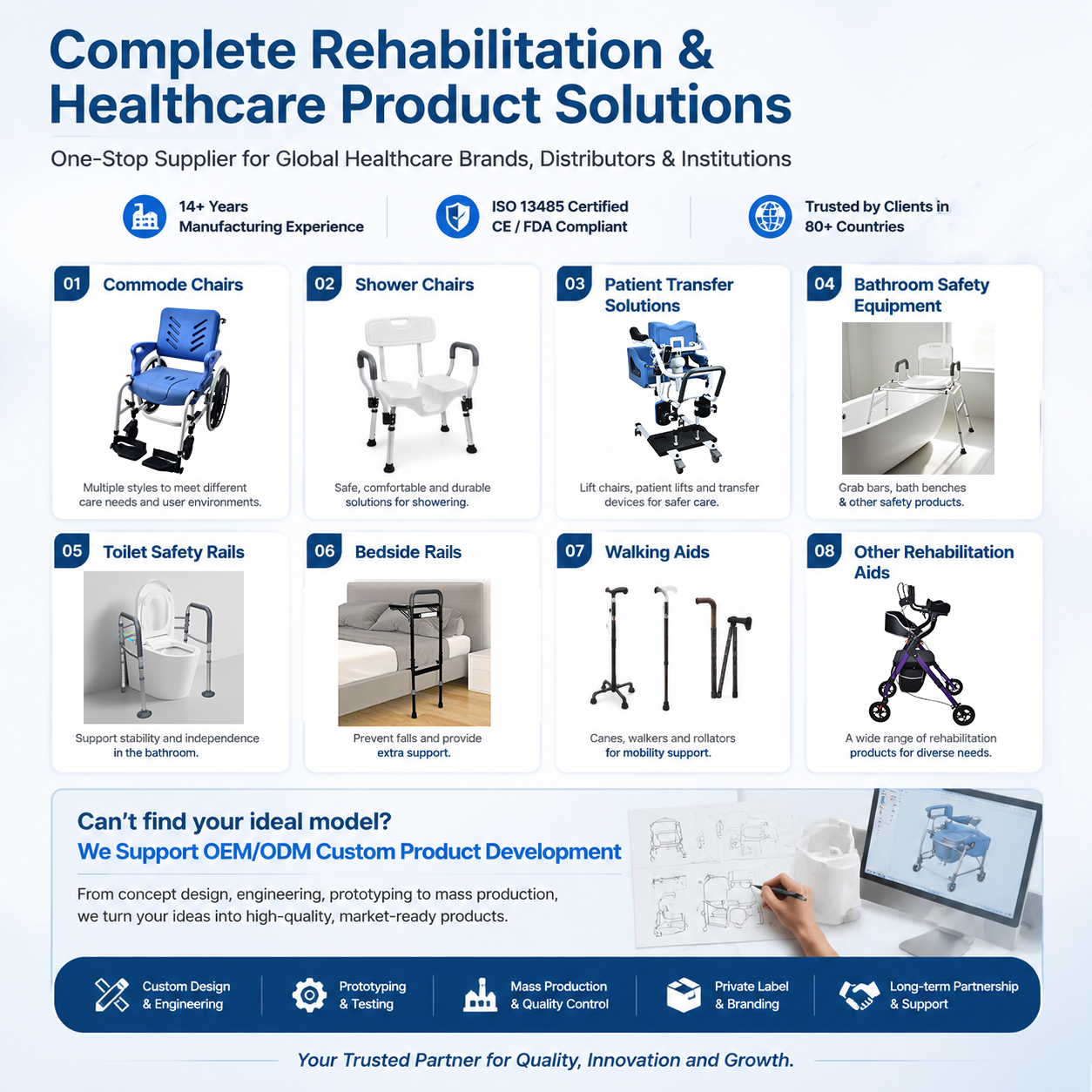
KDB Health develops rehabilitation and elderly care equipment for healthcare distributors, medical equipment importers, rehabilitation brands, private-label businesses, hospitals, and project buyers.
Our product categories include commode chairs, shower chairs, bathroom safety equipment, patient transfer products, bedside rails, and mobility-related equipment.
For ODM projects, the development process may begin with a market requirement, product concept, or specific customer request.
Depending on the project, development may involve engineering evaluation, product configuration, sample development, specification confirmation, production preparation, and mass production.
The goal is to provide a structured path from an initial product requirement to a manufacturable solution.
For healthcare businesses developing customized rehabilitation or elderly care equipment, understanding this process can help create clearer expectations before product development begins.
Conclusion: ODM Development Is a Process, Not a Single Service
ODM medical equipment development is not simply about changing the appearance of an existing product.
It is a structured process that transforms a market requirement or product idea into a defined and manufacturable solution.
The process typically moves through several stages:
Product Opportunity → Development Brief → Engineering Review → Product Concept → Prototype → Evaluation → Specification Freeze → Manufacturing Preparation → Production Trial → Mass Production → Product Improvement
The exact path may vary from project to project.
However, the principle remains the same.
A successful product needs to move gradually from an initial idea toward a clearly defined specification and a repeatable manufacturing process.
For healthcare distributors, rehabilitation brands, private-label businesses, hospitals, and project buyers, understanding the ODM development journey can make product development discussions more structured and practical.
KDB Health supports B2B partners developing rehabilitation and elderly care equipment through product engineering, sample development, customization, and manufacturing solutions based on specific project requirements.
Table of Contents
- Stage 1: Identifying the Product Opportunity
- Stage 2: Creating a Product Development Brief
- Stage 3: Engineering Feasibility Review
- Stage 4: Product Concept and Engineering Direction
- Stage 5: Prototype or Sample Development
- Stage 6: Product Evaluation and Revision
- Stage 7: Finalizing the Product Specification
- Stage 8: Preparing the Product for Manufacturing
- Stage 9: Production Trial and Process Confirmation
- Stage 10: Mass Production
- Stage 11: Product Improvement After Market Launch
- What Determines the Complexity of an ODM Project?
- The Difference Between a Product Idea and a Production-Ready Product
- How KDB Health Supports ODM Product Development
- Conclusion: ODM Development Is a Process, Not a Single Service