
 EN
EN
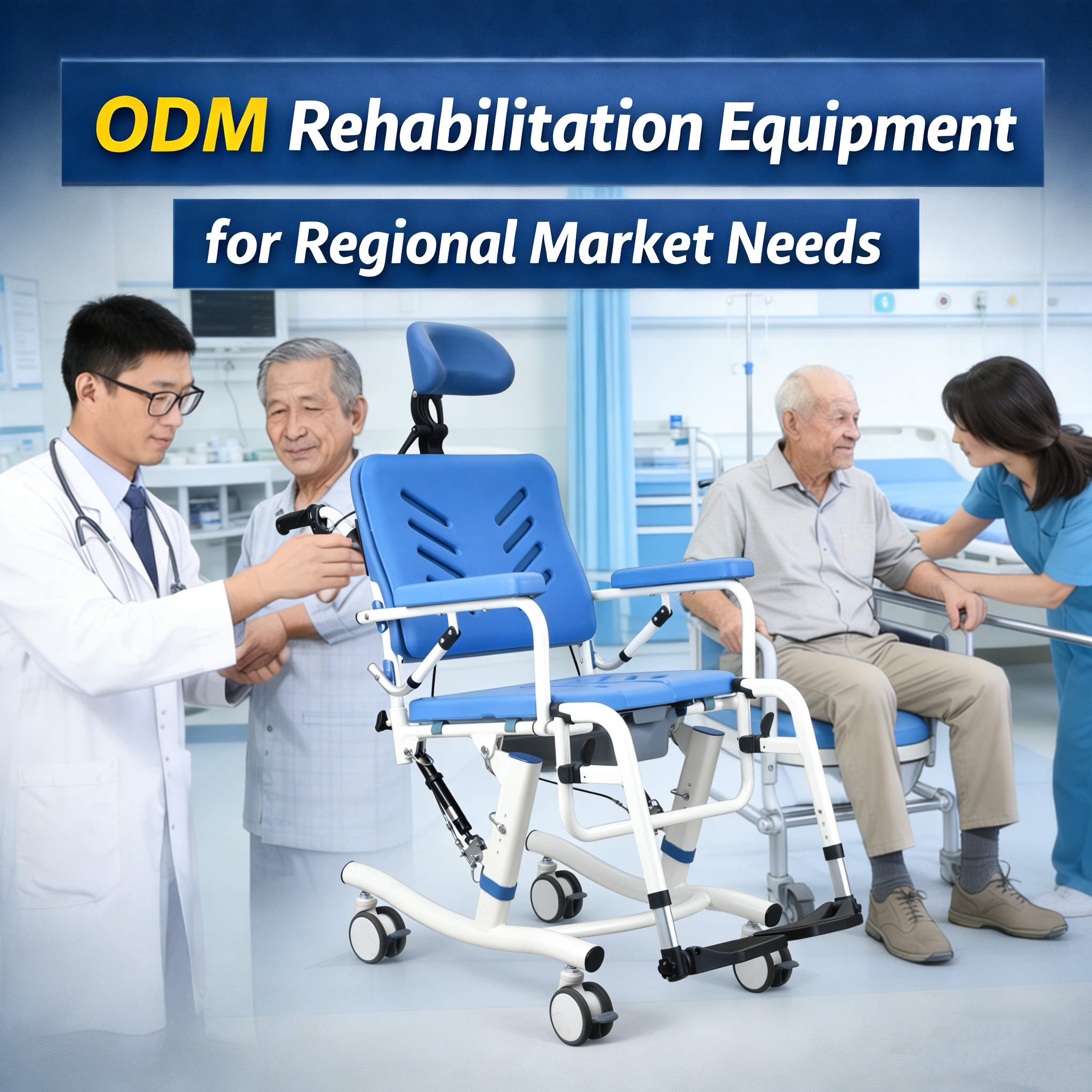
Global healthcare demand is not uniform. Bathroom layouts, regulatory frameworks, caregiver workflows, and user body structures vary significantly across regions.
For global B2B buyers, selecting a partner capable of true ODM rehabilitation equipment development requires more than basic manufacturing capacity. It demands engineering insight, compliance integration, and long-term operational reliability.
In today’s competitive environment, regional market adaptation has become a defining capability of a professional rehabilitation equipment manufacturer.
Why Regional Market Adaptation Matters
Rehabilitation products such as commode chairs, shower chairs, bedside rails, and patient transfer devices are directly linked to daily care safety. A product designed for one region may not perform efficiently in another due to:
-
Bathroom size differences
-
Cultural care habits
-
Regulatory standards
-
Caregiver workflow variations
-
Average user body structure
Effective structural engineering adaptation ensures that products meet weight standards, space limitations, and operational expectations across different markets.
This is where ODM product development becomes critical.
ODM Product Development vs. Simple Customization
Many suppliers offer cosmetic changes. Few offer true engineering-driven medical equipment customization.
Professional ODM product development goes beyond modifying colors or dimensions. It integrates:
-
Structural analysis and load validation
-
Mold redesign and tooling adjustments
-
Compliance-oriented design from early-stage concept
-
Functional adaptation for real care scenarios
A strong partner understands that compliance-oriented design must be embedded at the beginning of product development — not added later as a correction step.
Compliance Integration in Global Markets
For buyers serving Europe, Southeast Asia, or North America, regulatory differences cannot be ignored.
A qualified rehabilitation equipment manufacturer should maintain:
-
ISO 13485 manufacturing systems
-
Documented risk management procedures
-
Full traceability records
-
Structured quality validation protocols
For EU-oriented projects, proper CE compliance integration must be incorporated into the engineering stage, not postponed to final inspection.
Without this system-level foundation, customization becomes risky and unstable.
Engineering Adaptation in Practical Care Environments
ODM rehabilitation equipment must function in real-life care environments:
-
Compact home bathrooms in Asia
-
Assisted living facilities in Europe
-
Home-care-dominant markets in North America
Through regional market adaptation, engineering teams adjust:
-
Frame structure and width
-
Weight capacity reinforcement
-
Corrosion-resistant materials
-
Height and ergonomic support alignment
This level of structural engineering adaptation protects long-term durability and user safety.
The Role of Long-Term OEM Partnership
Regional customization is not a one-time transaction. It requires ongoing refinement, documentation alignment, and supply chain stability.
For global B2B buyers, building a long-term OEM partnership with a partner experienced in ODM rehabilitation equipment reduces:
-
Re-approval costs
-
Re-tooling risks
-
Compliance inconsistencies
-
Supply interruptions
As discussed in our core article,
Why Long-Term Global Buyers Prefer Working with One OEM Partner, strategic cooperation strengthens operational control and market stability.
Conclusion
ODM rehabilitation equipment is not about altering specifications on paper. It is about integrating engineering validation, regulatory alignment, and regional care understanding into a scalable product system.
For buyers seeking sustainable growth in rehabilitation categories, choosing a partner capable of:
-
Regional market adaptation
-
Compliance-oriented design
-
ISO 13485 manufacturing
-
CE compliance integration
-
Structured medical equipment customization
is not optional — it is foundational.
In global B2B healthcare supply, engineering depth determines long-term competitiveness.