 EN
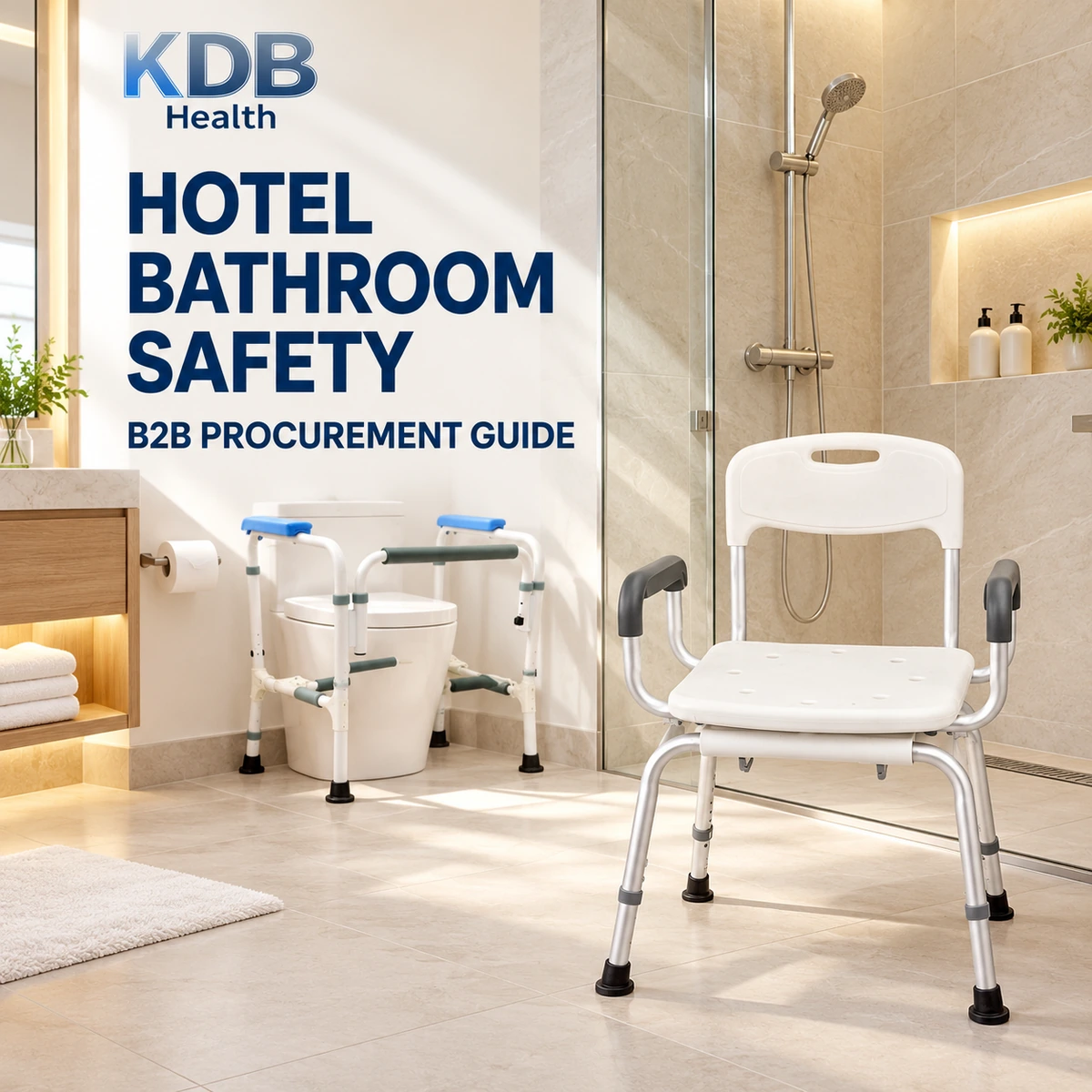
Bathroom safety is an important part of accessible guest-room planning, but purchasing equipment for a hotel project involves more than selecting a shower chair or grab bar from a catalogue.
Hotel owners, property developers, hospitality procurement teams and project suppliers must consider room dimensions, installation conditions, cleaning routines, product storage, replacement parts and the different needs of guests. A product that performs well in one room layout may not be suitable for another property or bathroom configuration.
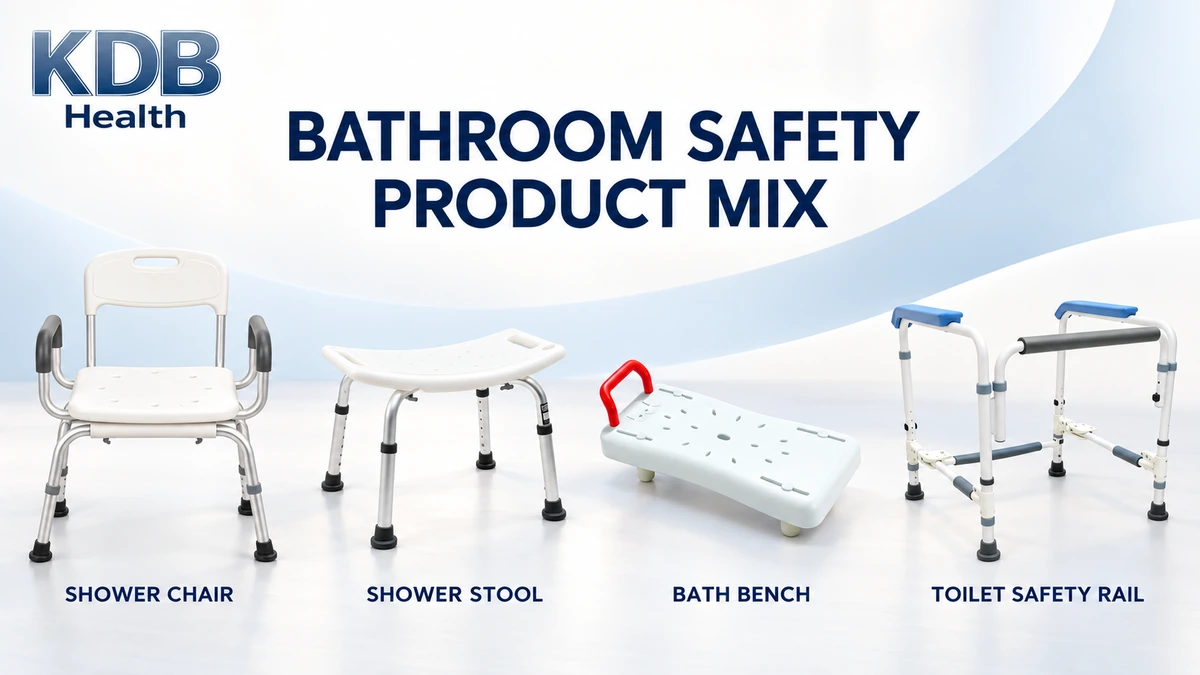
KDB Health supports hospitality project buyers with a broad range of bathroom safety solutions, including shower chairs, shower stools, toilet safety rails, grab bars and selected commode chair configurations.
This guide explains how B2B buyers can evaluate these products and plan a consistent bathroom safety programme across one or multiple properties.
Key Takeaways
▪ Begin with guest-room and bathroom scenarios rather than selecting products only by price.
▪ Confirm dimensions, installation conditions, user access and cleaning requirements before placing a project order.
▪ Ask for product-specific load, material, testing and documentation information instead of assuming that every model has the same certification status.
▪ Test selected products in a sample room before approving a multi-property rollout.
▪ Consider spare parts, packaging, storage and replacement planning as part of the total project cost.
1. Start with the Hotel Application Scenario
Hotels do not necessarily need the same equipment in every room. Product selection should reflect the property type, guest profile and intended use.
| Hotel area or scenario | Possible product categories | Main procurement considerations |
|---|---|---|
| Accessible guest rooms | Shower chairs, fixed grab bars, toilet safety rails | Room dimensions, installation, transfer space and user access |
| Standard rooms with equipment available on request | Portable shower stools, foldable shower chairs, removable toilet safety rails | Storage, quick deployment, cleaning and staff handling |
| Resorts, spa and pool areas | Corrosion-resistant shower stools and bathroom support products | Wet-environment durability, surface grip and maintenance |
| Serviced apartments and long-stay properties | Shower chairs, toilet rails and multifunctional bathroom safety products | Comfort, adjustability, replacement parts and long-term use |
| Central hotel storage | Foldable shower chairs and portable safety equipment | Folded dimensions, identification labels and inventory control |
A hotel project may combine several product types instead of relying on one universal model.
For example, permanently installed support products may be specified for designated accessible rooms, while portable equipment can be stored centrally and provided to guests when requested.
Portable products should not automatically be treated as replacements for permanently installed structural supports. Installation requirements must be reviewed according to the building structure, project specifications and applicable local accessibility requirements.
2. Select the Right Bathroom Safety Product Categories
Shower Chairs and Shower Stools
Shower chairs and stools provide seated support for guests who have reduced balance, strength or mobility.
When reviewing the KDB Health shower chair range, project buyers should compare:
▪ Seat width and seat depth
▪ Adjustable seat-height range
▪ Backrest and armrest configuration
▪ Fixed or removable components
▪ Frame material and surface treatment
▪ Foot-tip design and floor contact
▪ Folded size, where applicable
▪ Cleaning and drainage characteristics
A simple shower stool may be sufficient for a compact bathroom, while a model with a backrest and armrests may offer more support in an accessible guest room.
The final selection should reflect the available bathroom space and intended user group.
Grab Bars and Toilet Safety Rails
Grab bars and toilet safety rails can support guests when standing, sitting or moving within the bathroom.
Buyers evaluating bathroom safety equipment should distinguish between:
▪ Permanently installed wall-mounted supports
▪ Floor-mounted or toilet-mounted safety rails
▪ Foldable support arms
▪ Portable support products
▪ Products intended only for temporary assistance
For wall-mounted products, the wall structure, fixing method, fasteners and installation position are as important as the bar itself. Installation should be carried out according to the product instructions, project specifications and applicable local requirements.
Commode Chairs for Extended-Stay and Assisted-Travel Scenarios
Some long-stay properties, accessible apartments and hospitality projects serving rehabilitation travellers may also require commode chairs.
The KDB Health commode chair collection includes different frame structures, seat configurations and mobility options. The appropriate model depends on the user scenario, bathroom access, caregiver involvement and storage conditions.
Commode chairs should not be added to a hotel product list without first clarifying who will use them, where they will be stored and how staff will clean and manage them.
3. Check Product Fit Before Comparing Prices
A low unit price does not create value if the product cannot fit the intended bathroom or guest-room workflow.
Before requesting a quotation, project buyers should provide the supplier with:
▪ Bathroom layout or available floor space
▪ Shower-area dimensions
▪ Toilet height and surrounding clearance
▪ Door width and turning space
▪ Preferred seat-height range
▪ Expected user profiles
▪ Storage limitations
▪ Installation restrictions
▪ Estimated quantity by property or room type
For movable products, buyers should also review whether staff can carry, fold, store and redeploy the equipment efficiently.
A sample-room test can reveal problems that may not be visible in a specification sheet, such as restricted door movement, insufficient transfer space or difficulty positioning the product beside the toilet.
4. Evaluate Materials, Corrosion Resistance and Cleaning
Hotel bathroom equipment may be exposed to moisture, cleaning products and frequent handling. Material selection therefore affects both appearance and service life.
Common frame and component materials may include:
▪ Aluminum
▪ Stainless steel
▪ Powder-coated steel
▪ Engineering plastics
▪ Rubber or other non-slip materials
The material name alone does not determine performance. Buyers should also ask about surface treatment, joint construction, fasteners, cleaning instructions and the compatibility of components with the property’s normal cleaning process.
Important questions include:
▪ Can the seat or backrest be removed for cleaning?
▪ Are there unnecessary gaps where water and residue may collect?
▪ Which cleaning agents should be avoided?
▪ Can worn foot tips, fasteners or seats be replaced?
▪ Does the supplier provide cleaning and maintenance instructions?
▪ Are replacement parts available for the expected service period?
Easy-to-clean design is normally more useful to hotel operations than broad, unverified hygiene claims.
5. Assess Antimicrobial Claims Carefully
“Antimicrobial” should not be used as a general marketing term without product-specific evidence.
If antimicrobial materials, coatings or additives are requested, the buyer should ask the supplier to identify:
▪ The exact product or component that was tested
▪ The material or coating covered by the report
▪ The test method used
▪ The independent laboratory that conducted the test
▪ The microorganisms included in the test
▪ The measured result and test conditions
▪ Whether performance was evaluated after cleaning or wear
A test result for one plastic material or coating should not automatically be applied to every product in a bathroom safety range.
Antimicrobial properties also do not replace routine cleaning, disinfection or property hygiene procedures. KDB Health provides model-specific documentation where applicable rather than presenting one claim as covering every product.
6. Review Stability, Load and Instructions for Use
Bathroom safety products must be assessed as complete systems rather than as separate tubes, seats or fasteners.
Depending on the product category, buyers may need to review:
▪ Declared maximum user weight
▪ Frame and joint construction
▪ Stability on the intended floor surface
▪ Adjustment and locking mechanisms
▪ Foot-tip or wheel configuration
▪ Seat and armrest attachment
▪ Product warnings and limitations
▪ Assembly and installation instructions
▪ Inspection and maintenance procedures
Load figures should always be associated with a specific model and configuration. A value stated for one product should not be assumed to apply to another model that uses a different frame, seat, caster or accessory combination.
7. Use a Pilot Room Before a Large Rollout
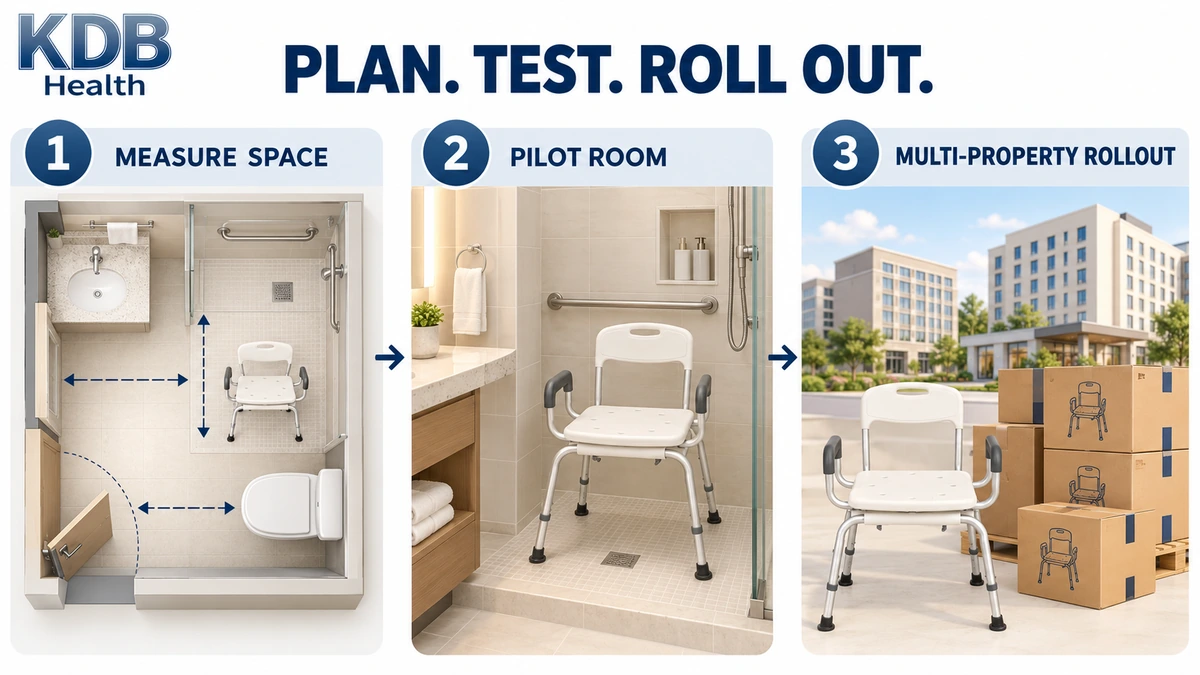
A pilot-room process can reduce risk before equipment is deployed across multiple rooms or properties.
A practical pilot may include:
-
Confirming the intended room and guest scenarios.
-
Selecting two or three suitable product configurations.
-
Reviewing dimensions and product documentation.
-
Installing or positioning samples in a representative bathroom.
-
Asking housekeeping, maintenance and project teams to evaluate daily handling.
-
Recording issues involving space, cleaning, storage or installation.
-
Approving the final configuration before bulk production.
For projects involving several hotels, the buyer may first approve one reference room and then use the confirmed product specification across additional properties.
Growing hospitality suppliers can also review KDB Health’s guide to low-MOQ medical equipment sourcing when planning pilot orders. Actual MOQ depends on the product, configuration, packaging and customization requirements.
8. Plan Customization Around the Project
Hospitality projects may require products that match a property’s interior, brand guidelines or operational process.
Depending on the selected model and order requirements, customization may include:
▪ Frame or plastic-component colors
▪ Brand labels
▪ Product identification labels
▪ User instructions
▪ Outer-carton markings
▪ Retail or project packaging
▪ Selected accessories
▪ Configuration adjustments
Cosmetic changes are generally easier to implement than structural modifications. Changes involving the frame, seat dimensions, load-bearing components or installation method require additional engineering review and may affect sampling, tooling, testing, MOQ and lead time.
For projects requiring structural development, buyers can review the KDB Health custom rehabilitation equipment ODM development guide.
9. Compare Total Project Cost, Not Only Unit Price
Unit price is only one part of the procurement decision.
The total project cost may also include:
▪ Sample preparation
▪ Product customization
▪ Installation components
▪ Packaging
▪ Freight and consolidation
▪ Import documentation
▪ Storage
▪ Staff training
▪ Replacement parts
▪ Warranty handling
▪ Product replacement caused by incorrect specification
A product with a slightly lower purchase price may become more expensive if it is difficult to clean, cannot fit the intended room, requires frequent replacement or lacks spare parts.
For multi-property projects, consistent specifications and repeatable supply may be more valuable than selecting the lowest quotation for each individual order.
10. Documentation and Market Requirements
Bathroom safety and rehabilitation products may be treated differently depending on their intended use, design and destination market.
Before ordering, buyers should confirm:
▪ Intended use of each product
▪ Product classification in the target market
▪ Applicable product and installation requirements
▪ Required labels and instructions
▪ Importer or distributor responsibilities
▪ Technical documents available for the selected model
▪ Whether changes to the product affect existing documentation
ISO 13485 relates to the manufacturer’s quality management system. It should not be interpreted as meaning that every product automatically has the same market approval or product certification.
Similarly, CE, FDA or other regulatory statements should be checked at model level and against the intended sales market. Buyers should request the documents relevant to the specific product rather than relying only on logos displayed in marketing materials.
11. Questions to Ask a Bathroom Safety Equipment Supplier
Before approving a hospitality project supplier, ask:
▪ Which models are suitable for the proposed room and user scenario?
▪ Can you provide verified dimensions and product specifications?
▪ What is included in the standard product configuration?
▪ Which components or accessories can be customized?
▪ What product-specific test or documentation is available?
▪ What are the sample and production schedules?
▪ How is MOQ determined for mixed-product projects?
▪ Can multiple product categories be consolidated for shipment?
▪ Which replacement parts are available?
▪ How are specification changes controlled between production batches?
▪ Can labels, instructions and cartons be prepared for the destination market?
Clear answers to these questions help distinguish a project-capable supplier from a company that simply offers a catalogue and price list.
Why Work with KDB Health?
KDB Health supports global distributors, hospitality suppliers, project buyers and healthcare brands with bathroom safety and rehabilitation equipment solutions.
Our capabilities include:
▪ More than 14 years of rehabilitation equipment experience
▪ An ISO 13485-certified quality management system
▪ In-house product development and engineering support
▪ A broad rehabilitation equipment product portfolio
▪ OEM and ODM support for selected products and projects
▪ Product configuration, packaging and documentation coordination
▪ Sample evaluation before project-scale production
Rather than applying one product, MOQ or compliance statement to every buyer, we evaluate the selected models, customization requirements and destination market before confirming a project proposal.
Frequently Asked Questions
Is the MOQ always 500 units for hotel projects?
No. MOQ depends on the selected product, configuration, color, packaging and customization requirements. Standard models and mixed-product projects may require different quantities.
Can a hotel project combine shower chairs, grab bars and toilet safety rails in one order?
Potentially, yes. Product compatibility, MOQ, packaging and shipping arrangements must be reviewed before confirmation. Buyers should provide an estimated quantity for each product category.
Do all KDB Health bathroom safety products have antimicrobial coatings?
No general antimicrobial claim should be applied to every product. Materials and surface treatments vary by model. If antimicrobial performance is required, request product-specific test information before ordering.
Can bathroom safety equipment be customized to match a hotel brand?
Selected colors, labels, instructions and packaging may be customized depending on the model and order quantity. Structural changes require separate engineering review.
What information should hotel project buyers provide?
The most useful information includes the destination market, property type, room layouts, installation requirements, product categories, expected quantities, packaging needs and delivery schedule.
Should buyers test samples before placing a project order?
Yes. Sample-room testing is strongly recommended for projects involving new room layouts, installation conditions or product configurations.
Discuss Your Hospitality Bathroom Safety Project
Planning accessible guest rooms, a hotel renovation or a multi-property hospitality project?
KDB Health can help you review product categories, room requirements, customization options, sample arrangements and project quantities.
Contact KDB Health to discuss your bathroom safety equipment requirements and request a project-specific proposal.
Table of Contents
- Key Takeaways
- 1. Start with the Hotel Application Scenario
- 2. Select the Right Bathroom Safety Product Categories
- 3. Check Product Fit Before Comparing Prices
- 4. Evaluate Materials, Corrosion Resistance and Cleaning
- 5. Assess Antimicrobial Claims Carefully
- 6. Review Stability, Load and Instructions for Use
- 7. Use a Pilot Room Before a Large Rollout
- 8. Plan Customization Around the Project
- 9. Compare Total Project Cost, Not Only Unit Price
- 10. Documentation and Market Requirements
- 11. Questions to Ask a Bathroom Safety Equipment Supplier
- Why Work with KDB Health?
-
Frequently Asked Questions
- Is the MOQ always 500 units for hotel projects?
- Can a hotel project combine shower chairs, grab bars and toilet safety rails in one order?
- Do all KDB Health bathroom safety products have antimicrobial coatings?
- Can bathroom safety equipment be customized to match a hotel brand?
- What information should hotel project buyers provide?
- Should buyers test samples before placing a project order?
- Discuss Your Hospitality Bathroom Safety Project