
 EN
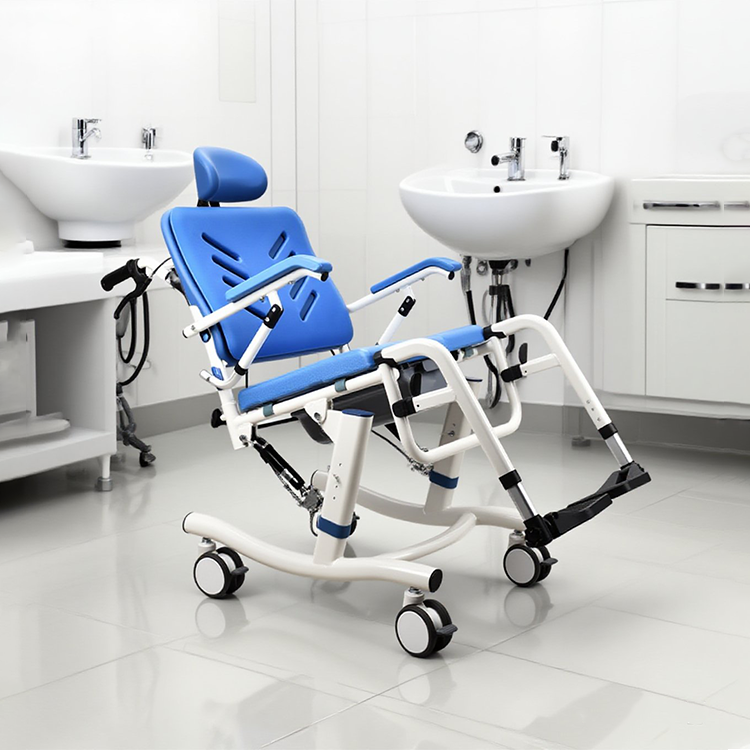
Australian aged-care and healthcare buyers should select mobile commode chairs around the care task, room layout and the exact model’s intended use. A wheeled chair may combine some toileting, bathing or movement functions, but those functions must be confirmed individually. Product popularity or a broad “all-in-one” label is not a substitute for assessment.
Define the intended use
State whether the chair will be used beside a bed, over a toilet, in a shower or for movement along an approved indoor route. Confirm whether occupied transport is permitted and which accessories are required. Ask clinical staff to assess the person’s transfer method, seating support and assistance needs.
Check dimensions against the bathroom
Compare overall width, turning space, seat height, usable seat width and under-seat clearance with the doorway, toilet and shower. Consider armrest and footrest positions during transfers. Measure the working configuration, including accessories, rather than relying on carton dimensions.
Review wheels, brakes and support
Request the manufacturer’s braking instructions for parking, transfers and movement. Check wheel compatibility with the intended floor and thresholds. Review locks, foot supports, armrests and bucket retention on a sample. Neither a reclining backrest nor a larger wheel independently proves suitability for a particular user.
Verify documents for Australian supply
Ask the Australian importer or sponsor to confirm the product’s applicable regulatory pathway, labeling and instructions before supply. Request documents for the exact model and intended use. Do not treat a CE marking or a quality-system certificate as proof of Australian market authorization.
Compare candidate models using current specifications
KDB Health’s product pages include KDB615B, a folding model with rear wheels and a reclining commode chair. Use these as a starting point for a shortlist, then obtain current drawings, rated load, configuration details and instructions. Availability and specifications should be confirmed in the quotation.
Plan cleaning and ongoing service
Check compatible cleaning agents, removable parts, drying requirements and inspection intervals. Agree spare-part supply and service responsibilities before ordering. Record model and batch details for traceability.
For purchasing criteria across equipment categories, see our hospital procurement guide. Send KDB Health the intended care tasks and dimensional constraints to request a documented model comparison.