 EN
Published: June 28, 2025 | Last Updated: November 2, 2026
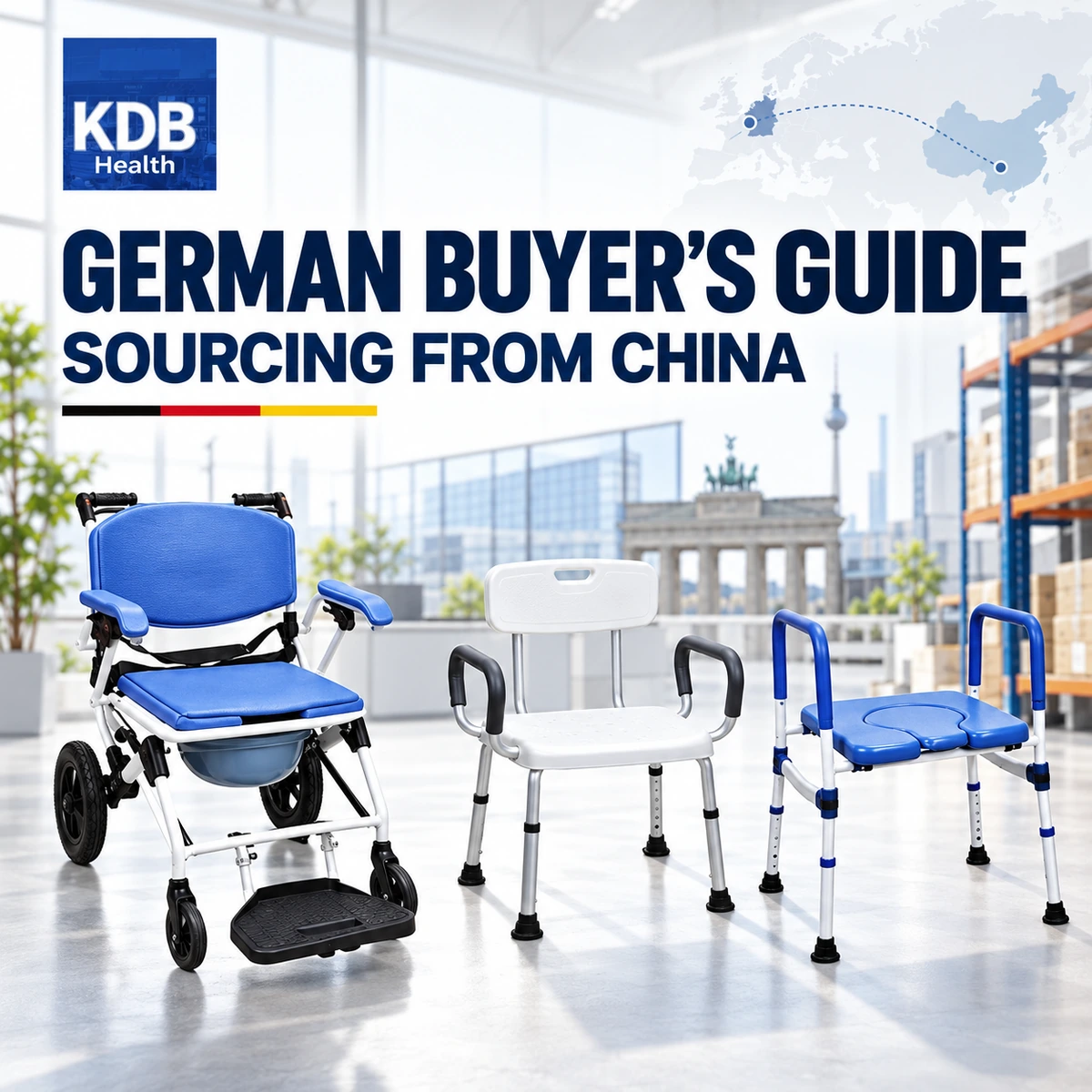
For German healthcare distributors, retailers, online sellers and project partners, sourcing rehabilitation equipment from China can provide access to a broad product range, flexible customization and competitive manufacturing capacity.
However, a successful purchasing decision should not be based on unit price alone. Products such as commode chairs, shower chairs, toilet safety rails and patient transfer equipment require clear technical specifications, consistent quality, appropriate documentation and reliable after-sales support.
This guide explains what German buyers should evaluate before selecting a Chinese rehabilitation equipment manufacturer—and how to reduce risk from the initial inquiry through mass production.
1. Start with a Detailed Product Brief
Before requesting a quotation, buyers should prepare a clear product brief. A request such as “We need shower chairs for Germany” is usually not detailed enough for an accurate proposal.
The brief should specify:
▪ Product category and intended use
▪ Target user and care environment
▪ Required dimensions and adjustment range
▪ Expected load capacity
▪ Preferred frame, seat and surface materials
▪ Folding, transfer or mobility functions
▪ Estimated trial order and annual purchasing volume
▪ Branding and packaging requirements
▪ Target retail, wholesale or project channel
For example, a shower chair intended for online retail may need compact packaging and tool-free assembly. A product supplied to a project partner may require different documentation, spare-parts planning and batch consistency.
Providing this information early helps the supplier recommend a suitable existing model or determine whether an OEM or ODM development project is required.
2. Verify Compliance Documentation Product by Product
German buyers should avoid relying on general claims such as “all products are CE certified” or “the factory is TÜV approved.”
Compliance should be checked for the exact model, intended use and target market.
Depending on the product, buyers may need to review:
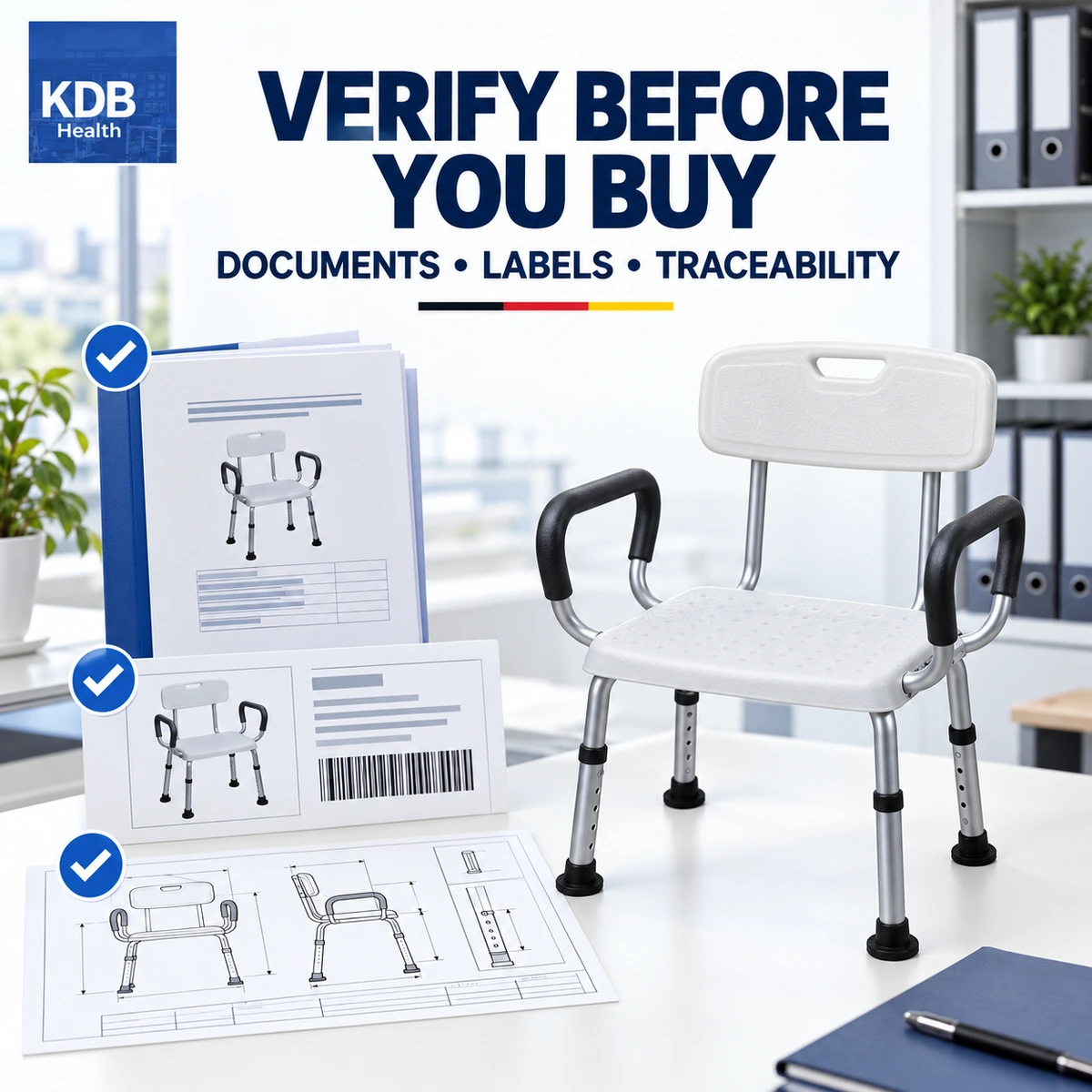
▪ Product classification and intended-purpose statement
▪ Declaration of Conformity
▪ Applicable CE documentation
▪ Manufacturer and EU authorized representative information
▪ Product labels and instructions for use
▪ Risk-management and relevant test documentation
▪ UDI or registration information where applicable
▪ Valid ISO 13485 quality-management certification
ISO 13485 confirms that a manufacturer operates a medical-device quality-management system. It does not, by itself, prove that every product model meets all German or EU market requirements.
Under Article 13 of the EU Medical Device Regulation, an importer must verify, among other requirements, that the device carries the applicable CE marking, has an EU Declaration of Conformity, identifies the manufacturer and authorized representative, and includes the required labeling and instructions.
A TÜV-issued report or certificate may be relevant when TÜV acted as the testing organization or notified body for a particular product. However, “TÜV certified” should not be treated as a universal requirement or as a substitute for reviewing the complete product documentation.
At KDB Health, available compliance and technical documents are confirmed according to the specific model and destination market before order approval. Buyers should request and review these documents rather than relying on broad catalogue statements.
3. Approve Specifications and Samples Before Mass Production
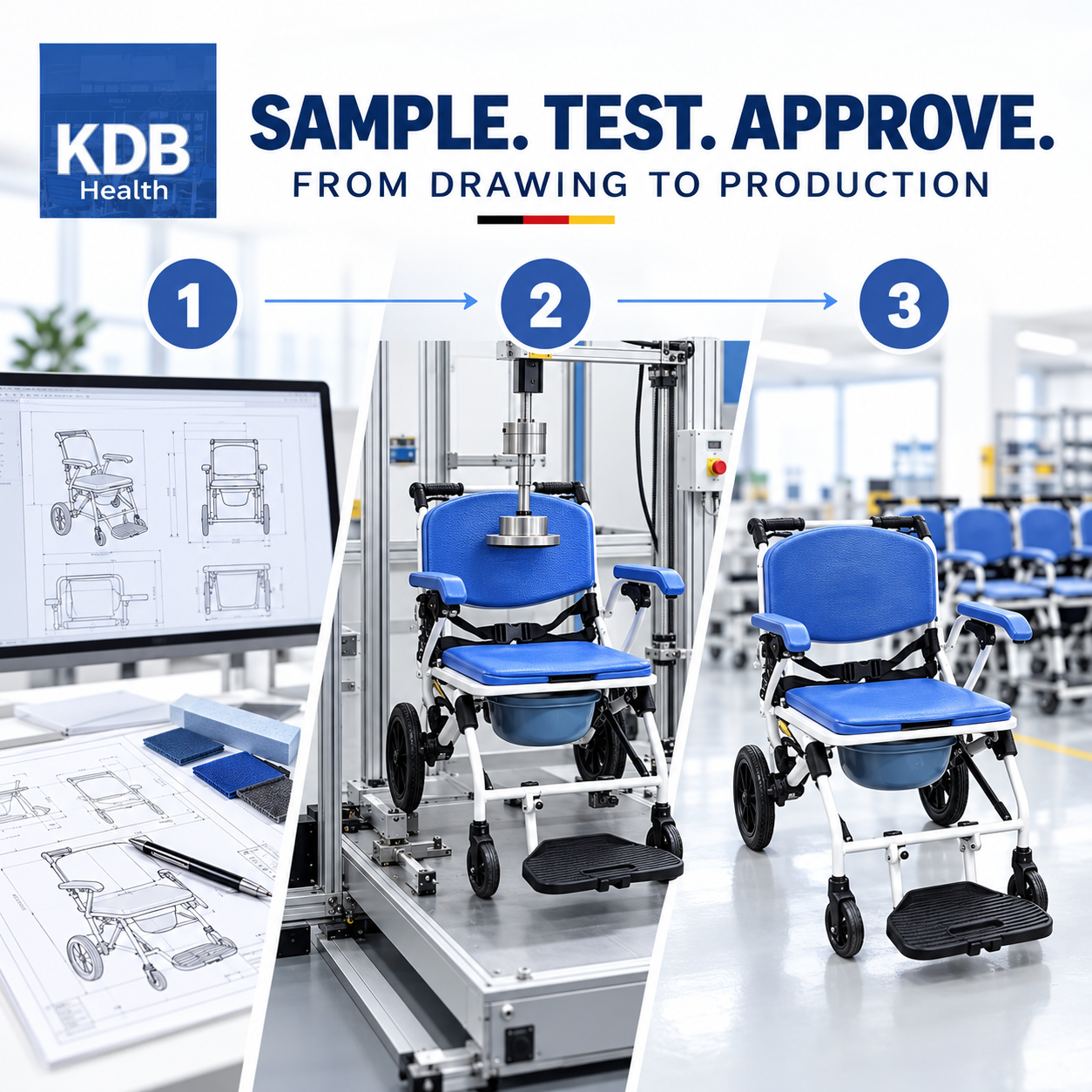
A reliable sourcing process should include a documented sample-approval stage.
Before confirming mass production, German buyers should check:
▪ Product dimensions and adjustment mechanisms
▪ Frame stability and structural strength
▪ Folding and locking functions
▪ Surface finish and corrosion resistance
▪ Seat comfort and ease of cleaning
▪ Assembly method and included components
▪ Labels, manuals, barcodes and packaging
▪ Carton strength and shipping protection
The approved sample should become the reference for mass production. Important specifications should also be recorded in drawings, specification sheets or a signed sample-approval document.
For customized products, buyers should identify which changes are cosmetic and which changes affect the product structure. A new color or logo may be relatively straightforward, while changes to the frame, caster system, load capacity or transfer mechanism may require additional engineering evaluation and testing.
4. Establish a Clear Quality-Control Plan
Quality consistency is particularly important for buyers supplying retail chains, online platforms or multi-location projects.
A practical quality-control plan may include:
▪ Incoming-material inspection
▪ Dimensional checks during production
▪ Welding and assembly inspection
▪ Functional testing of locks, brakes and adjustment systems
▪ Load and stability testing where applicable
▪ Packaging and labeling verification
▪ Final random inspection before shipment
▪ Batch and production-record traceability
Buyers should also agree on the inspection method before placing an order. This may involve the manufacturer’s internal final inspection, a buyer-appointed inspection team or an independent third-party inspection company.
Any approved inspection standard, sampling method and acceptance criteria should be written into the purchase agreement rather than discussed only after production has been completed.
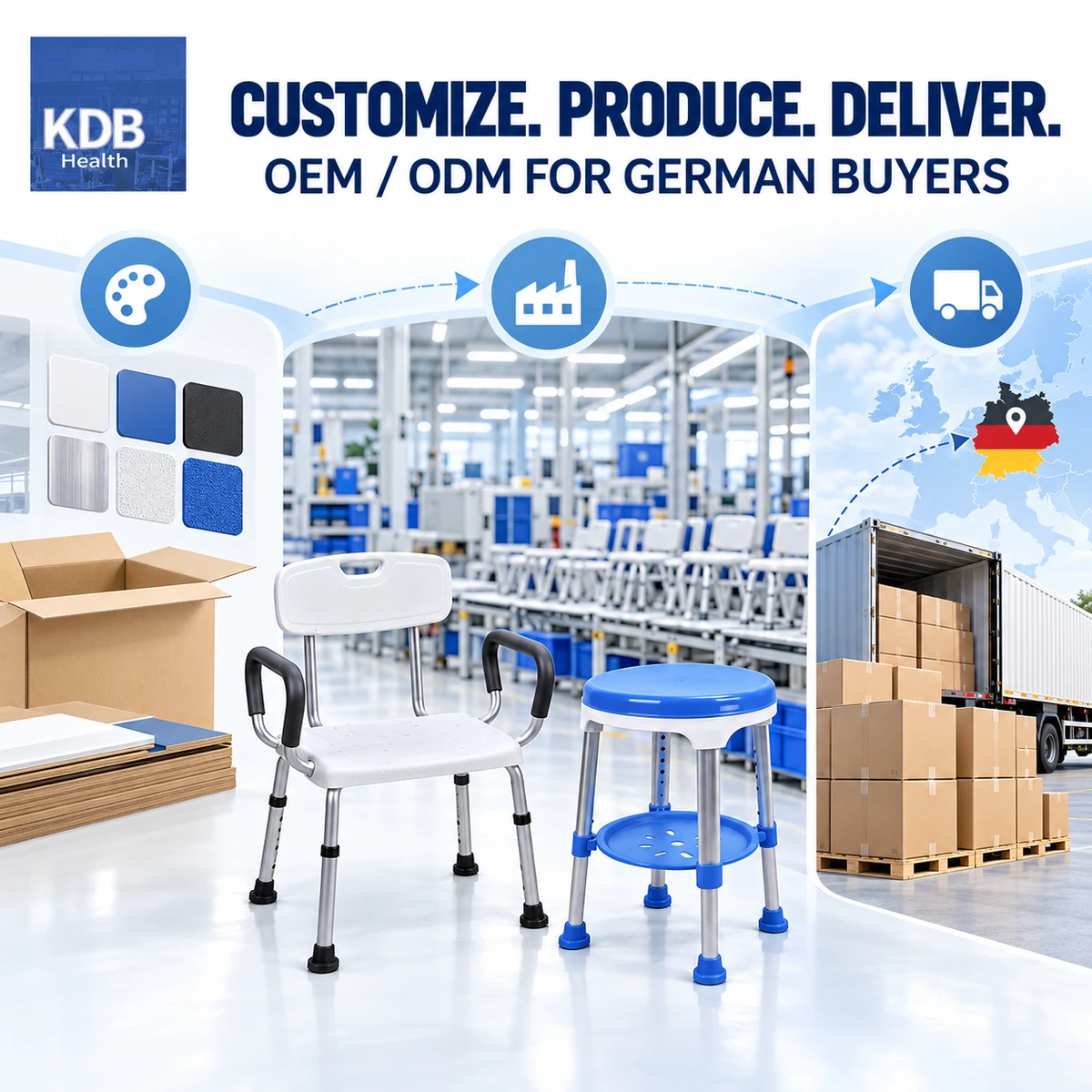
5. Plan OEM and ODM Customization Carefully
German distributors and healthcare brands often require products that differ from standard catalogue models.
Common customization options include:
▪ Logo printing and private labeling
▪ Customized retail or e-commerce packaging
▪ German-language manuals and labels
▪ Product colors and surface finishes
▪ Seat, armrest or backrest adjustments
▪ Caster, foot-tip or accessory selection
▪ Carton dimensions and pallet configuration
ODM manufacturing can be suitable for buyers who want to begin with an existing product platform and make controlled modifications. It generally requires less development time and investment than creating a completely new product.
OEM development may be more appropriate when the buyer already owns the product design or requires an exclusive structure.
Private labeling should not be treated as simply adding a logo. The manufacturer and buyer should clarify regulatory responsibilities, labeling content, documentation ownership and the effect of any product modifications before production begins.
6. Consider German Packaging Responsibilities
Packaging compliance should be reviewed early, especially for private-label products sold through retailers or e-commerce channels.
Companies placing packaged goods on the German market may have registration, system-participation and packaging-volume reporting obligations. The responsible party depends on the sales model and its position in the supply chain.
German buyers should check the official LUCID Packaging Register and confirm:
▪ Which company is responsible for registration
▪ Which brand names must be registered
▪ Whether the packaging is subject to system participation
▪ Who will report packaging volumes
▪ Whether an authorized representative is required
▪ What packaging data the supplier must provide
KDB Health can provide packaging specifications, material details and customized packaging information for buyer review. Final German packaging-registration responsibilities should be confirmed by the buyer or its local compliance adviser.
7. Calculate the Total Landed Cost
The lowest factory quotation is not always the lowest final cost.
German buyers should compare the complete landed-cost structure, including:
▪ Product price
▪ Tooling or customization costs
▪ Sample and testing fees
▪ Packaging and pallet costs
▪ Freight and cargo insurance
▪ Customs duties and import VAT
▪ Inspection expenses
▪ Warehousing and fulfillment costs
▪ Spare parts and warranty handling
The quotation should clearly state the applicable Incoterm, shipment point, payment conditions, production lead time and responsibilities of each party.
FOB, CIF and DDP quotations allocate costs and responsibilities differently. Buyers should clarify who acts as the importer of record and who is responsible for customs documentation, taxes and final delivery before selecting a shipping term.
8. Evaluate Communication and Project Transparency
A suitable long-term manufacturing partner should provide more than a quotation.
During supplier evaluation, buyers should consider whether the manufacturer can:
▪ Respond clearly to technical questions
▪ Provide drawings and product specifications
▪ Explain which documents apply to each model
▪ Share sample and production timelines
▪ Report production progress at agreed stages
▪ Support factory audits and pre-shipment inspections
▪ Investigate quality issues and provide corrective actions
▪ Maintain spare-parts availability for purchased products
A structured sourcing process commonly follows these steps:
Product brief → Model selection → Documentation review → Sample approval → Trial order → Mass production → Inspection → Shipment → After-sales follow-up
This process gives both parties clear approval points and reduces misunderstandings before mass production.
How KDB Health Supports German Buyers
KDB Health works with healthcare brands, distributors, retailers, online sellers and project partners sourcing bathroom safety equipment and rehabilitation products.
Our product portfolio includes:
▪ Commode chairs
▪ Shower chairs
▪ Toilet safety rails and raised toilet seats
▪ Patient transfer and lifting equipment
▪ Bedside safety products
▪ Walking and daily-living aids
KDB Health’s manufacturing support includes an ISO 13485 quality-management system, in-house engineering, OEM/ODM development, product sampling, packaging customization and production inspection.
For selected standard models and customization projects, trial orders may start from 50 units. Sample development can be completed in approximately 15 days for suitable projects, depending on the product structure, materials and customization requirements.
Product documentation, MOQ, lead time and available customization should always be confirmed for the selected model before ordering.
German Buyer’s Supplier Checklist
Before confirming a purchase order, check whether you have received:
▪ Final product specification sheet
▪ Approved sample or sample report
▪ Model-specific compliance documents
▪ Label and instruction-manual artwork
▪ Packaging specifications
▪ Confirmed MOQ and pricing tiers
▪ Production and inspection schedule
▪ Agreed Incoterm and payment terms
▪ Warranty and spare-parts conditions
▪ Contact process for quality claims
Frequently Asked Questions
Does ISO 13485 mean that every product is CE compliant?
No. ISO 13485 relates to the manufacturer’s quality-management system. Product conformity must still be evaluated and documented for the specific model and intended market.
Is TÜV certification mandatory for all rehabilitation equipment sold in Germany?
No. TÜV may act as a testing organization or notified body in certain cases, but a generic TÜV claim is not a universal market-access requirement. Buyers should review the applicable conformity procedure and exact product documentation.
Can existing documentation automatically cover a private-label product?
Not always. Branding, labeling and structural modifications may affect the documentation and the regulatory responsibilities of the parties. This should be reviewed before approving private-label production.
Can German buyers begin with a trial order?
Yes. A trial order can be used to evaluate product quality, packaging, customer response and delivery performance before increasing purchasing volume. MOQ depends on the model and customization level.
Build a More Reliable Sourcing Process
Working with a Chinese rehabilitation equipment manufacturer can provide German buyers with product variety, customization and scalable manufacturing.
The strongest partnerships are built on clear specifications, model-specific documentation, approved samples, transparent quality control and realistic logistics planning.
To discuss your product requirements, expected quantity and target sales channel, contact KDB Health for a model recommendation, document review and OEM/ODM project assessment.
Table of Contents
- 1. Start with a Detailed Product Brief
- 2. Verify Compliance Documentation Product by Product
- 3. Approve Specifications and Samples Before Mass Production
- 4. Establish a Clear Quality-Control Plan
- 5. Plan OEM and ODM Customization Carefully
- 6. Consider German Packaging Responsibilities
- 7. Calculate the Total Landed Cost
- 8. Evaluate Communication and Project Transparency
- How KDB Health Supports German Buyers
- German Buyer’s Supplier Checklist
- Frequently Asked Questions
- Build a More Reliable Sourcing Process