
 EN
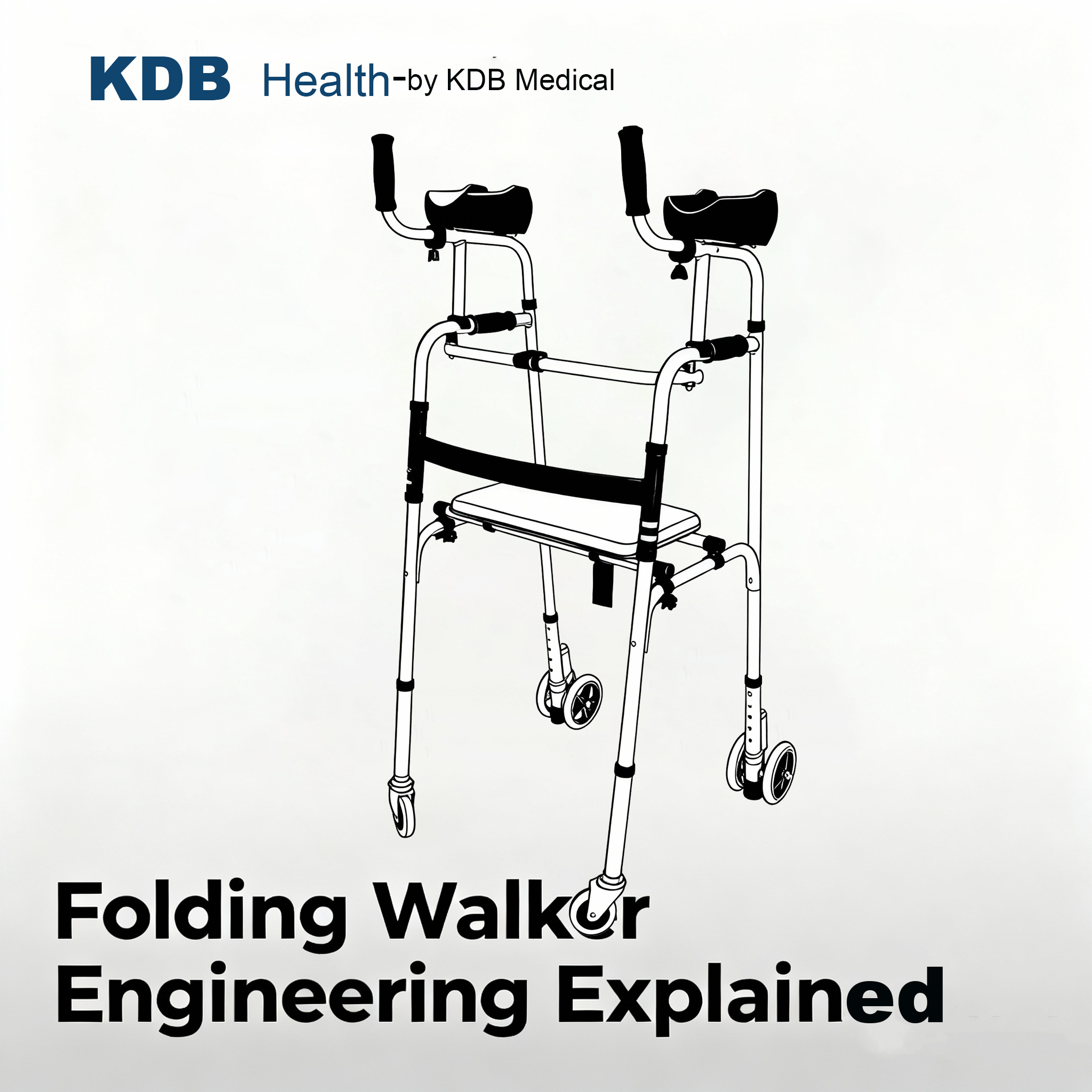
This is a document-based engineering review of the KDB916B-A03 forearm-support folding walker. It examines the published configuration and the evidence a buyer should request. It is not a physical test report, and the listed figures must be checked against the current model drawing and instructions before an order.
Published specification baseline
| Item | Previously published specification | Procurement check |
|---|---|---|
| Load rating | 100 kg | Confirm the rated use and supporting report, including any separate seat rating. |
| Overall size | 57 × 62 × 112–122 cm | Confirm width/depth orientation, adjustment position and tolerances on a drawing. |
| Seat | 35.5 × 23 cm; height 52.5–62.5 cm | Confirm permitted seated use and operating instructions. |
| Adjustment | Five upper-support positions; seven leg-tube positions | Obtain a configuration chart and verify minimum tube engagement. |
| Wheels | 5-inch front and 3-inch rear | Confirm wheel type, movement control and approved surfaces. |
The earlier description lists five height positions at 2.54 cm spacing. Four such intervals total 10.16 cm, while the stated overall range is 10 cm. This may reflect rounding, but buyers should request the dimensioned drawing rather than treat the two statements as an exact match.
Frame and folding joints
The published design describes aluminum main tubes and reinforced ferrous components at joints and brackets. Material selection alone cannot establish strength or service life. Request material and finish specifications, folding-lock details and model-specific strength, stability and repeated-operation evidence. Inspect the approved sample for fastener retention, joint movement, sharp edges and accessible pinch points.
Forearm support and adjustment
The described PU forearm platforms and vertical handles create a different support arrangement from a hand-grip walker. Check support spacing, length adjustment, pad condition and the locking method. A therapist should assess fit and whether the user can control the device. The design description does not prove reduced fatigue, fall prevention or suitability for a named diagnosis.
Wheels and route compatibility
Wheel diameter alone cannot establish obstacle performance or outdoor suitability. Confirm the instructions for movement control, parking, seated rest and floor conditions. Evaluate the intended route in a supervised assessment, including doorways and transitions. Do not infer that the device is a transport chair or that a user may be pushed while seated.
Cleaning and maintenance evidence
Ask for approved cleaning agents, contact times, drying instructions and inspection intervals for pads, wheel assemblies, adjustment buttons and folding locks. Obtain replacement-part references and removal-from-service criteria. A surface finish described as corrosion resistant does not independently prove compatibility with repeated hospital disinfection.
Decision before sample approval
The configuration is suitable for further evaluation where forearm support and folding storage are specified, subject to clinical suitability and verified documentation. Keep the purchasing decision open until current drawings, instructions, test evidence and the sample configuration agree. Record unresolved points instead of converting design features into performance guarantees.
Our engineering capability guide offers a wider supplier checklist. Request the current KDB916B-A03 technical file and a sample evaluation plan from KDB Health.