Product development at KDB Health does not end when a prototype is completed.
A product can perform well in drawings, tests and showroom demonstrations, yet still reveal new questions when it enters a real care environment. Room layouts, bed heights, bathroom thresholds, caregiver routines and individual support needs can all influence how equipment performs in daily use.
For this reason, KDB Health periodically brings selected product concepts and samples into real care settings. By observing how caregivers and residents interact with the equipment, our team can identify practical details that may be difficult to reproduce in a factory or showroom.
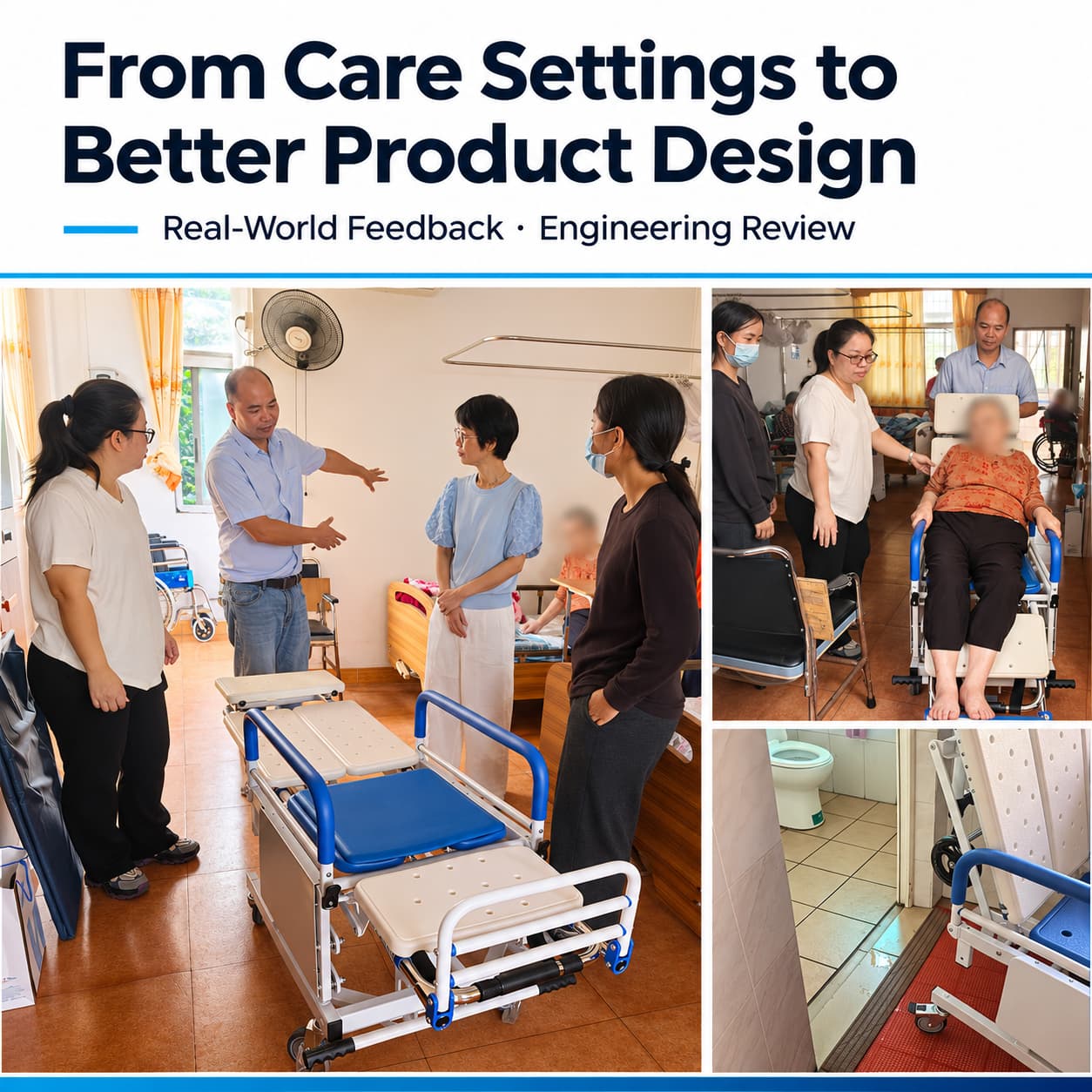
During a recent visit to local elderly-care facilities, KDB Health Founder and CEO Tony Lin joined the product team in observing equipment use and discussing daily care challenges directly with facility staff.
The purpose was straightforward: to listen, observe and bring practical findings back into product development.
In a controlled setting, product evaluation may focus on dimensions, functions, materials and structural performance. In a care facility, additional questions quickly become visible:
▪ Is the equipment easy for one caregiver to push and position?
▪ Does its transfer height match the beds used in the facility?
▪ Can it pass through narrow bathroom doors and restricted spaces?
▪ Does the frame fit around existing toilet layouts?
▪ Are the wheels quiet and stable during movement?
▪ Does the headrest provide appropriate positioning support?
▪ Is the backrest comfortable during longer periods of use?
▪ Are positioning and safety-support options needed for particular care situations?
▪ Can caregivers operate adjustments without adding unnecessary steps to their routine?
These details can directly affect usability, caregiver workload and the overall care experience. They also show why product development must consider not only the equipment itself, but the environment and people around it.
During the visit, the team reviewed how selected care products interacted with beds, toilets, bathroom entrances and everyday caregiver workflows.
Several areas were identified for further engineering assessment:
▪ Opportunities to reduce product weight without compromising structural requirements
▪ Lower transfer-height options for compatibility with different beds
▪ Improved maneuverability in narrow rooms and bathroom entrances
▪ Better frame compatibility with common toilet positions and layouts
▪ Quieter wheel systems and smoother rolling performance
▪ Further evaluation of headrest position and adjustability
▪ Optional positioning and safety-support features, subject to professional assessment and intended use
▪ Greater backrest support and comfort
These observations are not treated as immediate design instructions. Each one must first be reviewed according to the product’s intended use, structure, materials, safety requirements and target market.
Some suggestions may require a dimensional adjustment. Others may involve structural analysis, material evaluation, usability assessment, prototype testing or additional validation before they can be incorporated into a product.
Real-world feedback becomes valuable only when it is translated into a controlled development process.
After a field visit, KDB Health’s product, engineering and quality teams review the observations and determine:
▪ Whether the issue applies to one user, one environment or a broader market need
▪ Whether the proposed change could affect stability, load capacity or product dimensions
▪ Whether different materials or components should be evaluated
▪ Whether a revised prototype is required
▪ Which usability and mechanical tests should be performed
▪ Whether the change affects product documentation, instructions or regulatory requirements
This process helps the team distinguish between an isolated preference and a product improvement that may benefit a larger group of users and care providers.
Field observations do not replace formal risk management, mechanical testing, usability evaluation or regulatory assessment. Instead, they give the development team practical input from the environments in which care equipment is intended to operate.
Tony Lin’s connection with elderly-care products began before the establishment of KDB Health.
In 2011, during a volunteer visit to a care facility, he met elderly residents who had lost much of their mobility and independence. He saw how difficult basic activities—such as getting out of bed, moving to the bathroom or completing daily hygiene routines—could become when a person’s physical abilities declined.
The experience left a lasting impression.
At the time, Tony had recently become a father while also watching his own parents grow older. These two stages of family life made him think more deeply about ageing, dignity and the responsibility involved in designing products for physically vulnerable people.
That experience eventually became part of his motivation to enter the rehabilitation and elderly-care equipment industry.
One principle has remained central to his work:
Products for elderly and mobility-impaired users must be developed responsibly, because even a small design detail may influence someone’s safety, comfort or independence.
This belief continues to shape how KDB Health approaches product development today.
Caregivers often notice issues that are difficult to identify during a conventional product presentation.
They know whether equipment is difficult to maneuver around a bed, whether a bathroom entrance is too narrow, whether a wheel creates unnecessary noise at night, or whether an adjustment adds extra work during an already demanding routine.
Residents and users may notice different details: seat comfort, back support, positioning, ease of movement or the feeling of security during transfer.
Bringing these perspectives together helps KDB Health understand the complete care environment—not simply the technical specifications of one product.
It also encourages the team to ask better questions before an idea moves toward finalization.
KDB Health views product development as a continuing cycle:
Care Environment → Practical Observation → Engineering Review → Prototype Improvement → Testing and Validation
Once a potential improvement has been reviewed, the team may develop an updated sample or component for further assessment. Any structural or functional change must then follow the appropriate testing, documentation and quality-control process before it is considered for production.
Where appropriate, KDB Health may also provide selected products to care facilities for supervised evaluation or community-support initiatives, subject to facility approval and applicable requirements.
This continuing connection with care environments helps keep product development grounded in practical needs.
For KDB Health, visiting care facilities is not a promotional exercise. It is an opportunity to observe carefully, listen respectfully and understand how product decisions affect daily care.
The goal is not to assume that every suggestion should become a new feature. The goal is to identify the right questions and evaluate them responsibly.
Can a product be easier for caregivers to operate?
Can it fit a wider range of rooms, beds and bathroom layouts?
Can unnecessary weight, noise or complexity be reduced?
Can support and comfort be improved without compromising safety?
These are the questions that help transform real-world experience into meaningful product refinement.
Better products are not created only in factories.
They are shaped by the people who use them, the people who provide care and the real environments in which care takes place.
That is the principle Tony Lin has followed since the company’s earliest days—and one KDB Health intends to carry forward as it develops the next generation of rehabilitation and elderly-care solutions.
 EN