
 EN
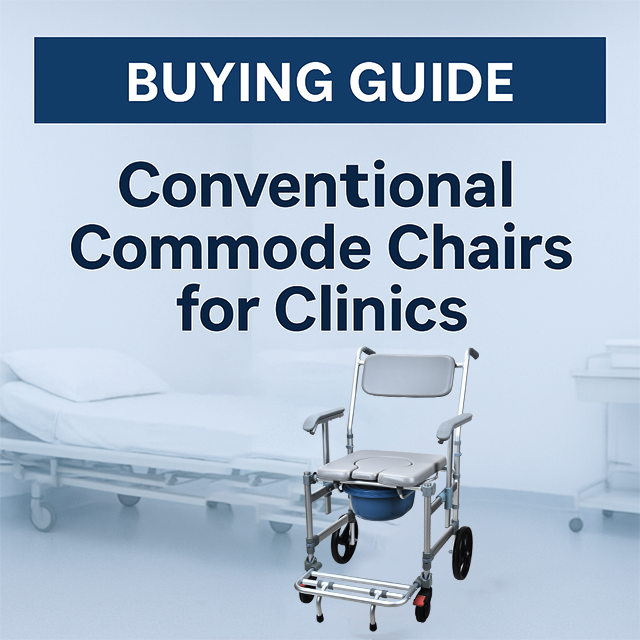
A conventional commode chair should be selected for its intended user group, care task and working environment. This guide brings together the fit, documentation and whole-life cost questions for clinics, hospitals and nursing homes, so buyers can compare models on the same basis.
1. Confirm the care task and intended use
Decide whether you need bedside toileting, over-toilet use, folding storage or another function. A conventional chair is not automatically suitable for showering or occupied transport. Confirm the permitted uses in the exact model’s instructions and have clinical staff assess user suitability and transfer assistance.
2. Compare seating and room dimensions
Record usable seat width and depth, seat height range, armrest spacing, overall footprint and bucket access. Compare these with the room, toilet and user group. Check the complete working configuration, including accessories. If compact storage is essential, use our foldable commode chair procurement guide.
3. Review rated load, stability and adjustment
Request the model’s rated load and supporting test evidence. Inspect the approved sample for frame stability, adjustment-button engagement, fastener retention, foot contact and locking mechanisms where fitted. Do not assume that padding prevents pressure injuries or that a particular frame eliminates tipping. Follow the manufacturer’s instructions for positioning and use.
4. Verify documents for the destination market
Ask for the legal manufacturer, model identification, intended use, relevant declarations or certificates, instructions and test reports. Check scope and validity. CE marking, FDA-related requirements and ISO 13485 address different matters; they should not be grouped into a blanket claim that every chair is “globally certified.” Consult our commode chair compliance guide for further document questions.
5. Check cleaning, inspection and replacement parts
Review removable seats and buckets, access to joints, approved cleaning agents and drying procedures. Confirm inspection intervals and replacement criteria for feet, fasteners, seats and other wear parts. Obtain spare-part references and warranty terms before ordering.
6. Compare total cost for bulk purchasing
The useful cost comparison includes unit price, freight, carton volume, assembly labor, cleaning, spare parts and expected downtime. Ask suppliers to quote the same configuration, quantity, accessories and trade term. Knock-down or modular packing may reduce shipping volume, but verify assembly requirements and packaging protection on the sample. Do not assume tool-free assembly, minimal maintenance or a longer service life without evidence.
7. Approve a specification before production
Agree the drawing, materials, finish, labeling, packaging and inspection criteria. For private-label or structural changes, define who reviews the affected documentation and testing. Confirm MOQ and lead time for the actual project in the quotation.
Use our hospital procurement guide to evaluate the supplier. Contact KDB Health with your care scenario, dimensions, order quantity and destination for a model-specific proposal.
Table of Contents
- 1. Confirm the care task and intended use
- 2. Compare seating and room dimensions
- 3. Review rated load, stability and adjustment
- 4. Verify documents for the destination market
- 5. Check cleaning, inspection and replacement parts
- 6. Compare total cost for bulk purchasing
- 7. Approve a specification before production