
 EN
EN
Published: October 11, 2025 | Last Updated: September 12, 2026
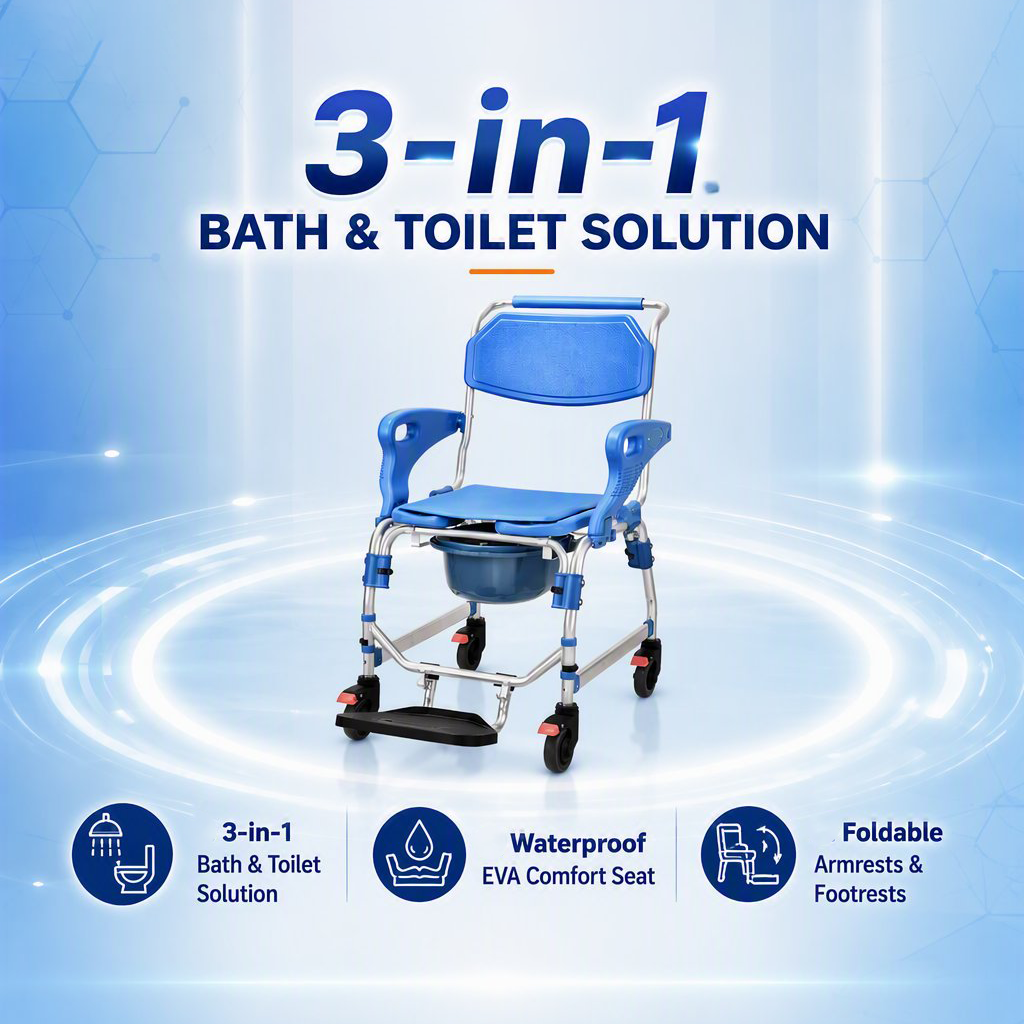
Adjustable height commode chairs are designed to accommodate different users, transfer methods and care environments. By allowing the seat position to be adjusted, they can provide a more appropriate setup than a fixed-height chair in hospitals, nursing homes, rehabilitation centers and homecare programs.
For professional buyers, however, height adjustment is only one part of the purchasing decision. Frame stability, locking mechanisms, seat configuration, cleaning requirements and compatibility with beds and toilets should all be evaluated before selecting a model.
This guide explains how healthcare distributors and institutional procurement teams can assess adjustable height commode chairs for different care applications.
What Is an Adjustable Height Commode Chair?

An adjustable height commode chair uses telescopic legs or another height-adjustment structure to change the position of the seat relative to the floor.
Depending on the model, it may be used:
- As a bedside commode
- As a freestanding toilet chair
- Over an existing toilet
- During rehabilitation and assisted-care routines
- In homecare or professional care environments
Unlike a fixed-height model, an adjustable chair can be configured for different users or installation conditions.
The adjustment range and adjustment increments vary by product. Buyers should therefore confirm the specifications of each model rather than assume that all adjustable commode chairs offer the same settings.
Distributors can review the broader KDB Health commode chair product range when comparing adjustable, fixed, wheeled and multifunctional configurations.
Why Seat Height Matters During Transfers
An appropriate seat height can influence how easily a user sits down, stands up or transfers with caregiver assistance.
If the seat is positioned too low, some users may experience greater difficulty when rising. If it is too high, the user may not be able to place their feet securely on the floor. Either situation may reduce stability during the transfer process.
The appropriate setting depends on factors such as:
- The user’s lower-leg length
- Mobility and balance
- Lower-limb strength
- Transfer method
- Bed or toilet height
- Foot positioning
- Caregiver assistance
- Use of other mobility equipment
There is no single height setting suitable for every user. Healthcare professionals and caregivers should assess the user’s individual needs, while procurement teams should verify that the product provides an appropriate and securely lockable adjustment range.
Where Adjustable Commode Chairs Are Commonly Used
Hospitals
Hospitals may need commode chairs for patients with different mobility levels and recovery stages. Adjustable models can provide greater flexibility when equipment is allocated across departments or temporarily assigned to different patients.
Procurement teams should also consider:
- Cleaning and disinfection procedures
- Frequency of use
- Ease of inspection
- Replacement-part availability
- Staff training requirements
- Compatibility with hospital beds and toilets
Nursing Homes and Long-Term Care Facilities
Residents in nursing homes may have different physical conditions and transfer requirements. An adjustable model can help care teams configure the chair for the intended user instead of relying on one fixed seat height.
For shared institutional equipment, the selected model should also be easy to inspect, clean and readjust according to the facility’s care protocol.
Rehabilitation Centers
A user’s mobility may change during rehabilitation. Height-adjustable equipment can provide more configuration options as transfer ability, lower-limb strength or caregiver support requirements change.
Any adjustment should be made according to professional assessment and the product instructions.
Homecare Programs
Distributors and homecare equipment providers may supply adjustable commode chairs to users with different bathroom layouts, bed heights and mobility conditions.
For these channels, straightforward assembly, clear adjustment markings and easy-to-understand instructions are particularly important.
Adjustable-Height vs. Fixed-Height Commode Chairs
Both configurations can be appropriate, depending on the application.
Adjustable-Height Models
Adjustable models may be more suitable when:
- The product will serve users with different body dimensions
- The chair must fit different beds or toilets
- The care environment requires greater configuration flexibility
- The distributor serves several institutional and homecare channels
They can offer a wider range of applications, but the adjustment system also introduces additional components that must be checked and maintained correctly.
Fixed-Height Models
Fixed-height models may be suitable when:
- The intended user and required seat height are already known
- Simple operation is the priority
- The product is assigned to one stable application
- Fewer adjustment steps are preferred
Buyers comparing the two options can also review the KDB Health guide to commode chairs vs. raised toilet seats to understand how different bathroom assistance products serve different mobility needs.
Key Features Professional Buyers Should Evaluate
1. Height-Adjustment Range
Confirm the minimum and maximum seat height, adjustment increments and whether the published measurements refer to the seat surface or another reference point.
The adjustment range should be evaluated against the intended users, beds and toilets.
2. Locking Mechanism
Each adjustable leg should lock securely at the selected position. Buyers should check whether:
- Locking buttons engage completely
- Adjustment holes are aligned consistently
- The setting can be inspected visually
- All legs can be set to the same height
- The mechanism remains secure during normal use
A poorly engaged adjustment point can affect the chair’s level position and stability.
3. Frame Stability
Frame material alone does not determine product performance. Buyers should also evaluate:
- Frame geometry
- Leg spacing
- Cross-bracing
- Joint construction
- Seat attachment
- Stability at different height settings
- Suitability for the intended environment
The chair should be assessed as a complete structure rather than by one material or component.
4. Foot Contact and Floor Conditions
Non-slip tips or other floor-contact components should be appropriate for the intended environment. Worn, damaged or incorrectly installed tips should be replaced.
Facilities should also consider the floor surfaces on which the chair will be used, including wet bathroom floors, tiles and bedside environments.
5. Armrest Configuration
Armrests can provide support during sitting, standing and transfers. Depending on the model, they may be fixed, removable, detachable or flip-up.
The correct configuration depends on the transfer method and care environment. Buyers should confirm that any movable armrest locks securely when returned to its working position.
6. Seat, Backrest and Commode Bucket
Procurement teams should review:
- Seat dimensions
- Seat opening design
- Backrest support
- Bucket installation and removal
- Splash protection
- Surface finish
- Cleaning access
- Availability of replacement components
The selected configuration should support both user needs and the facility’s cleaning process.
7. Product Identification and Instructions
Clear product labeling and instructions help users and care teams understand:
- How to adjust the chair
- How to confirm that each leg is locked
- How to inspect the product before use
- How to clean and maintain components
- When damaged or worn parts should be replaced
For distributors, these materials may also need to meet local language, branding and market requirements.
Questions to Ask Before Placing a Bulk Order
Professional buyers should request model-specific information instead of relying only on general product descriptions.
Important questions include:
- What is the complete seat-height adjustment range?
- How many adjustment positions are available?
- How is each adjustable leg locked?
- What are the overall and seat dimensions?
- What frame and seat materials are used?
- What configurations are available for the armrests and backrest?
- Is the model intended for bedside, over-toilet or multipurpose use?
- What cleaning and maintenance instructions are provided?
- Which replacement parts are available?
- Can the labeling, manual, color or packaging be customized?
- What is the MOQ for the selected configuration?
- Can a sample be evaluated before bulk production?
These questions allow buyers to compare products based on actual specifications and intended applications.
OEM and Private-Label Options for Distributors
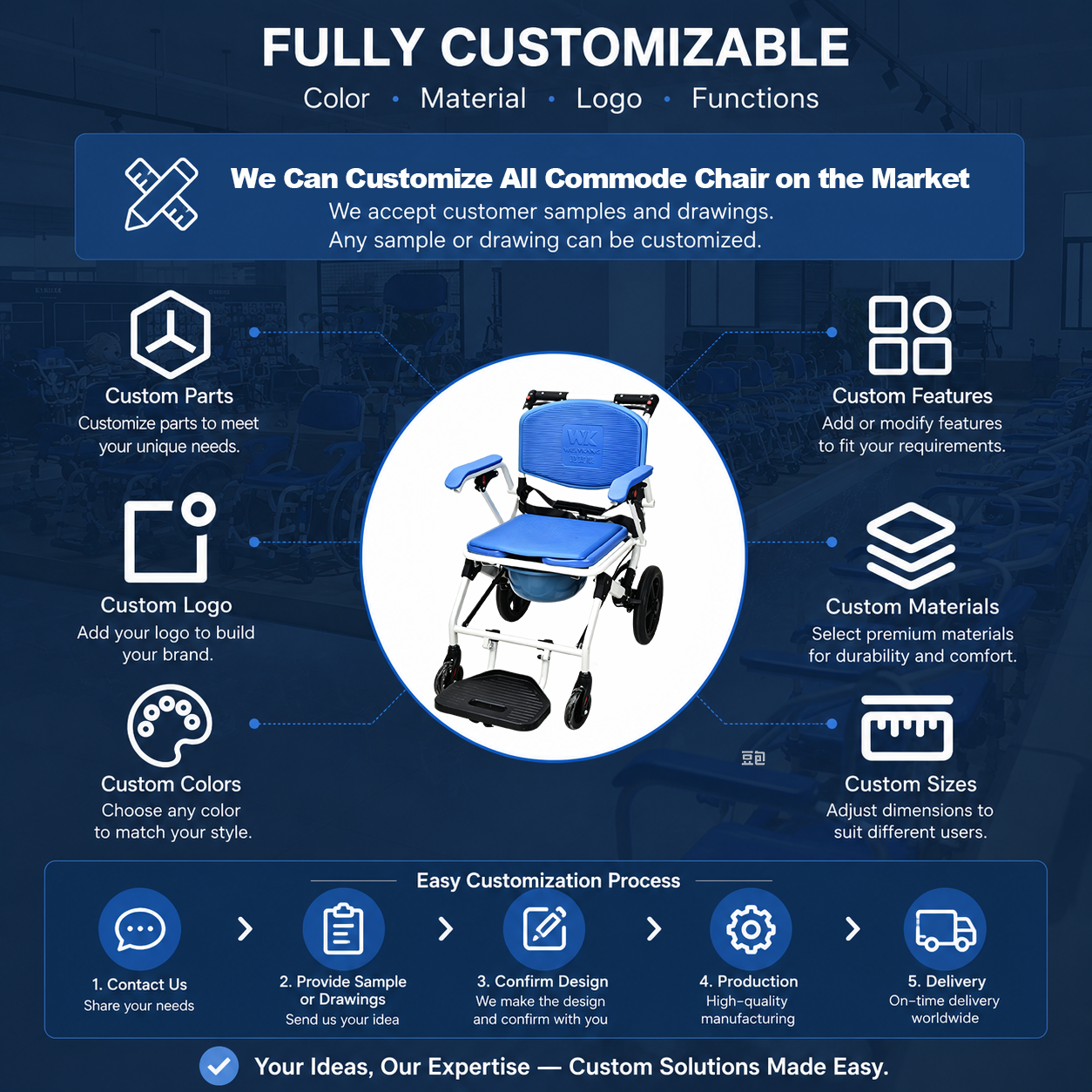
Distributors may require different configurations for hospitals, nursing homes, homecare retailers or rehabilitation channels.
Depending on the selected model and order requirements, customization may include:
- Product colors
- Logo application
- Private-label packaging
- Instruction manuals
- Product labels
- Carton markings
- Selected seat or armrest configurations
- Accessories and replacement-part packages
The MOQ depends on the model, order configuration and level of customization. Structural changes may require additional engineering evaluation and should not be treated in the same way as logo or packaging customization.
Buyers evaluating a long-term supplier can consult our guide on how to evaluate a medical equipment OEM manufacturer.
KDB Health’s Product and Manufacturing Support
KDB Health develops rehabilitation and homecare equipment solutions for distributors, healthcare brands and institutional buyers.
Our product and supply capabilities are supported by KDB Medical, the manufacturing division of KDB Health. Current manufacturing resources include:
- More than 14 years of rehabilitation equipment experience
- ISO 13485 quality management
- An 18,000-square-meter manufacturing facility
- Monthly production capacity of up to 80,000 commode chairs
- More than 500 existing product molds
- A professional R&D team of nine specialists
- OEM and ODM support for qualified projects
This structure allows KDB Health to combine product development, manufacturing coordination and B2B market support under one brand system.
Frequently Asked Questions
Are all adjustable commode chairs suitable for hospitals?
No. Suitability depends on the model’s construction, intended use, cleaning requirements, adjustment mechanism and the hospital’s procurement criteria. Buyers should evaluate each model individually.
What is the correct height for a commode chair?
There is no universal setting for every user. The appropriate height depends on the user’s body dimensions, mobility, transfer method and care environment. Professional assessment may be required.
Can one adjustable commode chair be used by different patients?
Adjustable equipment may provide configuration flexibility, but facilities must follow their own allocation, inspection, cleaning and infection-control procedures before the product is reassigned.
Should all four legs be set at the same height?
For standard use, the legs should normally be adjusted according to the manufacturer’s instructions so that the chair remains level and stable. Buyers and caregivers should always follow the instructions supplied with the specific model.
Can adjustable commode chairs be placed over a toilet?
Some models support over-toilet use, but buyers must confirm the frame dimensions, seat clearance, toilet height and intended application of the selected product.
Can adjustable commode chairs be customized for distributors?
Depending on the model and order requirements, KDB Health can support selected color, logo, labeling, packaging and configuration options. Structural changes require separate technical evaluation.
Discuss Your Commode Chair Requirements
Selecting an adjustable height commode chair requires more than comparing price and appearance. Professional buyers should evaluate adjustment range, locking reliability, frame stability, cleaning requirements and application suitability together.
Contact the KDB Health team for current product specifications, catalogs, MOQ information, OEM/ODM support or a tailored quotation for your distribution or institutional procurement project.
Table of Contents
- What Is an Adjustable Height Commode Chair?
- Why Seat Height Matters During Transfers
- Where Adjustable Commode Chairs Are Commonly Used
- Adjustable-Height vs. Fixed-Height Commode Chairs
- Key Features Professional Buyers Should Evaluate
- Questions to Ask Before Placing a Bulk Order
- OEM and Private-Label Options for Distributors
- KDB Health’s Product and Manufacturing Support
-
Frequently Asked Questions
- Are all adjustable commode chairs suitable for hospitals?
- What is the correct height for a commode chair?
- Can one adjustable commode chair be used by different patients?
- Should all four legs be set at the same height?
- Can adjustable commode chairs be placed over a toilet?
- Can adjustable commode chairs be customized for distributors?
- Discuss Your Commode Chair Requirements